Vision Statement for an AI-Ready Indian Medical System
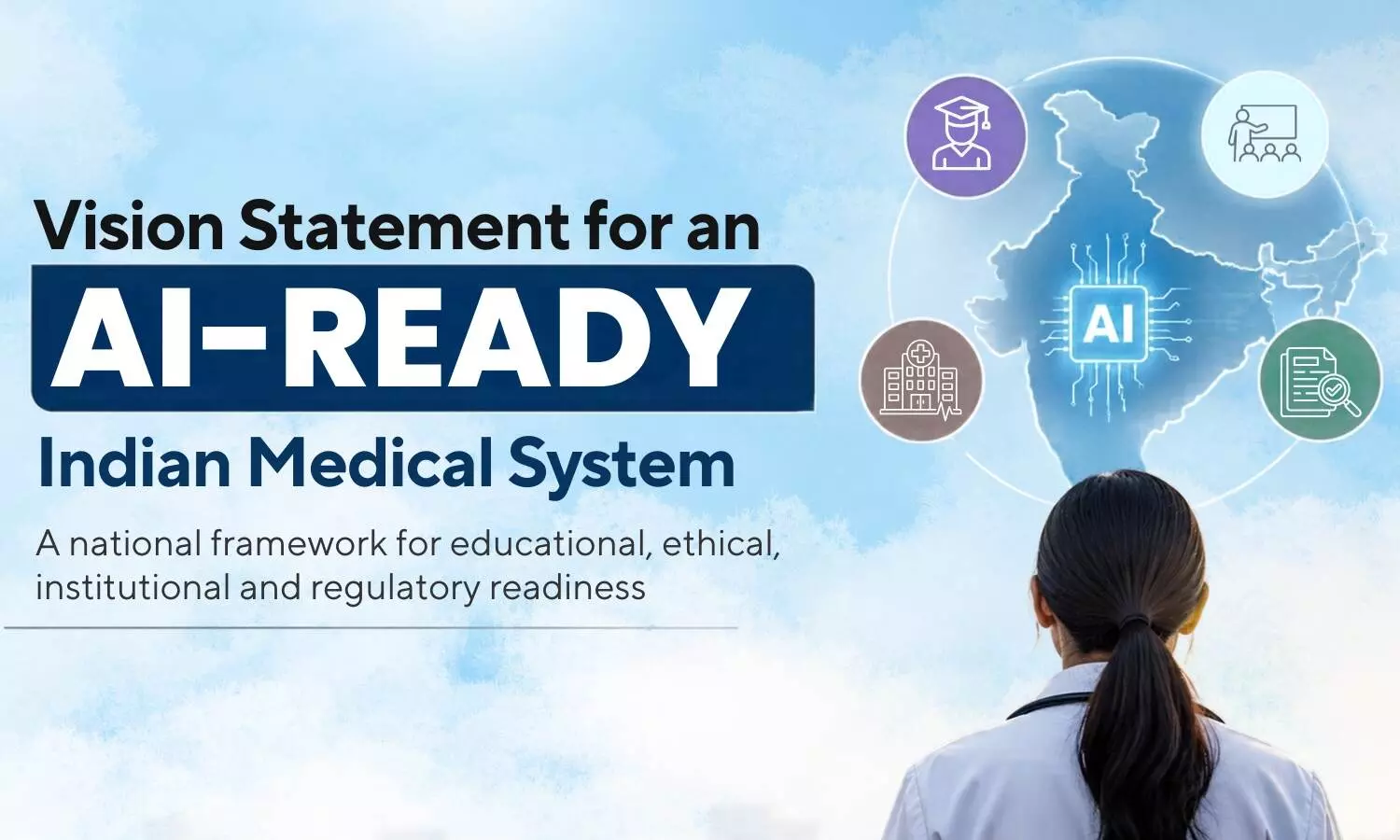


India does not merely need doctors who can use artificial intelligence. It needs a medical system in which the graduate, the teacher, the institution and the regulator are all prepared to use AI safely, critically, ethically and intelligently.
Artificial intelligence is entering medicine faster than most health systems have been able to prepare for it. It is already influencing clinical documentation, imaging, risk prediction, decision support, education, research and administrative processes. Generative AI has accelerated this transition further by placing powerful tools directly in the hands of students, teachers and clinicians.
The immediate response is often to ask which AI applications should be introduced, which platforms should medical colleges purchase, or how AI can make examinations and hospitals more efficient. Those questions are relevant, but they are downstream questions. The more important question is whether the medical ecosystem itself is ready for AI.
AI readiness is not synonymous with AI adoption. Adoption is the presence of technology. Readiness is the capacity to understand it, question it, govern it and remain accountable while using it. A system can be technologically advanced and still be poorly prepared if its doctors cannot recognise algorithmic error, its teachers cannot guide responsible use, its hospitals lack governance, or its regulatory architecture has not defined the boundaries of professional responsibility.
India therefore needs to move from an AI adoption conversation to an AI readiness agenda. A practical national framework can be built around four mutually dependent pillars: the AI-ready medical graduate, the AI-ready medical teacher, the AI-ready healthcare institution and the AI-ready regulator.
The Four-Pillar Framework 1. Graduate
Competence to use AI critically, ethically and with preserved clinical judgement.
2. Faculty
Capacity to teach, assess and model responsible AI use across the professional lifecycle.
3. Institution
Governance for safe implementation, data protection, validation, monitoring and equitable access.
4. Regulator
Principles that protect patients and professional accountability while enabling responsible innovation.
Pillar 1: The AI-Ready Medical Graduate
| 1. Graduate | Competence to use AI critically, ethically and with preserved clinical judgement. |
| 2. Faculty | Capacity to teach, assess and model responsible AI use across the professional lifecycle. |
| 3. Institution | Governance for safe implementation, data protection, validation, monitoring and equitable access. |
| 4. Regulator | Principles that protect patients and professional accountability while enabling responsible innovation. |
The future doctor does not need to become a computer scientist. But every doctor will increasingly practise in an environment in which algorithms influence diagnosis, treatment choices, clinical documentation, prognosis and communication. AI literacy should therefore be considered an emerging component of medical competence.
An AI-ready graduate should be able to understand what an AI-generated recommendation represents, recognise that outputs depend on data and design, distinguish assistance from authority, verify clinically important information, identify uncertainty and bias, and know when human judgement must override a machine-generated suggestion.
This is particularly important because one of the most consequential risks may be automation bias: the tendency to accept a confident technological output without sufficient clinical challenge. The more fluent AI becomes, the more important it will be to teach students that plausibility is not the same as truth and prediction is not the same as judgement.
The curriculum response should be proportionate. It may not be necessary to create a large standalone subject called “Artificial Intelligence”. Many competencies can be embedded longitudinally within existing teaching. Basic AI literacy can accompany evidence-based medicine and research methodology; specialty applications can be taught during clinical postings; and the ethical and communication dimensions can be incorporated into the existing Attitude, Ethics and Communication framework.
Students should encounter case-based questions such as: What should a doctor do when an AI recommendation conflicts with bedside judgement? Should the patient be informed when AI materially influences a decision? Can identifiable patient information be entered into an external generative AI tool? How should uncertainty in an AI-generated risk estimate be communicated? These are educational questions today, but they will become routine professional questions tomorrow.
The objective is not to create doctors who obey AI. It is to create doctors who can work with AI while remaining clinically responsible.
Pillar 2: The AI-Ready Medical Teacher
An AI-ready student cannot be produced by an AI-unprepared faculty. Faculty development may therefore be the most urgent and most easily underestimated component of national AI readiness.
Teachers require structured exposure to the strengths and limitations of AI, responsible use of generative systems, verification of outputs, data confidentiality, bias, academic integrity and the changing nature of assessment. They also need practical understanding of where AI can genuinely improve teaching rather than simply add technological novelty.
AI will also force medical education to reconsider what is worth assessing. When information retrieval becomes instantaneous, examinations cannot remain excessively dependent on recall. Clinical reasoning, interpretation, communication, application of evidence and judgement will become even more important. Assessment reform should therefore accompany AI integration rather than follow it years later.
AI may support personalised learning, formative feedback, simulation, question-quality analysis, identification of competency gaps and faculty productivity. These opportunities deserve experimentation, but educational validity, fairness, transparency and human oversight must remain non-negotiable.
Faculty development should not be confined to a one-time workshop. A tiered programme can include foundational AI literacy for all teachers, advanced training for faculty champions, specialty-specific modules, and continuing medical education for doctors who completed their formal training before the AI era.
In this sense, faculty development and CME reform become one continuum. AI readiness has to accompany the doctor throughout professional life.
Pillar 3: The AI-Ready Healthcare Institution
Even an AI-literate clinician cannot practise responsible AI medicine inside an institution that lacks appropriate governance. Hospitals, medical colleges and training institutions will increasingly deploy AI in radiology, pathology, critical care, triage, clinical decision support, documentation, workflow management and population-level analytics.
Every institution therefore needs a governance pathway for AI adoption. Before a high-impact system is introduced, there should be clarity about its intended use, the evidence supporting it, the population on which it was validated, its known limitations, its data requirements and the circumstances in which human review is mandatory.
Responsibility must remain visible. Who approves an AI tool? Who monitors its performance? How are errors or near misses reported? What happens if local performance differs from published performance? How is a clinician expected to document disagreement with an algorithm? These cannot be left to individual improvisation.
Data governance is equally important. Convenience must not override confidentiality. Institutions need clear policies on approved platforms, use of patient information, de-identification, data sharing, cybersecurity and retention of AI-generated material. Clinical AI governance should sit alongside existing quality, ethics, information-security and patient-safety structures rather than remain an isolated technology function.
Readiness must also include inclusion. The elderly, people with low digital literacy, persons with disability, patients speaking different languages and populations poorly represented in training datasets should not become collateral casualties of technological progress. The test of responsible AI is not only how well it works for the digitally fluent patient, but whether it reduces or amplifies existing inequity.
India’s private healthcare sector has a major role here. Private hospitals and teaching institutions can become responsible implementation laboratories, generating real-world learning and scalable models. But innovation should connect with public-health priorities, interoperability and national standards so that the benefit does not remain confined to islands of excellence.
Pillar 4: The AI-Ready Regulator
Technology evolves rapidly; regulation must be thoughtful. But thoughtful regulation cannot mean regulatory silence. As AI begins to influence professional decisions, medical regulation will increasingly have to address the interface between innovation, ethics, patient rights and professional accountability.
The most useful approach may not be to regulate every algorithm. That would be neither practical nor durable. Regulatory bodies can instead establish principles: the clinician remains accountable for clinical decisions; high-impact AI requires appropriate validation and human oversight; patient confidentiality must be protected; material use of AI should be transparent where relevant; and innovation must not erode professional judgement or patient trust.
A number of questions will require progressive guidance. When should a patient be informed that AI materially contributed to a clinical decision? What constitutes acceptable reliance on AI? How should AI-generated clinical documentation be authenticated? What are the professional obligations when an algorithm and clinician disagree? How should bias and unsafe deployment be addressed? What constitutes inappropriate use of generative AI by a medical student, teacher or practitioner?
These issues cut across education, ethics, registration, clinical practice and institutional responsibility. They therefore require dialogue among regulatory bodies, educators, clinicians, ethicists, legal experts, technologists, patient representatives and healthcare institutions.
The purpose of regulation should not be to slow responsible innovation. It should be to make responsible innovation possible by creating clarity, trust and accountability.
A mature regulatory approach can therefore be enabling rather than merely restrictive: define the guardrails, protect the patient, preserve professional responsibility, and allow evidence-based innovation to develop within them.
Two Principles Must Run Across All Four Pillars
Inclusion, particularly healthy ageing and vulnerable populations
AI should not be designed only for the young, digitally literate and technologically confident. India’s ageing population, people with multimorbidity, patients requiring caregiver support and those with limited digital access must be included deliberately in design, consent, communication and implementation. An AI-ready system must also be an inclusive system.
The private healthcare-public health interface
India’s healthcare ecosystem is plural. Academic institutions, public systems, private hospitals, professional organisations and technology innovators all hold different capabilities. AI readiness will advance faster if these capabilities are connected through common standards, interoperable approaches, responsible data practices and shared public-health objectives.
From Four Pillars to a National Readiness Framework
The four pillars are mutually dependent. An AI-ready graduate requires an AI-ready teacher. An AI-ready clinician requires an AI-ready institution. Responsible institutions require an enabling regulatory environment. Weakness in any one pillar can compromise the others.
This suggests a practical national agenda. India can define a minimum set of AI competencies for undergraduate and postgraduate medical education; create faculty-development and CME pathways; establish model institutional governance principles; and progressively develop ethical and professional guidance for clinical AI. These components can then evolve as evidence, technology and clinical practice change.
A readiness framework should be dynamic rather than prescriptive. Its purpose would not be to freeze technology into regulation, but to establish enduring principles while allowing applications to evolve. Periodic review, pilots, multi-stakeholder consultation and outcome evaluation should be built into the process.
The most important outcome would be cultural. AI should become neither an object of fear nor an object of unquestioned faith. It should become a powerful clinical and educational instrument used by professionals who understand both its potential and its limits.
The Human Principle
Artificial intelligence will become increasingly capable. That makes human judgement more important, not less.
The future doctor will need to know when to use AI, when to verify it, when to challenge it and when to put it aside. The future teacher must prepare students for that responsibility. The future institution must create the environment for safe use. And the future regulator must protect both innovation and trust.
India has an opportunity not merely to become one of the world’s largest users of medical AI, but to develop a model for its responsible integration into medical education and healthcare.
The objective should therefore not simply be an AI-enabled health system. It should be an AI-ready Indian medical system: technologically capable, educationally prepared, ethically grounded, institutionally responsible and unmistakably human.
“Medicine must determine how AI enters medicine — not the other way around.”