
Double Stenting Improves Early Myocardial Work in Complex Left Main Bifurcation Lesions: Study
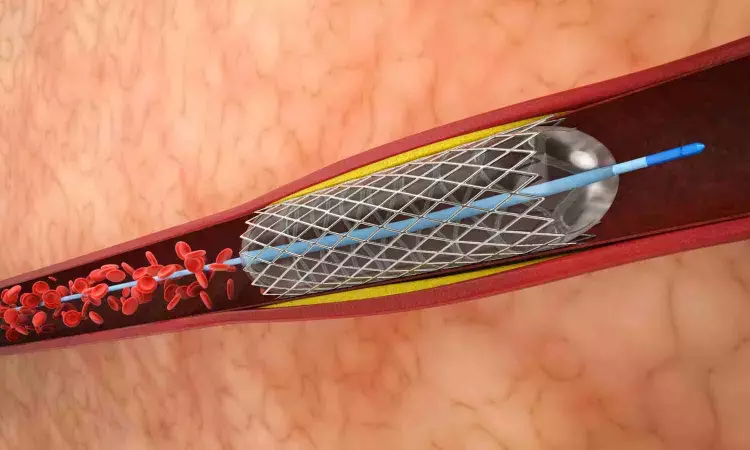


A new study published in the journal of Cardiovascular Revascularization Medicine revealed that in patients with complex left main (LM) bifurcation lesions, a double-stenting strategy results in better 30-day recovery of myocardial work (MW) compared with provisional single stenting, indicating improved left ventricular efficiency.
This single-center analysis followed 282 patients who underwent percutaneous coronary intervention (PCI) for complex LM bifurcation disease between October 2023 and June 2025. To ensure a fair comparison, the patients were matched one-to-one by propensity score into 2 equal groups: 141 received a double-stent technique (culotte, nano-inverted-T, or TAP), while 141 were treated with provisional single stenting.
Heart muscle performance was evaluated using advanced echocardiography both before the procedure and 30 days afterward. Rather than relying only on traditional ejection fraction, the investigators measured non-invasive myocardial work (MW) indices, which reflect how efficiently the left ventricle converts pressure into useful pumping action. These indices included the Global Work Index (GWI), Global Constructive Work (GCW), Global Wasted Work (GWW), and Global Work Efficiency (GWE).
At baseline, both groups were remarkably similar. The patient demographics, lesion characteristics, and all myocardial work measurements showed no meaningful differences, allowing investigators to directly attribute changes at follow-up to the stenting strategy itself.
30 days after PCI, both groups demonstrated significant improvements in heart muscle performance. GWI and GCW rose sharply, which indicated a stronger and more productive ventricular contractions, while GWW fell, showing that less energy was being lost during the heart’s pumping cycle. GWE also improved, which reflected more efficient overall cardiac performance.
However, the magnitude of improvement differed substantially between strategies. The patients who received double stenting experienced nearly double the gain in GWI compared with those treated with provisional single stenting. Similarly, GCW increased much more in the double-stent group, meaning their hearts performed significantly more useful work with each beat. Wasted work declined almost twice as much with double stenting, and work efficiency rose by more than 3% points, over twice the improvement seen with provisional stenting.
The study highlighted how comparable the 2 groups were before PCI and clearly demonstrates the superior improvements achieved by double stenting across every metric of myocardial work. Overall, the findings suggest that in anatomically complex LM bifurcation lesions, double stenting may provide faster and more robust recovery of left ventricular performance within the first month after intervention.
Source:
Zuin, M., Marchese, G., Prevedello, F., Hiso, E., Bertolini, A., Foroni, M., & Rigatelli, G. (2025). Impact of double versus single stenting on myocardial work in complex left main bifurcation percutaneous coronary intervention. Cardiovascular Revascularization Medicine: Including Molecular Interventions. https://doi.org/10.1016/j.carrev.2025.12.015

