
In AF patients, LAAO May Carry Slightly Higher Ischemic Stroke Risk Than Oral Anticoagulation: Study
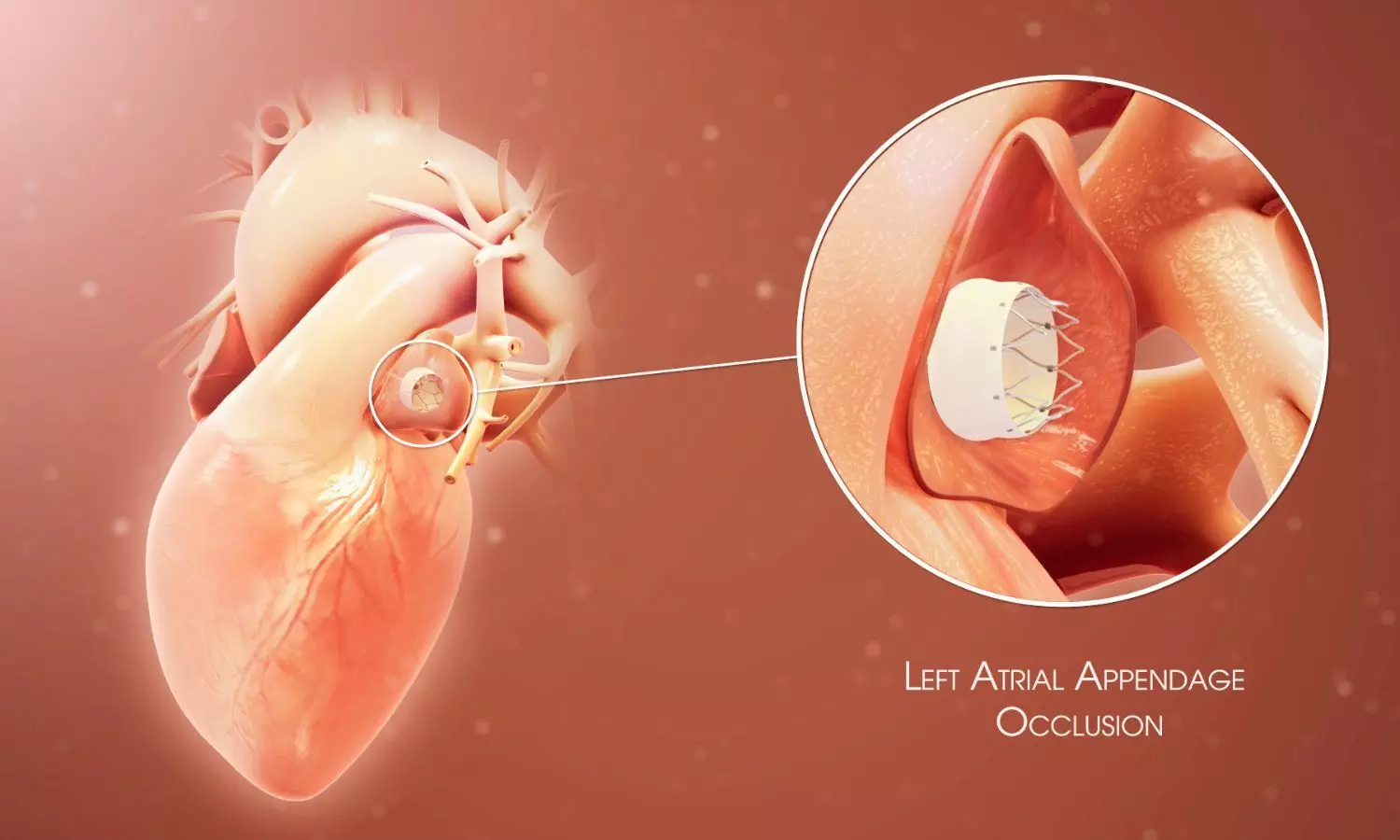


USA: A Bayesian analysis has found that left atrial appendage occlusion (LAAO) in patients with atrial fibrillation was associated with a higher rate of stroke than oral anticoagulation, primarily due to ischemic stroke. However, the association was not statistically robust, and the absolute excess risk was small. LAAO was also associated with a 45% lower incidence of hemorrhagic stroke, highlighting the need to balance ischemic and bleeding risks when considering treatment options.
The systematic review and Bayesian meta-analysis, published online in the Journal of the Society for Cardiovascular Angiography & Interventions on September 10, 2026, was conducted by Amar Rai, MBBS, Department of Internal Medicine, University of Pennsylvania, Philadelphia, and colleagues.
LAAO is a nonpharmacological approach to stroke prevention in patients with nonvalvular atrial fibrillation, while oral anticoagulation remains an established strategy for reducing thromboembolic risk. However, findings from randomized trials comparing the two approaches have been inconsistent, prompting the researchers to examine the probability and clinical magnitude of differences in stroke outcomes.
The investigators performed a Bayesian hierarchical meta-analysis of randomized controlled trials comparing percutaneous LAAO with oral anticoagulation. The primary outcome was ischemic stroke, assessed using Bayesian random-effects Poisson regression. The analysis incorporated different prior assumptions to evaluate the consistency of the findings.
Six randomized trials involving 7,004 patients and more than 18,000 patient-years of follow-up were included. The analysis showed:
- Ischemic stroke occurred at a higher rate with LAAO than oral anticoagulation, with an incidence rate ratio (IRR) of 1.34.
- There was a 94% posterior probability that LAAO was associated with an ischemic stroke rate above that of oral anticoagulation.
- The probability that LAAO produced more than 0.5 additional ischemic stroke events per 100 patient-years was 12%, while the probability of exceeding one additional event per 100 patient-years was only 0.5%.
- The difference in any-stroke risk was smaller (IRR, 1.09).
- Hemorrhagic stroke was less frequent with LAAO (IRR, 0.55), corresponding to an estimated 45% reduction.
- The reduction in hemorrhagic stroke was less pronounced in trials in which direct oral anticoagulants (DOACs) were used as medical therapy (IRR, 0.80).
The study’s limitations include the use of aggregate data, differences in trial designs and treatments, and variable follow-up periods, which may limit the reliability of long-term conclusions.
The authors identified device-related thrombus as a possible contributor to increased ischemic stroke risk and highlighted the need to standardize post-procedure antithrombotic therapy.
The researchers concluded that LAAO was associated with a small excess risk of ischemic stroke but a lower risk of hemorrhagic stroke compared with oral anticoagulation, underscoring the importance of weighing both risks when considering treatment.
Reference:
Rai, A., Kandala, A., Bola, H., Schurr, J., Singh, M., Ahmad, Y., Fanaroff, A., Hu, R., Malik, N., Frankel, D. S., Markman, T., Nazarian, S., Giri, J., Shah, T., & Nathan, A. (2026). Percutaneous Left Atrial Appendage Occlusion Versus Oral Anticoagulation in Atrial Fibrillation: A Systematic Review and Bayesian Meta-analysis. Journal of the Society for Cardiovascular Angiography & Interventions, 105625. https://doi.org/10.1016/j.jscai.2026.105625

Next Story