
Medical Dialogues
  • Dermatology
Login Register
This site is intended for healthcare professionals only
Login Register
  • MD Brand Connect
  • Webinars
  • Vaccine Hub
  • MDTV
    • Breaking News
    • Medical News Today
    • Health News Today
    • Latest
    • Journal Club
    • Medico Legal Update
    • Latest Webinars
    • MD Shorts
    • Health Dialogues
  • Fact Check
  • Health Dialogues
Medical Dialogues
  • Medical News & Guidelines
      • Anesthesiology
      • Cardiology and CTVS
      • Critical Care
      • Dentistry
      • Dermatology
      • Diabetes and Endocrinology
      • ENT
      • Gastroenterology
      • Medicine
      • Nephrology
      • Neurology
      • Obstretics-Gynaecology
      • Oncology
      • Ophthalmology
      • Orthopaedics
      • Pediatrics-Neonatology
      • Psychiatry
      • Pulmonology
      • Radiology
      • Surgery
      • Urology
      • Laboratory Medicine
      • Diet
      • Nursing
      • Paramedical
      • Physiotherapy
  • Health news
      • Doctor News
      • Government Policies
      • Hospital & Diagnostics
      • International Health News
      • Medical Organization News
      • Medico Legal News
      • NBE News
      • NMC News
  • Fact Check
      • Bone Health Fact Check
      • Brain Health Fact Check
      • Cancer Related Fact Check
      • Child Care Fact Check
      • Dental and oral health fact check
      • Diabetes and metabolic health fact check
      • Diet and Nutrition Fact Check
      • Eye and ENT Care Fact Check
      • Fitness fact check
      • Gut health fact check
      • Heart health fact check
      • Kidney health fact check
      • Medical education fact check
      • Men's health fact check
      • Respiratory fact check
      • Skin and hair care fact check
      • Vaccine and Immunization fact check
      • Women's health fact check
  • AYUSH
    • Ayurveda
    • Homeopathy
    • Siddha
    • Unani
    • Yoga
  • State News
      • Andaman and Nicobar Islands
      • Andhra Pradesh
      • Arunachal Pradesh
      • Assam
      • Bihar
      • Chandigarh
      • Chattisgarh
      • Dadra and Nagar Haveli
      • Daman and Diu
      • Delhi
      • Goa
      • Gujarat
      • Haryana
      • Himachal Pradesh
      • Jammu & Kashmir
      • Jharkhand
      • Karnataka
      • Kerala
      • Ladakh
      • Lakshadweep
      • Madhya Pradesh
      • Maharashtra
      • Manipur
      • Meghalaya
      • Mizoram
      • Nagaland
      • Odisha
      • Puducherry
      • Punjab
      • Rajasthan
      • Sikkim
      • Tamil Nadu
      • Telangana
      • Tripura
      • Uttar Pradesh
      • Uttrakhand
      • West Bengal
  • Medical Education
      • Ayush Education News
      • Dentistry Education News
      • Medical Admission News
      • Medical Colleges News
      • Medical Courses News
      • Medical Universities News
      • Nursing education News
      • Paramedical Education News
      • Study Abroad
  • Industry
      • Health Investment News
      • Health Startup News
      • Medical Devices News
      • Pharma News
      • Pharmacy Education News
      • AI and healthcare
      • Industry Perspective
  • MDTV
      • Health Dialogues MDTV
      • Health News today MDTV
      • Latest Videos MDTV
      • Latest Webinars MDTV
      • MD shorts MDTV
      • Medical News Today MDTV
      • Medico Legal Update MDTV
      • Top Videos MDTV
      • Health Perspectives MDTV
      • Journal Club MDTV
      • Medical Dialogues Show
This site is intended for healthcare professionals only
LoginRegister
Medical Dialogues
LoginRegister
  • Home
  • Medical news & Guidelines
    • Anesthesiology
    • Cardiology and CTVS
    • Critical Care
    • Dentistry
    • Dermatology
    • Diabetes and Endocrinology
    • ENT
    • Gastroenterology
    • Medicine
    • Nephrology
    • Neurology
    • Obstretics-Gynaecology
    • Oncology
    • Ophthalmology
    • Orthopaedics
    • Pediatrics-Neonatology
    • Psychiatry
    • Pulmonology
    • Radiology
    • Surgery
    • Urology
    • Laboratory Medicine
    • Diet
    • Nursing
    • Paramedical
    • Physiotherapy
  • Health news
    • Doctor News
    • Government Policies
    • Hospital & Diagnostics
    • International Health News
    • Medical Organization News
    • Medico Legal News
    • NBE News
    • NMC News
  • Fact Check
    • Bone Health Fact Check
    • Brain Health Fact Check
    • Cancer Related Fact Check
    • Child Care Fact Check
    • Dental and oral health fact check
    • Diabetes and metabolic health fact check
    • Diet and Nutrition Fact Check
    • Eye and ENT Care Fact Check
    • Fitness fact check
    • Gut health fact check
    • Heart health fact check
    • Kidney health fact check
    • Medical education fact check
    • Men's health fact check
    • Respiratory fact check
    • Skin and hair care fact check
    • Vaccine and Immunization fact check
    • Women's health fact check
  • AYUSH
    • Ayurveda
      • Ayurveda Giuidelines
      • Ayurveda News
      • Top Ayurveda News
    • Homeopathy
      • Homeopathy Guidelines
      • Homeopathy News
    • Siddha
      • Siddha Guidelines
      • Siddha News
    • Unani
      • Unani Guidelines
      • Unani News
    • Yoga
      • Yoga Guidelines
      • Yoga News
  • State News
    • Andaman and Nicobar Islands
    • Andhra Pradesh
    • Arunachal Pradesh
    • Assam
    • Bihar
    • Chandigarh
    • Chattisgarh
    • Dadra and Nagar Haveli
    • Daman and Diu
    • Delhi
    • Goa
    • Gujarat
    • Haryana
    • Himachal Pradesh
    • Jammu & Kashmir
    • Jharkhand
    • Karnataka
    • Kerala
    • Ladakh
    • Lakshadweep
    • Madhya Pradesh
    • Maharashtra
    • Manipur
    • Meghalaya
    • Mizoram
    • Nagaland
    • Odisha
    • Puducherry
    • Punjab
    • Rajasthan
    • Sikkim
    • Tamil Nadu
    • Telangana
    • Tripura
    • Uttar Pradesh
    • Uttrakhand
    • West Bengal
  • Medical Education
    • Ayush Education News
    • Dentistry Education News
    • Medical Admission News
    • Medical Colleges News
    • Medical Courses News
    • Medical Universities News
    • Nursing education News
    • Paramedical Education News
    • Study Abroad
  • Industry
    • Health Investment News
    • Health Startup News
    • Medical Devices News
    • Pharma News
      • CDSCO (Central Drugs Standard Control Organisation) News
    • Pharmacy Education News
    • AI and healthcare
    • Industry Perspective
  • Home
  • Cardiology-CTVS
  • Cardiology & CTVS News
  • The Overworked Indian...

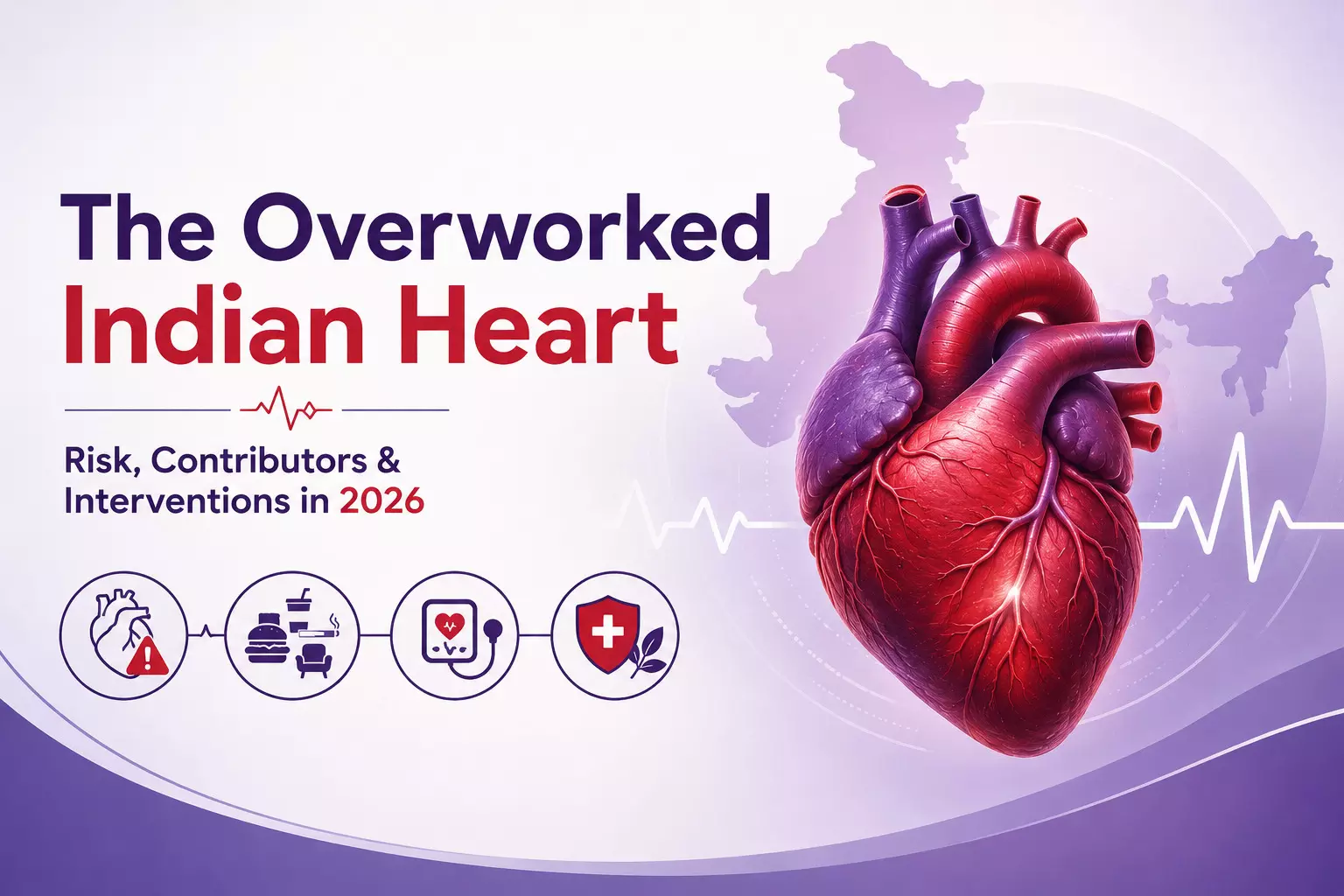
The Overworked Indian Heart: Risk, Contributors and Interventions in 2026
Written By : Prem Aggarwal Published On 2026-08-29T12:32:32+05:30  |  Updated On 29 Aug 2026 4:24 PM IST
The Overworked Indian Heart: Risk, Contributors and Interventions in 2026
  • facebook
  • twitter
  • linkedin
  • whatsapp
  • Telegram
  • Email

The "Overworked Heart"-Describing Pathophysiological Agony of CV Risk Burden

The human heart is built to work continuously. However, normal physiological activity differs from the sustained workload imposed when the heart must repeatedly pump against elevated blood pressure, beat at a persistently higher rate, or respond to increased autonomic and metabolic demands. The term “overworked heart” is not a clinical diagnosis, but a useful metaphor describing a common pathophysiological phenomenon arising from cumulative cardiovascular burden when haemodynamic load, metabolic risk, sympathetic activation, lifestyle stressors and unfavourable environmental exposures persist over time.

High blood pressure increases cardiac afterload and, over time, can promote subclinical myocardial remodelling, left ventricular hypertrophy (LVH) and hypertension-mediated organ damage (HMOD) (1,2). An elevated resting heart rate may reflect sympathetic overactivity and is associated with adverse cardiovascular outcomes and cardiac remodelling (2,3). Together, these commonly encountered factors can progressively increase cardiovascular risk (1-3)

Why is the Indian Heart Overworked, Rendering it at Higher CV Risk?

The ICMR-INDIAB study, which included 113,043 adults from urban and rural areas across India, estimated the weighted prevalence of hypertension at 35.5%. Hypertension existed within a much broader metabolic-risk landscape: diabetes affected 11.4%, generalised obesity 28.6%, abdominal obesity 39.5% and dyslipidaemia 81.2% (4).

The burden is compounded by gaps across the hypertension-care pathway. A 2025 analysis of NFHS-5 data covering 743,067 Indian adults aged 18–54 years identified 118,231 individuals with hypertension. Across districts, an average of 46.0% of individuals with hypertension were aware of their condition, while 18.7% were receiving treatment. Among those treated, 32.9% had their BP under control, with substantial geographical variation across India (5).

For millions of Indians, therefore, cardiovascular risk may accumulate alongside interconnected metabolic abnormalities and remain insufficiently addressed before effective BP control is achieved (4,5)

Elevated BP and Heart Rate – The Pressure and Pace Duo Raises CV Risk

Blood Pressure (BP) and Heart Rate (HR) represent distinct but complementary dimensions of cardiovascular function. Persistent hypertension increases afterload, requiring the left ventricle to generate greater pressure during systole. Over time, this pressure burden may contribute to left ventricular hypertrophy, myocardial fibrosis, diastolic dysfunction and cardiovascular remodelling (6).

HR reflects another component of cardiac workload. As HR rises, the heart contracts more frequently, myocardial oxygen demand may increase, and diastole, the phase important for coronary perfusion, shortens (7).

A 2025 study of 692,217 adults from Asian and European cohorts, followed up for approximately 25 years, found that a resting HR of 80–99 beats/min were independently associated with all-cause mortality across age groups (8).

Gluco-Metabolic Risk Drivers of Elevated Blood Pressure & Heart Rate

The Indian heart is also burdened by diabetes, central obesity, dyslipidaemia, chronic kidney disease, smoking, sleep apnoea and chronic stress. These factors are interconnected: visceral adiposity promotes inflammation, insulin resistance, endothelial dysfunction and sympathetic activation, while sleep apnoea produces recurrent nocturnal hypoxia and BP surges (1,4,9)

Managing Hypertension & Associated CV Risk: A Multidimensional Intervention Framework

• Effective hypertension management begins by identifying and addressing the factors that sustain the haemodynamic and cardiovascular burden.

• Weight management, regular physical activity, dietary sodium restriction, smoking cessation, moderation of alcohol intake and adequate sleep remain fundamental.

• Equally important is the optimal management of associated conditions such as diabetes and dyslipidaemia, which further amplify overall cardiovascular risk. Home or ambulatory BP monitoring can complement office measurements by detecting masked hypertension, nocturnal hypertension and inadequately controlled BP (10,11).

• When appropriately indicated, pharmacotherapy should address the multiple pathways contributing to elevated BP. Because monotherapy may not provide adequate or sustained control for many patients, contemporary treatment strategies increasingly favour combining agents with complementary mechanisms of action (10,11).

• Accordingly, the ESC guidelines on hypertension recommend initiating most patients with confirmed hypertension on a low-dose two-drug combination, preferably delivered as a single pill, and escalating to triple combination therapy when BP remains uncontrolled. Treatment should nevertheless be individualised according to BP severity, cardiovascular risk, comorbidities, tolerability and the presence of specific therapeutic indications (10).

Integrating Newer Anti-Hypertensive Treatment Combination Options for Managing Heart Rate & Blood Pressure in Hypertension

In appropriately selected patients with uncontrolled BP and an indication for HR reduction, telmisartan, amlodipine and bisoprolol target complementary pathways. Telmisartan inhibits angiotensin-II-mediated vasoconstriction, amlodipine reduces peripheral vascular resistance, and bisoprolol lowers HR, contractility and myocardial oxygen demand through selective beta-1 blockade (1,2).

A newer FDC comprising telmisartan, amlodipine and bisoprolol can consolidate these components into one tablet when all three are independently indicated. Bisoprolol offers high beta-1 selectivity and effective HR control, with a comparatively favourable metabolic profile among conventional beta-blockers (1,2). The triple fixed-dose combination of Telmisartan, Amlodipine, Bisoprolol may be useful in uncontrolled hypertensive patients with elevated heart rate (>80 bpm) for effective blood pressure and HR control, together securing a high-risk, overworked heart.

Final Message: Treat the Hypertensive Patient, Not Just the Blood Pressure Number

  • High-CV Risk Overworked Indian Heart: Persistent high blood pressure, elevated heart rate, metabolic and lifestyle stressors are highly rampant in Indian hypertensive patients and can keep the heart “overworked,” driving cardiac remodelling and increasing long-term cardiovascular risk.
  • Elevated BP & Heart Rate Both Matter: In some patients, uncontrolled BP and elevated HR together increase the cardiovascular workload (1–3).
  • Address BP & HR in Hypertension, when indicated: When BP control and HR reduction are both clinically indicated, combining complementary antihypertensive agents containing beta-blockers with a heart rate-lowering effect may offer a more comprehensive approach (1,2).
  • Consider Newer Antihypertensive FDC Options: Newer options that bring telmisartan, amlodipine, and bisoprolol together in a single pill may help integrate BP and HR control, reduce pill burden, with potential to secure cardio-protection in appropriately selected hypertensive patients.

Abbreviations: LVH-Left Ventricular Hypertrophy; HMOD- Hypertension-Mediated Organ Damage; NFHS-National Family Health Survey; BP-Blood Pressure; HR-Heart Rate; CVD-cardiovascular disease; ESC-European Society of Cardiology; FDC- Fixed Drug Combination

References:
  • 1.Gupta R, Maheshwari A, Verma N, Narasingan SN, Tripathi K, Joshi S, Manoria PC. 2025. Indian Society of Hypertension consensus guideline for the management of hypertensionHypertens J.1176-138
  • 2.Mahfoud F, Wang J, Ray S. 2024. The current position of β-blockers in hypertension: guidelines and clinical practice.Curr Med Res Opin.25-32
  • 3.Dalal J, Dasbiswas A, Sathyamurthy I, Maddury SR, Kerkar P, Bansal S, et al. 2019. Heart rate in hypertension: review and expert opinion.Int J Hypertens.
  • 4.Anjana RM, Unnikrishnan R, Deepa M, Pradeepa R, Tandon N, Das AK, et al. 2023. Metabolic non-communicable disease health report of India: the ICMR-INDIAB national cross-sectional study (ICMR-INDIAB-17).11474-489
  • 5.Kulothungan V, Seenappa K, Mohan R. 2025 Variations in the hypertension care cascade across districts and the factors influencing it among Indian adults: findings from the National Family Health Survey-5J Hum Hypertens39585-594
  • 6.Nwabuo CC, Vasan RS. 2020. Pathophysiology of hypertensive heart disease: beyond left ventricular hypertrophy.Curr Hypertens Rep.22
  • 7.Fox K, Borer JS, Camm AJ, Danchin N, Ferrari R, Lopez-Sendon JL, et al. 2007. Resting heart rate in cardiovascular disease.J Am Coll Cardiol50823-830
  • 8.Wen CP, Chen CH, Nauman J, Wai JPM, Tsai MK, Lee JH, et al. 2025. Resting heart rate—the forgotten risk factor? Comparison of resting heart rate and hypertension as predictors of all-cause mortality in 692,217 adults in Asia and Europe.Prog Cardiovasc Dis.35-44
  • 9.Chopra HK, Nanda NC, Das AK, Kripalani A, Jadhav U, Wander GS, et al. 2025 BEAT-HTN India: burden, epidemiology, and trends of hypertension—a nationwide survey.Cardiol Res.16403-412
  • 10.McEvoy JW, McCarthy CP, Bruno RM, et al. 2024 2024 ESC Guidelines for the management of elevated blood pressure and hypertension.Eur Heart J.453912-4018
  • 11.Jones DW, Ferdinand KC, Taler SJ, Johnson HM, Shimbo D, Abdalla M, et al. 2025 2025 AHA/ACC/AANP/AAPA/ABC/ACCP/ACPM/AGS/AMA/ASPC/NMA/PCNA/SGIM guideline for the prevention, detection, evaluation and management of high blood pressure in adults.Hypertension82212-316

cardiovascular diseaseblood pressurehigh resting heart ratehypertensionhypertension-mediated organ damageresting heart ratetelmisartanamlodipinebisoprololfixed drug combination
Prem Aggarwal
Prem Aggarwal

Dr Prem Aggarwal, (MD Medicine, DNB Medicine, DNB Cardiology) is a Cardiologist by profession and also the Co-founder and Chairman of Medical Dialogues. He focuses on news and perspectives about cardiology, and medicine related developments at Medical Dialogues. He can be reached out at drprem@medicaldialogues.in

Print Article
Show Full Article
Next Story

Editorial

Dapagliflozin in Non-Diabetic Kidney Disease (N-DKD): A Nephrologists Practical Perspective

Dapagliflozin in Non-Diabetic Kidney Disease (N-DKD): A Nephrologist's Practical Perspective

SURMOUNT -5 clinical trial data,Tirzepatide vs Semaglutide in  obesity

SURMOUNT -5 clinical trial data,Tirzepatide vs Semaglutide in obesity

Key Takeaways on the Emerging Role of PPAR Agonists in MASLD/MASH: ADA 2026 Update

Key Takeaways on the Emerging Role of PPAR Agonists in MASLD/MASH: ADA 2026 Update

The AI Imperative: Preparing Indian Medicine for Transformation - Dr Raju Vaishya

The AI Imperative: Preparing Indian Medicine for Transformation - Dr Raju Vaishya

Metastatic Prostate Cancer Treated with TPGS-Docetaxel-Based Chemotherapy: A Case Profile - Dr Kaushal Patel

Metastatic Prostate Cancer Treated with TPGS-Docetaxel-Based Chemotherapy: A Case Profile - Dr...

View All

Journal Club Today

Reduced Brain Volume May Predict Progression to Early-Onset Dementia, Study Finds

Reduced Brain Volume May Predict Progression to Early-Onset Dementia, Study Finds

View All

Health News Today

Health Bulletin 29/August/2026

Health Bulletin 29/August/2026

View All
© 2022 All Rights Reserved.
Powered By: Hocalwire
X
We use cookies for analytics, advertising and to improve our site. You agree to our use of cookies by continuing to use our site. To know more, see our Cookie Policy and Cookie Settings.Ok