
Bio-Inspired Nacre-Like Composite for Aesthetic Dental Applications: Study Sheds Light


UK: A bio-inspired nacre-like glass flake/polymer composite has been developed, demonstrating strong mechanical properties, enhanced crack resistance, antibacterial activity, and favorable translucency, making it suitable for aesthetic dental applications.
In a recent study published in the Journal of Dentistry, researchers led by Huijun Sun from the Bristol Dental School, University of Bristol, UK, reported the development of an advanced dental composite material inspired by the natural structure of nacre, or mother-of-pearl. The material was designed to address persistent challenges in aesthetic dentistry, including insufficient mechanical strength, susceptibility to cracking, bacterial colonisation, and the need for an enamel-like appearance.
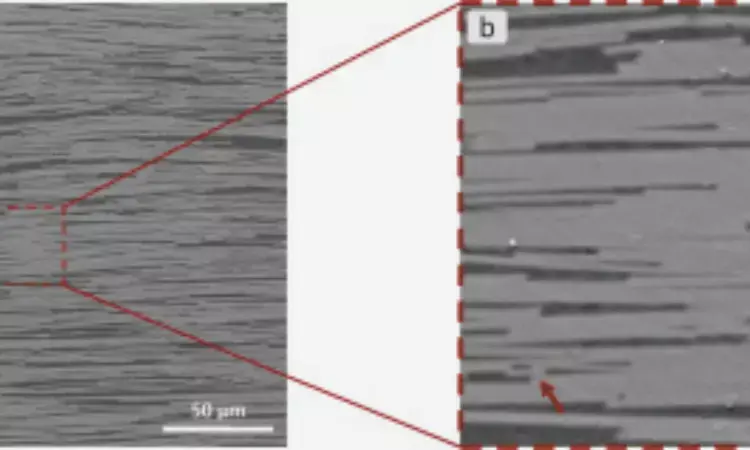
Nacre is well known for its exceptional toughness, achieved through a layered microstructure that effectively resists crack propagation. Drawing inspiration from this natural design, the researchers fabricated a glass flake/polymer composite with a similar layered architecture. Glass flakes were first aligned into an ordered scaffold using a vacuum filtration-based self-assembly process. Following heat treatment, a polymer matrix containing methyl methacrylate, acrylic acid, and varying concentrations of the antibacterial monomer dimethylaminohexadecyl methacrylate (DMAHDM) was infiltrated into the scaffold and polymerised in situ.
The study led to the following findings:
- The composites showed a distinct nacre-like layered microstructure across all tested DMAHDM concentrations.
- Mechanical testing indicated that the concentration of the antibacterial agent was critical in balancing mechanical strength and functional performance.
- Incorporation of 3 wt% DMAHDM resulted in a noticeable reduction in flexural strength.
- The composite with 1.5 wt% DMAHDM demonstrated optimal performance, achieving a flexural strength of nearly 127 MPa.
- This flexural strength was comparable to that of commonly used aesthetic dental composites.
- The elastic modulus of the optimised composite closely matched that of natural human dentine.
- The nacre-like composite exhibited strong resistance to crack propagation, as evidenced by a rising R-curve behaviour.
- Fracture toughness reached up to 3.88 MPa·m½, indicating excellent damage tolerance and potential for improved long-term durability.
- The composite with 1.5 wt% DMAHDM showed significant antibacterial activity, effectively reducing viable counts of Streptococcus mutans.
- The antibacterial effect is particularly relevant for restorative dentistry, where secondary caries is a major cause of restoration failure.
- The addition of antibacterial functionality did not compromise aesthetics.
- The optimised composite maintained translucency levels comparable to natural enamel, supporting its use in visible restorative applications.
Overall, the study highlights the potential of DMAHDM-functionalised nacre-like glass flake/polymer composites as a next-generation material for aesthetic dentistry. By combining robust mechanical properties, superior crack resistance, antibacterial activity, and enamel-like translucency, this bio-inspired composite offers a promising pathway toward longer-lasting and more functional dental restorations in clinical practice.
Reference:
Sun, H., Luangpattarawong, A., Tabrizian, P., Qambrani, A., Sui, T., Nobbs, A. H., Ireland, T., & Su, B. (2026). Bio-inspired nacre-like glass flake/polymer composites with antibacterial function and translucent appearance. Journal of Dentistry, 166, 106327. https://doi.org/10.1016/j.jdent.2025.106327

Next Story