
Frequent Flossing Linked to Healthier Oral Microbial Profile, suggests research
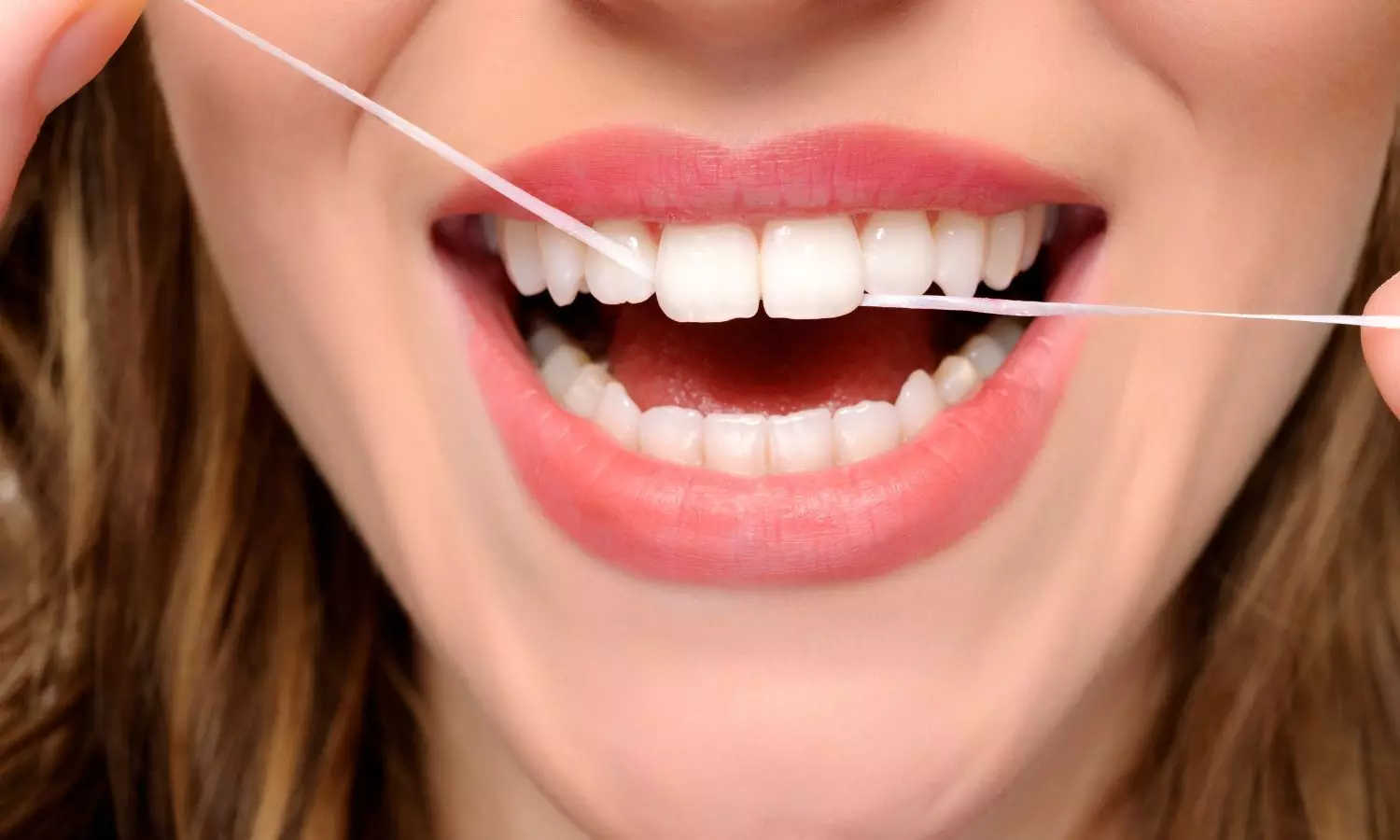


A new study published in the Annals of Medicine showed that frequent flossing was linked to lower phylogenetic diversity and microbial richness, indicating a positive change toward a more stable and healthy oral microbial population.
Daily oral hygiene habits have a significant impact on the composition of the oral microbiome, which is essential for preserving oral and systemic health. Interdental microbial populations may change as a result of dental flossing in particular. This study investigates the relationship between oral microbiota profiles and flossing frequency in adult Americans. Thus, this study investigated the relationship between self-reported dental flossing frequency and oral microbiota diversity.
4,772 persons between the ages of 30 and 69 from NHANES 2009–2012 were included in this cross-sectional investigation. The frequency of flossing was divided into 3 categories as daily users (7 days/week), some flossers (1-6 days/week), and non-users (0 days/week). 16S rRNA sequencing was used to assess the makeup of the oral microbiome.
Observed amplicon sequence variations (ASVs), Shannon, Inverse Simpson, and Faith's Phylogenetic Diversity (PD) were used to determine α-diversity; Bray-Curtis and UniFrac distances were used to calculate β-diversity. PERMANOVA and survey-weighted linear regression were employed with covariate correction.
Among the participants were daily users (30%), some flossers (38%), and non-users (32%). Flossing frequency was found to have a dose-response association with decreased phylogenetic diversity and microbiological richness. Daily users showed considerably reduced phylogenetic diversity (Faith's PD: β = −0.88, 95% CI: −1.20 to −0.56) and richness (Observed ASVs: β = −11.46, 95% CI: −15.62 to −7.29) than non-users.
There was no significant correlation between daily flossing and the Inverse Simpson index, however it was linked to a little decrease in Shannon diversity. Current smokers did not exhibit inverse relationships, although younger and lower-income persons did. Although effect sizes were small (Bray–Curtis R2 = 0.059%; unweighted UniFrac R2 = 0.090%), β-diversity varied considerably between groups.
Overall, this extensive epidemiological investigation shows that increased self-reported dental flossing frequency, especially daily usage, is dose-dependently linked to decreased oral microbiome richness and phylogenetic diversity as well as observable changes in the general community structure. Sub-daily flossing showed trend-level decreases, but these were not statistically significant.
Source:
Xu, Z., Hu, J., Luo, H., Qi, X., Liu, R., Liu, Y., Zheng, Y., Li, H., & Wu, B. (2026). Association between dental flossing frequency and oral microbiome in U.S. adults. Annals of Medicine, 58(1), 2614826. https://doi.org/10.1080/07853890.2026.2614826

