
- Home
- Medical news & Guidelines
- Anesthesiology
- Cardiology and CTVS
- Critical Care
- Dentistry
- Dermatology
- Diabetes and Endocrinology
- ENT
- Gastroenterology
- Medicine
- Nephrology
- Neurology
- Obstretics-Gynaecology
- Oncology
- Ophthalmology
- Orthopaedics
- Pediatrics-Neonatology
- Psychiatry
- Pulmonology
- Radiology
- Surgery
- Urology
- Laboratory Medicine
- Diet
- Nursing
- Paramedical
- Physiotherapy
- Health news
- Fact Check
- Bone Health Fact Check
- Brain Health Fact Check
- Cancer Related Fact Check
- Child Care Fact Check
- Dental and oral health fact check
- Diabetes and metabolic health fact check
- Diet and Nutrition Fact Check
- Eye and ENT Care Fact Check
- Fitness fact check
- Gut health fact check
- Heart health fact check
- Kidney health fact check
- Medical education fact check
- Men's health fact check
- Respiratory fact check
- Skin and hair care fact check
- Vaccine and Immunization fact check
- Women's health fact check
- AYUSH
- State News
- Andaman and Nicobar Islands
- Andhra Pradesh
- Arunachal Pradesh
- Assam
- Bihar
- Chandigarh
- Chattisgarh
- Dadra and Nagar Haveli
- Daman and Diu
- Delhi
- Goa
- Gujarat
- Haryana
- Himachal Pradesh
- Jammu & Kashmir
- Jharkhand
- Karnataka
- Kerala
- Ladakh
- Lakshadweep
- Madhya Pradesh
- Maharashtra
- Manipur
- Meghalaya
- Mizoram
- Nagaland
- Odisha
- Puducherry
- Punjab
- Rajasthan
- Sikkim
- Tamil Nadu
- Telangana
- Tripura
- Uttar Pradesh
- Uttrakhand
- West Bengal
- Medical Education
- Industry
Polypropylene needles better than stainless steel versions for cleaning apical portion of severely curved root canals: Study
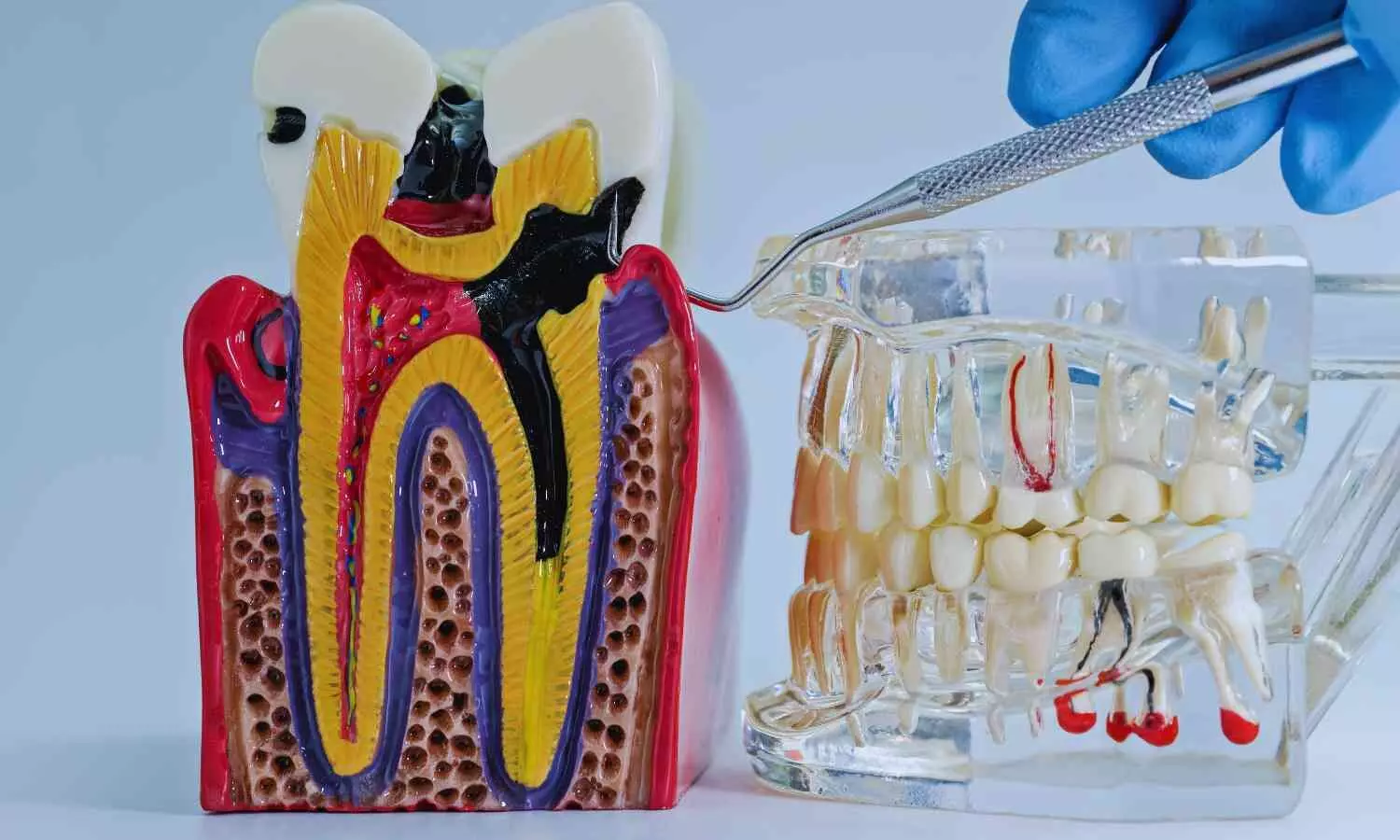
Researchers have found in a new research that Polypropylene needles outperformed traditional stainless steel versions for cleaning the apical portion of severely curved root canals. While the material choice made a difference, supplemental activation was the most effective method for overall debridement across all canal shapes, though it carried a higher risk of pushing material beyond the apex (extrusion).
This in vitro study compared the cleaning efficacy and irrigant extrusion of polypropylene needles and various supplemental irrigation techniques in curved root canals. Simulated canals with 20° (moderate) and 40° (severe) curvatures were prepared to size 25/0.07 and filled with biofilm-mimicking hydrogel.
Six irrigation techniques were tested (n = 9 per group): conventional irrigation with stainless steel needles (SN), conventional irrigation with polypropylene needles (PN), and stainless-steel needles supplemented with manual dynamic agitation using a 4% standardized cone (MDA-S), manual dynamic agitation with a matched cone (MDA-M), sonic activation with EDDY, or mechanical activation with XP-endo Finisher (XP). Residual hydrogel in the main canal, hydrogel clearance in accessory canals, and irrigant extrusion through the apical vent were assessed. Data were analyzed using two-way ANOVA with Bonferroni post hoc test (P < .05).
Results: In the severe curvature, PN resulted in significantly less residual hydrogel in the main canal than SN (P < .05). However, in both curvatures, all supplemental techniques showed superior performance compared with PN (P < .05). MDA-M provided the greatest hydrogel clearance in main and accessory canals (P < .05), but with the highest extrusion (P < .05).
Polypropylene needles improved apical cleaning in severely curved canals compared with stainless steel needles. However, supplemental activation provided superior overall debridement in both curvatures, although with an increased risk of extrusion.
Reference:
Comparative Efficacy and Extrusion risk of Polypropylene Needle Versus Various Supplemental Irrigations in Cleaning Simulated Curved Root Canals. Eungnapatanin, Sasin et al. Journal of Endodontics, Volume 0, Issue 0

Dr. Shravani Dali has completed her BDS from Pravara institute of medical sciences, loni. Following which she extensively worked in the healthcare sector for 2+ years. She has been actively involved in writing blogs in field of health and wellness. Currently she is pursuing her Masters of public health-health administration from Tata institute of social sciences. She can be contacted at editorial@medicaldialogues.in.
Dr Kamal Kant Kohli-MBBS, DTCD- a chest specialist with more than 30 years of practice and a flair for writing clinical articles, Dr Kamal Kant Kohli joined Medical Dialogues as a Chief Editor of Medical News. Besides writing articles, as an editor, he proofreads and verifies all the medical content published on Medical Dialogues including those coming from journals, studies,medical conferences,guidelines etc. Email: drkohli@medicaldialogues.in. Contact no. 011-43720751

