
Proanthocyanidin Improves Composite Bond Strength After Tooth Bleaching, suggests study
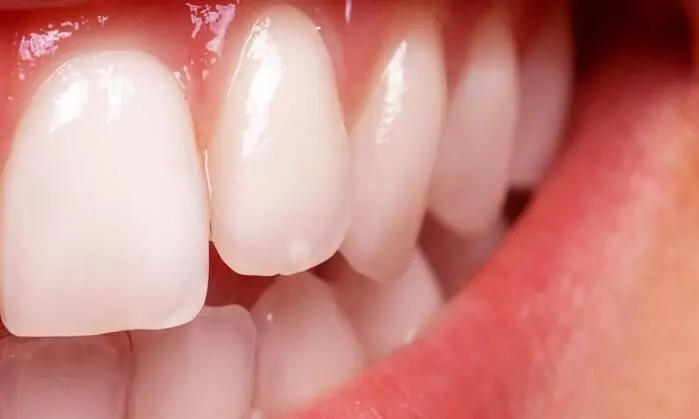


A new study published in the Cureus Journal of Medical Science showed that using antioxidants following tooth whitening greatly enhanced the adhesion of composite resin to enamel.
Tooth whitening is a well-accepted and minimally invasive method for treating tooth discoloration. However, the leftover oxygen radicals produced during whitening can interfere with the bonding of resin-based dental materials, leading to a decrease in bonding strength if bonding procedures are carried out right after whitening.
Antioxidants are being considered as a solution to counteract these remaining radicals and enhance bonding efficacy. This research aims to compare the impact of 6.5% proanthocyanidin, 10% sodium ascorbate, and 10% selenium on the strength of adhesion between composite resin and enamel after professional whitening treatment.
75 permanent upper front teeth were chosen for a bleaching procedure in the dental office, utilizing 37.5% hydrogen peroxide. The teeth were divided randomly into 5 groups of 15 each: 1) Immediate bonding after bleaching, 2) Delayed bonding after three weeks, 3) Treatment with 6.5% proanthocyanidin, 4) Treatment with 10% sodium ascorbate and 5) Treatment with 10% selenium
After the surface treatment, the enamel samples were etched with 37% phosphoric acid, bonded with Adper™ Single Bond 2 (3M ESPE, St. Paul, MN, USA), and filled with Filtek Z250 XT (3M ESPE, St. Paul, MN, USA) composite resin. The bond strength was measured using a universal testing machine (UTM) at a speed of 0.5 mm/min.
The proanthocyanidin group showed the highest average SBS at 45.52 ± 1.37 MPa, with sodium ascorbate following at 31.11 ± 1.98 MPa, delayed bonding at 30.39 ± 1.51 MPa, selenium at 15.95 ± 0.82 MPa, and immediate bonding at 11.17 ± 1.66 MPa.
The ANOVA analysis indicated significant variations among the different experimental groups (F = 1209.846, p < 0.001). Proanthocyanidin displayed notably superior SBS when compared to the other groups.
Overall, bleaching notably decreased the bond strength of composite resin when bonding was done right away. Applying antioxidants helped to restore the bond strength, with 6.5% grape seed extract showing the best recovery, followed by 10% sodium ascorbate, which had similar results to bonding done after a delay. Selenium was found to be less effective in comparison.
Reference:
Aggarwal, A., Khurana, N. S., Mann, J. S., Kaur, J., Garg, S., & Yadav, G. (2026). Effect of three antioxidants on the shear bond strength of composite resin to bleached enamel: An in vitro study. Cureus, 18(8), e114722. https://doi.org/10.7759/cureus.114722

