
Tooth Color Stabilizes by the Third Week After Internal Bleaching with Hydrogen Peroxide: Study
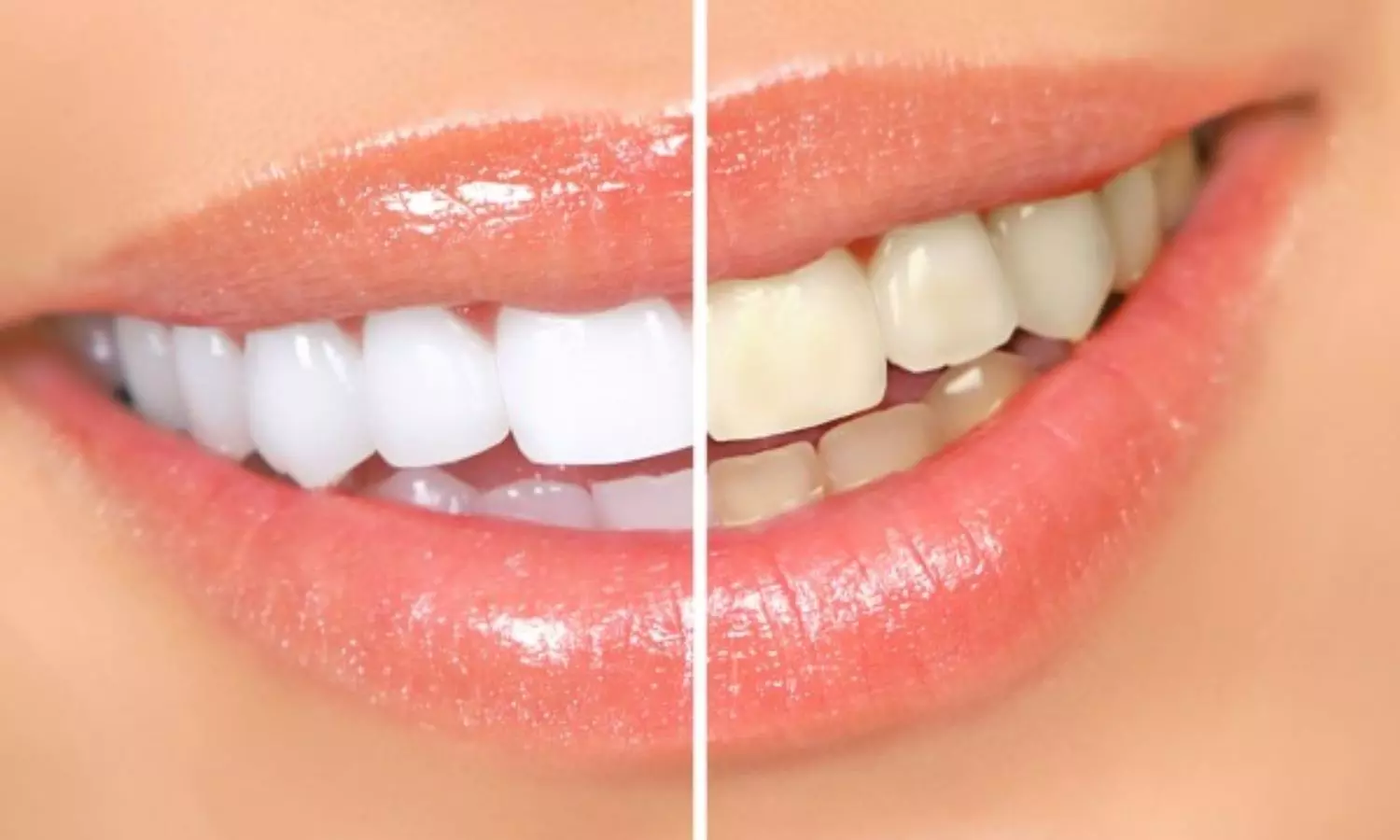


A new study published in the Journal of Dentistry showed that about half of patients stabilized their tooth color by the third week after internal bleaching (IOB) with 35% hydrogen peroxide, albeit the exact time varied depending on the evaluation technique.
Although in-office tooth whitening provides quick, clinician-controlled outcomes, the high hydrogen peroxide concentrations pose a risk of sensitivity. The effectiveness of treatment varies widely across patients, making outcome prediction challenging. The majority of whitening happens in the first few sessions before reaching a color saturation threshold when subsequent treatments raise the possibility of adverse effects but offer no extra benefit. Thus, this study determined the median number of bleaching sessions required to achieve color stability throughout a series of sessions and to describe the color change progression during in-office bleaching. This additionally assessed gingival irritation (GI), tooth sensitivity (TS), and patient-reported aesthetic results.
40 people with canine shade A2 or darker were participated in this study, where 6 IOB treatments with 35% hydrogen peroxide were performed on the participants. Following each session, color change was evaluated using both visual and instrumental criteria. Kaplan-Meier techniques were used to examine the time to stabilization, which was defined as the first session after which all future inter-session variations stayed below perceptibility thresholds (PT). Visual analog scales were used to record TS and GI. Both before and after treatment, the Orofacial Esthetic Scale (OES) was used. After ten months, pulp sensitivity was assessed.
By the third session, only 18–25% of the subjects had stabilized color with PT. At the second-third session, shade-guide-based results stabilized at a median level. At the third session, median stabilization under acceptability thresholds (AT) took place.
GI and TS were modest, transitory, and showed no signs of cumulative deterioration (p<0.05). Every patient that was recalled (28 out of 40) had a normal pulpal reaction. From baseline to post-treatment, every OES item showed a substantial improvement (p<0.05).
Less than half of the participants met the predetermined instrumental stability requirement under PT within six sessions, but 35% of HP exhibited progressive clinical color change throughout successive sessions under the standardized 48-hour in-office bleaching regimen.
By the third session, roughly 50% had stabilized under AT. The median time to stabilization was seen in the second or third session when shade guidelines were utilized. Overall, all teeth assessed at the 10-month follow-up had positive pulp sensitivity, and patient-reported TS and GI were moderate and temporary with no indication of cumulative deterioration between sessions.
Source:
Dias, R. M., Cordeiro, D. C. F., Rodrigues, M. A., Condolo, L., Lenhani, M. M., Favoreto, M. W., Loguercio, A. D., & Reis, A. (2026). Time to color stabilization during in-office bleaching with 35% hydrogen peroxide: A prospective clinical study. Journal of Dentistry, 106856,. https://doi.org/10.1016/j.jdent.2026.106856

