
- Home
- Medical news & Guidelines
- Anesthesiology
- Cardiology and CTVS
- Critical Care
- Dentistry
- Dermatology
- Diabetes and Endocrinology
- ENT
- Gastroenterology
- Medicine
- Nephrology
- Neurology
- Obstretics-Gynaecology
- Oncology
- Ophthalmology
- Orthopaedics
- Pediatrics-Neonatology
- Psychiatry
- Pulmonology
- Radiology
- Surgery
- Urology
- Laboratory Medicine
- Diet
- Nursing
- Paramedical
- Physiotherapy
- Health news
- Fact Check
- Bone Health Fact Check
- Brain Health Fact Check
- Cancer Related Fact Check
- Child Care Fact Check
- Dental and oral health fact check
- Diabetes and metabolic health fact check
- Diet and Nutrition Fact Check
- Eye and ENT Care Fact Check
- Fitness fact check
- Gut health fact check
- Heart health fact check
- Kidney health fact check
- Medical education fact check
- Men's health fact check
- Respiratory fact check
- Skin and hair care fact check
- Vaccine and Immunization fact check
- Women's health fact check
- AYUSH
- State News
- Andaman and Nicobar Islands
- Andhra Pradesh
- Arunachal Pradesh
- Assam
- Bihar
- Chandigarh
- Chattisgarh
- Dadra and Nagar Haveli
- Daman and Diu
- Delhi
- Goa
- Gujarat
- Haryana
- Himachal Pradesh
- Jammu & Kashmir
- Jharkhand
- Karnataka
- Kerala
- Ladakh
- Lakshadweep
- Madhya Pradesh
- Maharashtra
- Manipur
- Meghalaya
- Mizoram
- Nagaland
- Odisha
- Puducherry
- Punjab
- Rajasthan
- Sikkim
- Tamil Nadu
- Telangana
- Tripura
- Uttar Pradesh
- Uttrakhand
- West Bengal
- Medical Education
- Industry
Blood Metabolites May Have Causal Links with Alopecia Areata: Study
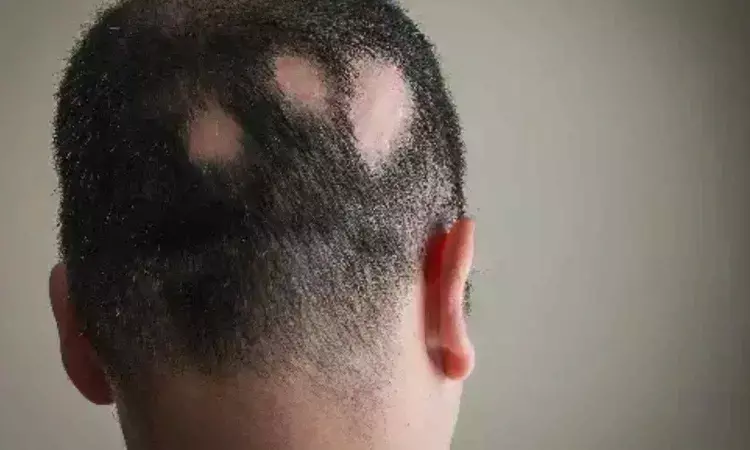
Researchers have found in a new study a potential causal associations between alopecia areata and blood levels of glutamine, citric acid, glucose, as well as various lipids and lipoproteins. Initial analyses showed no evidence of reverse causality, though further studies are needed to validate these findings.
Alopecia areata (AA) is an autoimmune hair loss disorder that affects approximately 2% of the global population, imposing a substantial psychological burden and impairing the quality of life. Although observational studies have correlated blood metabolites with AA, these associations are susceptible to confounding and reverse causality, leaving the causal direction unclear. This study employed a 2-sample Mendelian randomization (MR) approach to infer the causal relationship between blood metabolites and AA.
This study used publicly available genome-wide association study summary statistics for blood metabolites (Kettunen et al, N = 24,925) and AA (FinnGen, 682 cases/361,140 controls), both based on European ancestry populations. Single-nucleotide polymorphisms significantly associated with metabolites were selected as instrumental variables, while those in linkage disequilibrium or with an F-statistic < 10 were excluded to ensure the robustness of the instruments. The primary analysis utilized the inverse variance weighted method, supplemented by MR-Egger, weighted median, and MR-PRESSO analyses to assess horizontal pleiotropy and heterogeneity. A leave-one-out sensitivity analysis was performed to evaluate the influence of individual single-nucleotide polymorphisms.
Reference:
Yang, Xiao-Shuang, et al. "Causal Effects of Glutamine and Lipid-related Metabolites On Alopecia Areata: a 2-sample Mendelian Randomization Study." Medicine, vol. 104, no. 50, 2025, pp. E46312.

Dr. Shravani Dali has completed her BDS from Pravara institute of medical sciences, loni. Following which she extensively worked in the healthcare sector for 2+ years. She has been actively involved in writing blogs in field of health and wellness. Currently she is pursuing her Masters of public health-health administration from Tata institute of social sciences. She can be contacted at editorial@medicaldialogues.in.
Dr Kamal Kant Kohli-MBBS, DTCD- a chest specialist with more than 30 years of practice and a flair for writing clinical articles, Dr Kamal Kant Kohli joined Medical Dialogues as a Chief Editor of Medical News. Besides writing articles, as an editor, he proofreads and verifies all the medical content published on Medical Dialogues including those coming from journals, studies,medical conferences,guidelines etc. Email: drkohli@medicaldialogues.in. Contact no. 011-43720751

