Salivary Biomarkers May Predict Early-Onset Atopic Dermatitis: Study
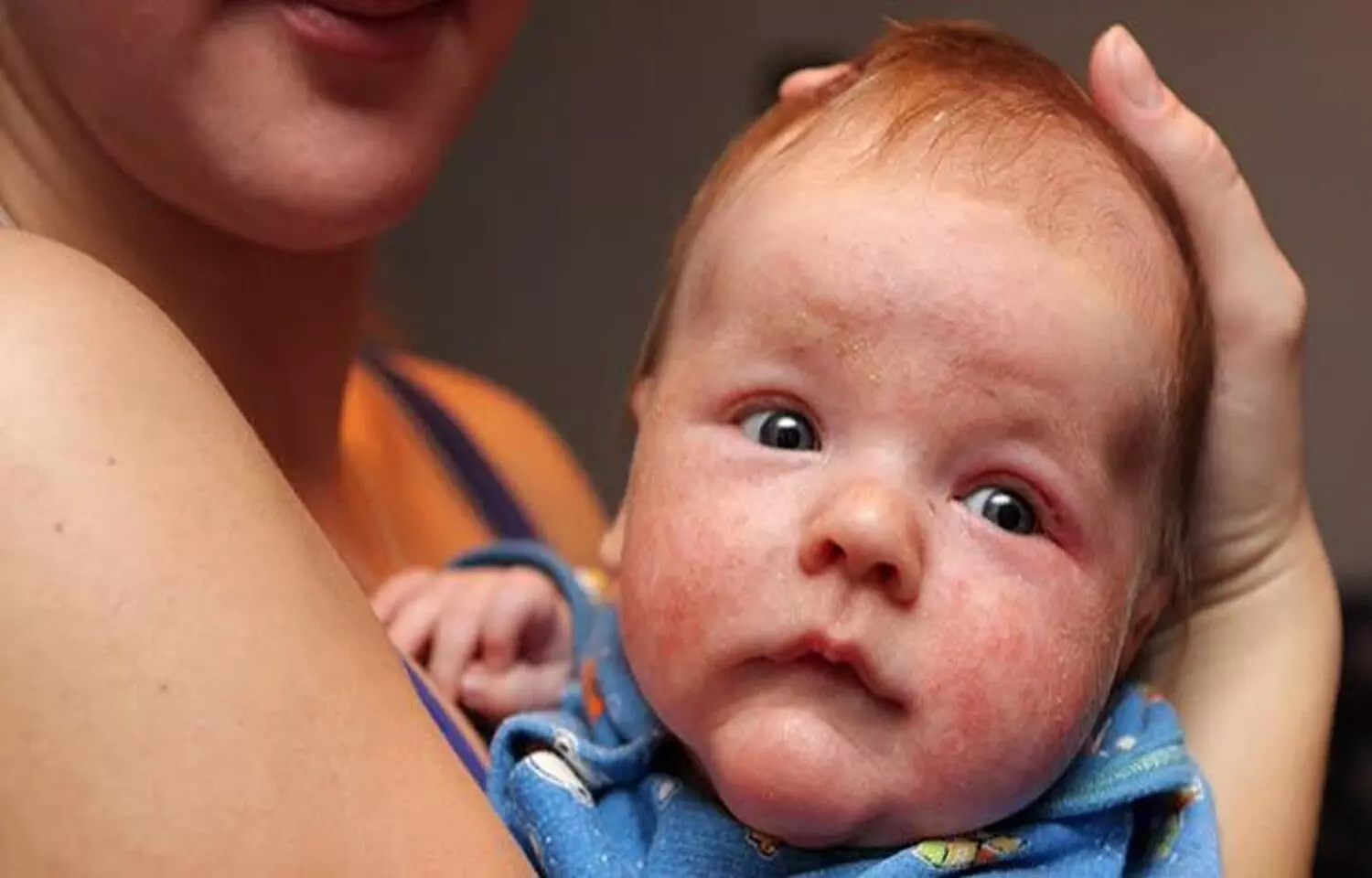


Researchers have found in a recent study that early-life salivary biomarkers, including hormonal, cytokine, and microbiome signatures, may provide a noninvasive way to identify infants at increased risk of developing atopic dermatitis (AD) early in life.
Atopic dermatitis (AD) often develops in early childhood and may persist into adulthood. Noninvasive measures to identify infants at risk for AD are limited. We investigated whether oral biomarkers and oral microbiota are associated with AD onset within the first 2 years of life.
In this prospective cohort study, we followed 119 infants residing in Upstate New York from birth to 24 months (2018–2023). AD diagnoses were obtained from electronic health records. Saliva samples were collected at seven time points (1, 2, 4, 6, 12, 18, and 24 months) and analyzed for 5 hormones and 23 cytokines using multiplex immunoassays. Salivary microbiome profiles were characterized via metagenomic sequencing.
Nearly half (48%) of infants developed AD by age 2, with most cases manifesting by 12 months (42%) and peak incidence occurring between months 2–4. Infants who developed AD by 1 year demonstrated significantly elevated estradiol (p = .007) and progesterone (p = .046) at 1 month, and a significantly lower salivary cortisol level (p = .019) at 6 months. Additionally, these infants exhibited higher sIL-1ra (p = .024) and IL-9 (p = .034) in saliva at 4 months and lower IL-1α (p = .038) at 6 months. Salivary microbiome beta diversity differed significantly at 2 months between infants with and without AD by 1 year (p = .038), with lower differential abundances of Bifidobacterium breve and Veillonella atypica in early infancy prior to AD onset.
Early-life salivary biomarkers, including hormonal, cytokine, and microbiome signatures, may serve as noninvasive indicators of infants at risk for early AD onset.
Reference:
Alomeir N, Chinchilli E, Terio C, et al. Salivary OMICS factors associated with atopic dermatitis in early infancy. Pediatr Allergy Immunol. 2026; 37:e70468. doi:10.1111/pai.70468
Keywords:
Salivary, Biomarkers, Predict, Early-Onset, Atopic Dermatitis, Study, Alomeir N, Chinchilli E, Terio C,