
Allergic Rhinitis (AR) with Nasal Congestion: Why Antihistamine Monotherapy May Not Be Enough
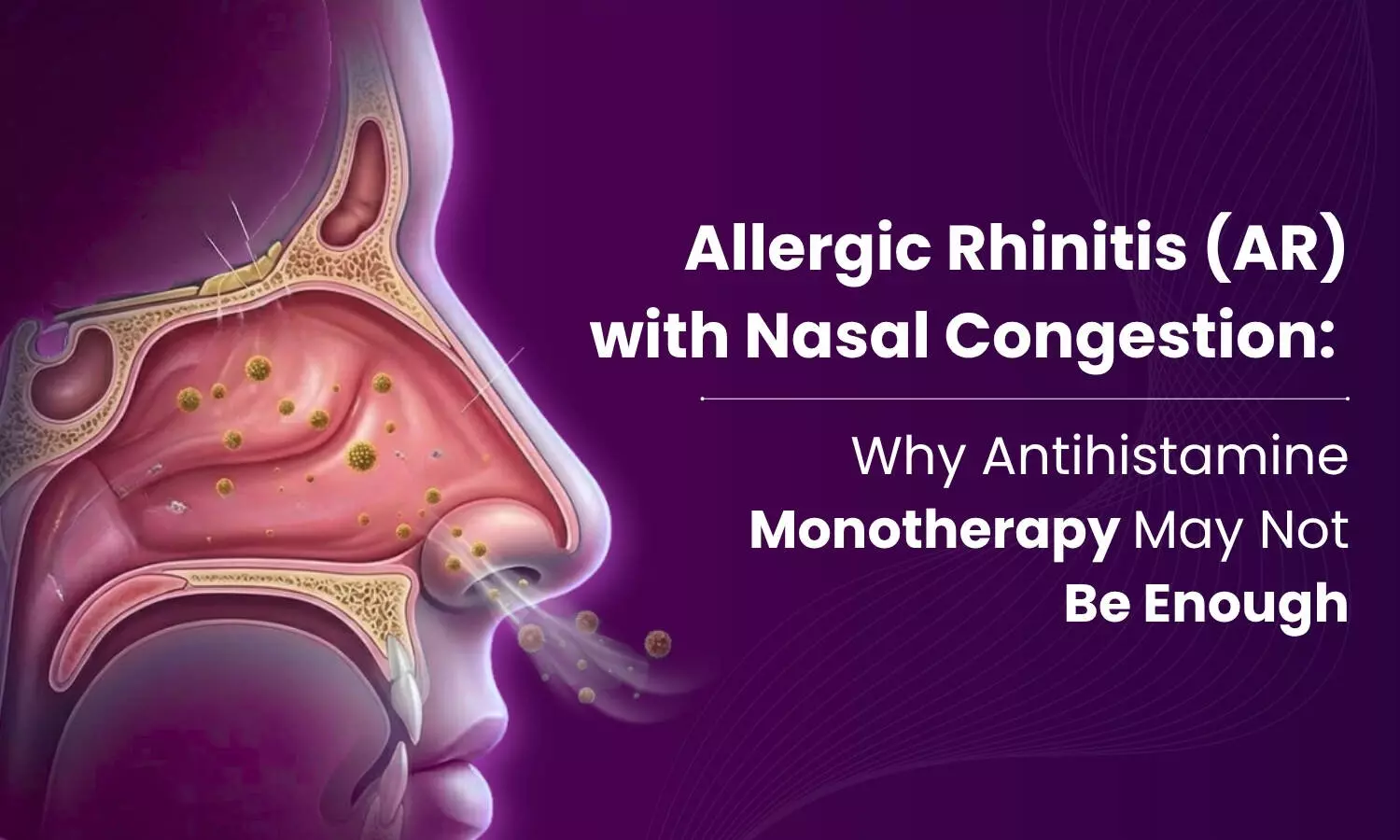


Allergic rhinitis (AR) typically presents with four familiar nasal symptoms: sneezing, rhinorrhoea, itching and congestion. However, individual symptoms may differ in their response to treatment. Oral H1-antihistamines are particularly useful for histamine-associated symptoms such as sneezing, itching and rhinorrhoea, whereas nasal congestion may remain troublesome because nasal obstruction reflects broader underlying inflammatory and vascular pathophysiological interactions (1).
For clinicians, symptom control should therefore be assessed not only by whether overall “allergy symptoms” improve, but also by whether the symptom causing the greatest functional burden has been adequately controlled.
Why Does Nasal Congestion Behave Differently in the Allergic Rhinitis Patient Symptom Journey?
During the early allergic response, histamine and other mediators contribute to sneezing, nasal itching and watery rhinorrhoea through effects on sensory nerves, vascular permeability and glandular secretion (1). This provides the rationale for the use of H1-antihistamines when these symptoms predominate.
Nasal congestion has a broader pathophysiological basis. Changes in the nasal vasculature, including vasodilatation and vascular engorgement, together with increased vascular permeability and mucosal oedema, can reduce nasal airway calibre. Nasal obstruction may become particularly prominent during the late-phase allergic response, when continued mediator activity and inflammatory-cell recruitment can sustain mucosal inflammation (1).
This helps explain a common clinical pattern in AR: sneezing, itching and rhinorrhoea may improve while nasal obstruction continues to remain bothersome.
Potential Role and Scope of Fexofenadine in Allergic Rhinitis Symptom Relief
Fexofenadine is a second-generation H1-antihistamine with low sedating potential and established efficacy in seasonal allergic rhinitis. A meta-analysis of eight randomized, double-blind, placebo-controlled trials found a significant reduction in total symptom scores among 1,833 patients receiving fexofenadine. Benefits were also observed across individual nasal symptoms, including sneezing, rhinorrhoea, itching and congestion, while the overall incidence of reported adverse events did not differ significantly from placebo (2). Although antihistamines can improve nasal congestion, control may be incomplete in some patients because nasal obstruction also has important vascular and inflammatory components. Persistent blockage therefore does not necessarily indicate failure of antihistamine therapy; it may indicate that an additional therapeutic approach to mitigate congestion needs to be addressed.
Fexofenadine and Pseudoephedrine – Complementary Actions for Comprehensive Symptom Relief
Pseudoephedrine is a sympathomimetic decongestant that reduces congestion through vasoconstriction within the nasal mucosa, thereby decreasing mucosal swelling and improving nasal airflow. It therefore targets a component of nasal obstruction that is not optimally controlled by H1-receptor blockade.
Fexofenadine and Pseudoephedrine: Better Symptom Relief than Monotherapy: The clinical rationale for combining fexofenadine with pseudoephedrine was established in a multicentre, double-blind study involving 651 patients with seasonal allergic rhinitis. Fexofenadine 60 mg plus sustained-release pseudoephedrine 120 mg, administered twice daily, provided significantly greater improvement in nasal congestion than fexofenadine alone. The combination was also more effective than pseudoephedrine alone in controlling histamine-associated symptoms, including sneezing, rhinorrhoea and nasal itching (3). Thus, the combination of fexofenadine and pseudoephedrine act through complementary mechanisms to address different contributors to the patient's symptom journey.
Fexofenadine and Pseudoephedrine: Rapid Onset of Action & Objective Evidence for Improved Nasal Patency: The effect on nasal obstruction has also been demonstrated using objective airflow assessment. In a randomized study involving 24 adults with house-dust-mite-induced perennial allergic rhinitis and nasal obstruction, fexofenadine/pseudoephedrine was compared with fexofenadine alone, with nasal obstruction assessed using rhinomanometry-derived nasal airflow and a visual analogue scale over eight hours (4). The onset of benefit with the combination of fexofenadine/pseudoephedrine was observed at 30 minutes based on nasal airflow and at 60 minutes based on patient-reported obstruction. The beneficial effect was maintained after onset, whereas fexofenadine alone showed no significant change during the observation period (4). These findings provide objective evidence that adding a decongestant can improve nasal patency when nasal obstruction remains a troublesome symptom despite antihistamine therapy.
Fexofenadine and Pseudoephedrine in Allergic Rhinitis: Practice Considerations
Fexofenadine–pseudoephedrine provides complementary antihistaminic and decongestant effects, offering relief from multiple allergic rhinitis symptoms, including troublesome nasal congestion. Clinical evidence demonstrates significantly greater improvement in nasal congestion with the combination compared with fexofenadine alone (p<0.0005) (3). A randomized controlled trial involving 24 adult patients with house dust mite-induced perennial allergic rhinitis and nasal obstruction demonstrated improved nasal airflow within 30 minutes of administration (4). Another randomized, placebo-controlled trial involving 298 patients with moderate-to-severe seasonal allergic rhinitis demonstrated significant symptom relief within 45 minutes (6). The ARIA-EAACI 2024–2025 guidelines recognize second-generation oral H1-antihistamines as an option for allergic rhinitis management (5). From a safety perspective, Pseudoephedrine use was associated with a small but statistically significant rise in systolic blood pressure (SBP) of 0.99 mmHg (95% CI: 0.08–1.90) and heart rate (HR) of 2.83 beats/min (95% CI: 2.0–3.6), while no significant change was observed in diastolic blood pressure (DBP) (0.63 mmHg; 95% CI: −0.10 to 1.35) (7). The pseudoephedrine component warrants careful patient selection, particularly in individuals with cardiovascular conditions, hypertension, glaucoma, or urinary retention. Together, these findings support fexofenadine–pseudoephedrine as a symptom-directed treatment option for appropriately selected patients experiencing nasal congestion alongside other allergic rhinitis symptoms.
Clinical Takeaway
Allergic rhinitis management becomes more effective, and satisfying for the patient when treatment is matched to the symptoms that remain uncontrolled. Fexofenadine is effective across several nasal symptoms, including sneezing, rhinorrhoea, itching and congestion, but nasal obstruction may remain troublesome in some patients because vascular and inflammatory mechanisms also contribute to congestion.
In appropriately selected patients requiring additional short-term relief of nasal blockage, fexofenadine–pseudoephedrine may offer complementary pharmacological actions: H1-receptor blockade for histamine-responsive symptoms and sympathomimetic decongestant activity for nasal obstruction, providing prompt and effective relief in patients with allergic rhinitis.
Abbreviations
AR – Allergic Rhinitis, H1 – Histamine-1 receptor, VAS – Visual Analogue Scale, ARIA – Allergic Rhinitis and its Impact on Asthma, EAACI – European Academy of Allergy and Clinical Immunology, INCS – Intranasal Corticosteroids, BP – Blood Pressure, SAR – Seasonal Allergic Rhinitis, HCl – Hydrochloride, SBP- Systolic Blood Pressure, DBP- Diastolic Blood Pressure, HR- Heart rate
MAT-IN-2601331-v1.0-29/10/2026
For the use only of a Registered Medical Practitioner or a hospital or a laboratory.
- 1. International consensus statement on allergy and rhinology: Allergic rhinitis-2023.Int Forum Allergy Rhinol.13293-859
- 2. Systematic review on the efficacy of fexofenadine in seasonal allergic rhinitis: a meta-analysis of randomized, double-blind, placebo-controlled clinical trials.Int Arch Allergy Immunol.1561-15
- 3. The efficacy and safety of fexofenadine HCl and pseudoephedrine, alone and in combination, in seasonal allergic rhinitis.J Allergy Clin Immunol.104100-106
- 4. Effect of fexofenadine/pseudoephedrine combination tablet on nasal obstruction in patients with allergic rhinitis using rhinomanometry: a randomized controlled trial.Asian Pac J Allergy Immunol.42147-153
- 5. Allergic Rhinitis and Its Impact on Asthma (ARIA)-EAACI Guidelines-2024-2025 Revision: Part II-Guidelines on oral and ocular treatments.Allergy.811947-1970
- 6. Onset of action, efficacy, and safety of fexofenadine 60 mg/pseudoephedrine 120 mg versus placebo in the Atlanta allergen exposure unitAnn Allergy Asthma Immunol.8938-45
- 7. Effect of oral pseudoephedrine on blood pressure and heart rate: a meta-analysis.Arch Intern Med.1651686-1694
