Fact Check: Can kasni (chicory) seeds and leaves, kharbooja seeds (melon) and dried mako (black nightshade) remove gallbladder stones naturally within 7–8 days?
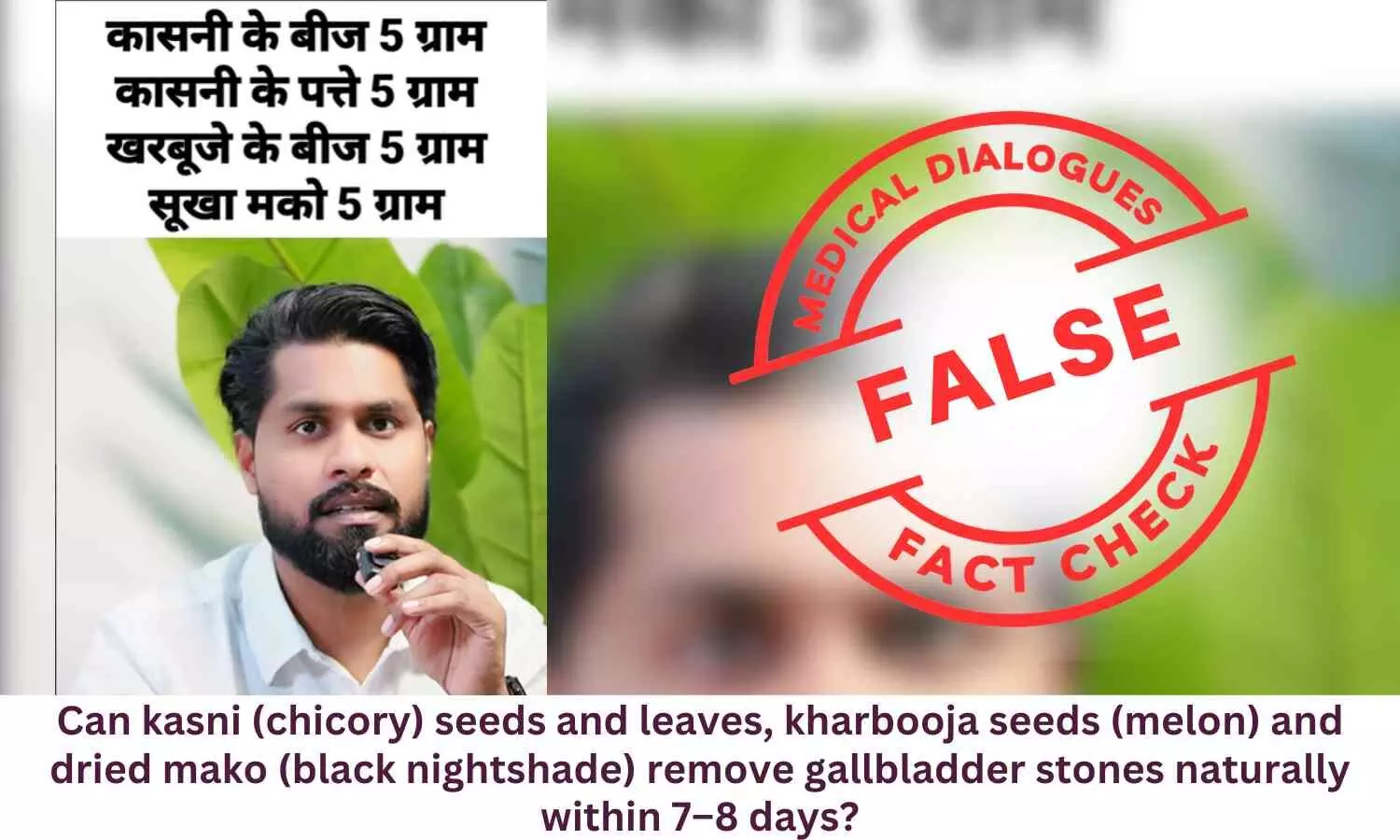


An Instagram reel claims that kasni (chicory) seeds and leaves, kharbooja seeds (melon) and dried mako (black nightshade) removes gallbladder stones naturally within 7–8 days. The claim is FALSE.
Claim
In an Instagram reel it is claimed that kasni (chicory) seeds and leaves, kharbooja seeds (melon) and dried mako (black nightshade) remove gallbladder stones naturally within 7–8 days. In the reel by ansari_healthtips it is said, "People who suffer from gallbladder stones (gallstones) often hear the same advice everywhere — that surgery is necessary. However, many individuals are unable to undergo surgery or feel scared, so they look for alternative remedies that might help pass the stones naturally.
In Unani medicine, there is a remedy that is believed to be very effective in helping gallstones pass on their own, although many people hesitate to trust herbal treatments.
The remedy is as follows: take chicory seeds, chicory leaves, dried mako (black nightshade), and melon seeds 5 grams each. Boil all these ingredients in two glasses of water until the water reduces to about half a glass. Divide this into two doses.
Take one dose in the morning after breakfast and the second dose in the evening before dinner. This is the daily dosage. Additionally, take one spoon of olive oil regularly on an empty stomach.
Use this remedy consistently for 7–8 days and observe the effects yourself."
The claim can be accessed here.
Fact Check
The claim is FALSE. There is no credible clinical evidence to support that these ingredients can dissolve or eliminate gallstones within 7–8 days. In medical practice, gallstones are typically managed through surgical interventions, such as cholecystectomy, and cannot be reliably removed through natural remedies—especially not within such a short timeframe.
What are Gall Stones?
Gall Stones also known as Cholelithiasis, are hardened deposits of digestive fluid that can form in the gallbladder. The gallbladder, a small organ located just beneath the liver, stores bile a digestive fluid released into the small intestine.
There are three main pathways in the formation of gallstones:
Cholesterol supersaturation occurs when the liver produces more cholesterol than the bile can dissolve, leading to the precipitation of excess cholesterol as crystals. These crystals become trapped in the gallbladder mucus, forming what is known as gallbladder sludge. Over time, these crystals may grow and form stones, which can occlude the bile ducts and result in gallstone disease.
Excess bilirubin, a yellow pigment formed from the breakdown of red blood cells, is another factor in gallstone formation. When certain hematologic conditions cause the liver to produce too much bilirubin during the breakdown of hemoglobin, this excess bilirubin can contribute to the formation of gallstones.
Gallbladder hypomotility, or impaired contractility, is a condition where the gallbladder does not empty effectively. When the gallbladder fails to contract and empty bile properly, the bile can become concentrated, leading to the formation of gallstones.
Can Gall Stones be removed?
The treatment for gallstones is surgery to remove the gallbladder. Gallstones are typically removed through surgery because there is no duct through which they can pass naturally. The gallbladder is not an essential organ, which means you can live normally without a gallbladder.
What are the Nutritional Benefits of Kasni (Chicory), Kharbooja seeds (melon) and Dried Mako?
Kasni widely recognized in traditional systems of medicine, offers a range of therapeutic benefits owing to its rich phytochemical composition, including glycosides, flavonoids, saponins, caffeic acid derivatives, inulin, lactucin, and sonchuside. All parts of the plant leaves, seeds, and roots are used medicinally and are known for their diuretic, laxative, antibilious, and antipyretic properties.
Melon seeds offer notable nutritional and health benefits, particularly through their oil, which is rich in polyunsaturated fatty acids especially linoleic acid and high levels of vitamin E, including tocopherols and tocotrienols. These components contribute to antioxidant activity, support heart health, and promote skin health.
Mako commonly known as black nightshade, is a medicinal plant belonging to the Solanaceae family. Phytochemical studies have shown that the plant contains bioactive compounds such as alkaloids, flavonoids, terpenoids, saponins, steroids, and phenolic compounds. It has been explored for various pharmacological activities, including analgesic, antimicrobial, and hepatoprotective effects.
Can kasni (chicory) seeds and leaves, kharbooja seeds (melon) and dried mako (black nightshade) remove gallbladder stones naturally within 7–8 days?
There is no scientific evidence that kasni (chicory), kharbooja (melon) seeds, or dried mako (black nightshade) can dissolve or remove gallbladder stones within 7–8 days. Gallstones typically require medical evaluation, and in many cases, surgical or evidence-based treatment.
Kasni has been reported to offer several health benefits. According to the Journal of Drug Delivery and Therapeutics, it possesses diuretic, laxative, antibilious, and antipyretic properties and is considered supportive of liver health.
Melon seeds have notable health benefits; research by Adrián Rabadán et. al. indicates that they are rich in polyunsaturated fatty acids, particularly linoleic acid, and contain a high concentration of vitamin E, which may help support liver function.
Mako has been reported to offer multiple health benefits; a study by Mohd Afsahul Kalam et. al. found that it exhibits antimicrobial and hepatoprotective activities.
There is no scientific evidence or medical consensus to support this claim. Furthermore, it should be noted that gallstones cannot be reliably removed without medical intervention, and definitive treatment is typically surgical.
Responding to the claim Dr. Kona Lakshmi Kumari, Minimal Access & Robotic GI Surgeon, Metabolic and Bariatric Surgeon, Yashoda Hospitals, Hyderabad explained, "The claim that a combination of chicory seeds and leaves, melon seeds and dried mako (black nightshade) can remove gallbladder stones within 7–8 days is not supported by scientific evidence. While these ingredients—Cichorium intybus (Kasni), Cucumis melo (kharbooja), and Solanum nigrum (Mako)—do have recognized medicinal properties in traditional systems, their role in gallstone dissolution is unproven.
Kasni is known for mild hepatoprotective and digestive benefits. Melon seeds provide healthy fats and antioxidants like vitamin E. Mako has shown antimicrobial and liver-supportive activity in preliminary studies. However, none of these have demonstrated the ability to dissolve gallstones in humans, especially within such a short timeframe.
Gallstones, particularly cholesterol or pigment stones, form due to imbalances in bile composition. Their management depends on size, number, and symptoms. In modern medicine, treatment options include observation (for asymptomatic cases), medications like ursodeoxycholic acid in selected cases, and most commonly, surgical removal of the gallbladder (cholecystectomy) for symptomatic stones. There is no clinically validated herbal remedy that can reliably eliminate gallstones in 7–8 days.
Relying on such claims may delay appropriate care and can lead to complications like biliary colic, infection (cholecystitis), or pancreatitis. Patients experiencing symptoms such as abdominal pain, nausea, or jaundice should seek medical evaluation promptly."
Dr. D. Chandra Sekhar Reddy, Senior Consultant Gastroenterologist, Hepatologist and Therapeutic Endoscopist, Yashoda Hospitals, Hyderabad further added, "While Kasni (Cichorium intybus), melon seeds (Cucumis melo), and Mako (Solanum nigrum) have traditional uses—such as liver support, antioxidant effects, and digestive benefits—there is no clinical proof that they can dissolve or eliminate gallstones. Gallstones form due to imbalances in bile and are typically managed based on symptoms and severity. Standard medical treatment includes observation, medications in select cases, or surgical removal of the gallbladder (cholecystectomy), which remains the most definitive option. Gall stones can lead to complications like Gall bladder cancer. Relying on unproven remedies may delay proper treatment and increase the risk of complications like infection or pancreatitis. Consult a doctor for appropriate diagnosis and management."
Medical Dialogues Final Take
The claim that kasni, kharbooja seeds, and dried mako can remove gallbladder stones within 7–8 days is FALSE. While these ingredients may contribute to general health, they do not replace medical evaluation or treatment for gallstones. Gall stones can only be removed through surgical interventions.
Hence, the claim is FALSE.