
Dengue in India: Understanding the Drivers of a Rising Burden & Evolving Patterns
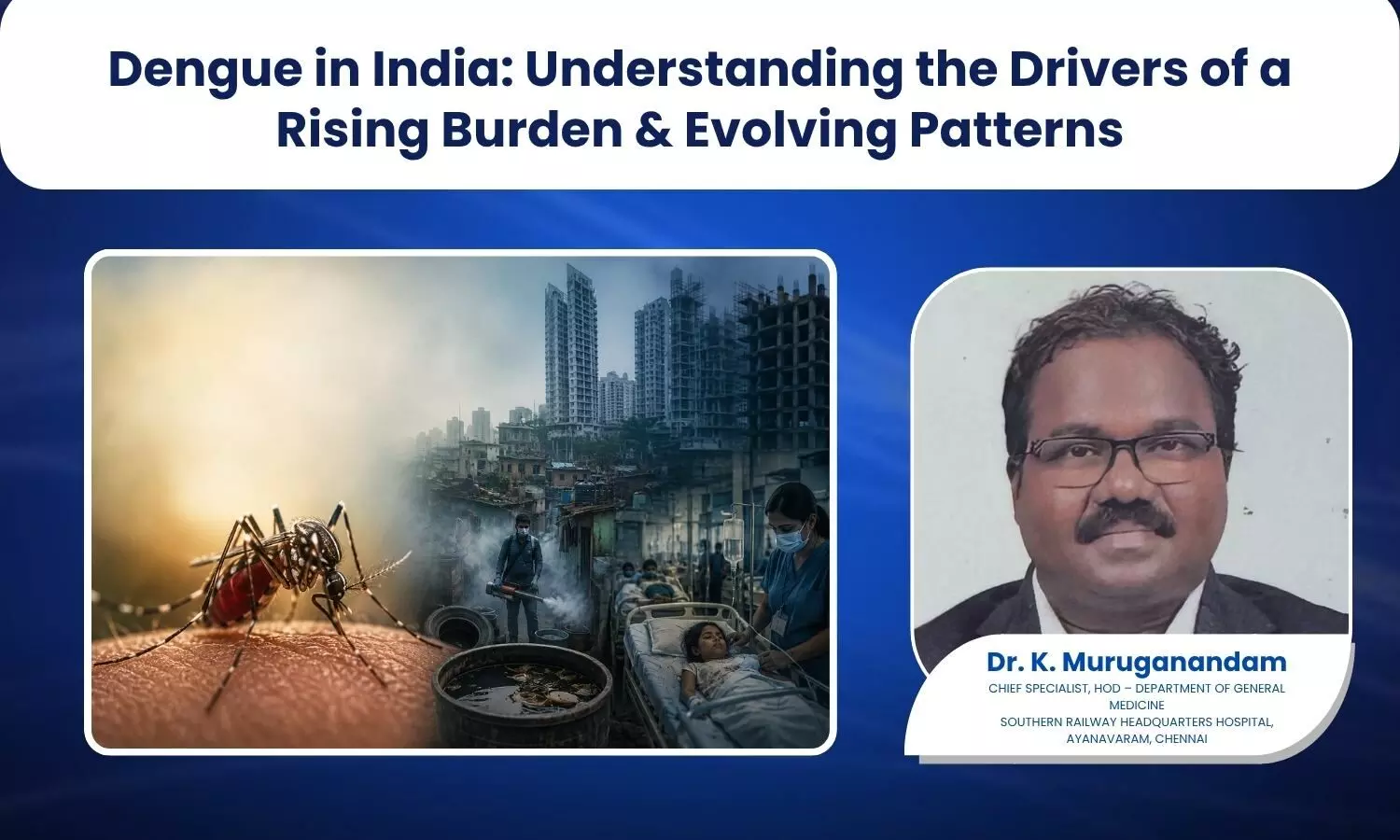


India has reported more than ten-fold rise in reported dengue cases, from 28,066 cases in 2010 to 2,89,235 cases in 2023 (1). Although reported cases have declined to 2,33,519 in 2024 and 1,21,824 in 2025, provisional 2026 data already record 6,927 cases and 10 deaths, reminding us that dengue remains a persistent public health challenge rather than a short seasonal outbreak (2). The true burden of dengue in India is significantly higher than reported surveillance figures, as gaps in case detection and reporting may result in considerable underestimation of disease burden (3).
Forces Driving Dengue Burden & Disease Pattern
- Climate Change: Rising temperatures and shifting rainfall patterns are fundamentally altering the disease's reach and time patterns. Warmer weather boosts mosquito reproduction, speeds up larval growth, and causes the virus to replicate faster within the mosquito's body (1)
- Rapid urbanisation is another important driver of dengue transmission in India. A 2024 Scientific Reports study from a high-incidence area of Delhi found that household density, water supply patterns, drainage conditions, garbage collection methods, nearby garbage collection sites, and construction sites were significant household and community-level predictors of dengue occurrence, highlighting how urban living conditions can create favourable breeding environments for Aedes mosquitoes (4).
- Water shortage practices: Irregular piped water supplies force residents to store water in containers like coolers, cement tanks, and plastic drums. A 2024 study in Patna found that cement tanks and desert coolers were the most productive breeding sites for Aedes aegypti (5)
Previously, dengue was primarily restricted to urban areas, but the geographical expansion of dengue epidemics has been frequently reported in semi-urban and rural India. Changing lifestyles aided by rapid urbanisation, climatic change, population growth, migration, and climate change are attributed as strong drivers of the frequent dengue outbreaks (6)
India’s Evolving Dengue Epidemiology – Expanding Geographies & Multiple Circulating Serotypes
Even more alarming is the spread of dengue into previously non-endemic, high-altitude regions. Areas such as Jammu & Kashmir, Uttarakhand, Himachal Pradesh, and Nagaland, where colder temperatures once limited transmission, are now reporting exponential growth in cases. For example, Himachal Pradesh reported 168 times more cases between 2016 and 2022 than in the preceding eight years (6)
There are four serotypes of DENV (DENV-1, DENV-2, DENV-3, and DENV-4) and all of them can cause dengue fever (DF), a self-limiting febrile illness. DENV has been in circulation in the Indian subcontinent since 1950s.
The disease is perennial in nature, with cases occurring year-round in southern states and Gujarat, while the rest of the country experiences sharp peaks during the monsoon and post-monsoon seasons (7). According to a recent study, DENV-2 was the most prevalent serotype during the dengue outbreaks in the Bhopal region of Central India in 2019 and 2021, followed by other serotypes (8), while a highly divergent lineage of DENV-4 has established itself in South India (9).
The co-circulation of all four dengue virus serotypes in India creates a complex epidemiological landscape and is associated with diverse clinical presentations, especially following infection with multiple serotypes over time (7).
Figure 1. Convergence of factors driving the expanding dengue burden in India.
Fighting Dengue – Clinical Challenges
Dengue fever has become a major public health concern in our country, causing significant morbidity and mortality as it causes a wide range of diseases. This could range from the subclinical disease (where people are unaware they are infected) to the severe flu-like symptoms in persons who are infected. Although it is less common, sometimes a few people develop very severe dengue that can result in a variety of complications such as organ impairment, severe bleeding, or plasma leakage (7).
Dengue fever manifests across a broad clinical spectrum, ranging from subclinical or mild flu-like symptoms to severe, life-threatening complications such as organ impairment, severe bleeding, and plasma leakage. Severe forms like Dengue Hemorrhagic Fever (DHF) and Dengue Shock Syndrome (DSS) carry a high risk of mortality if not managed appropriately, with children under five being particularly vulnerable, accounting for approximately 90% of global DHF cases and a 2.5% mortality rate (7). Evidences suggests that advanced age and underlying comorbidities, including cardiovascular disease, stroke, diabetes, chronic respiratory disease, and renal disease, are associated with an increased risk of severe dengue and adverse clinical outcomes (8). Obesity also shows a strong correlation with increased dengue risk, likely linked to urban lifestyle factors (6).
Severe dengue can also affect multiple organs, with liver and kidney involvement frequently observed in critically ill patients. Markedly elevated liver enzymes and the development of acute kidney injury are associated with poorer clinical outcomes and underscore the need for close monitoring and timely intervention (9).
The primary obstacle is heterotypic immunity. Recovery from one serotype provides lifelong protection against that specific strain but only brief protection against the others (10). Subsequent infection with a different serotype can lead to Antibody-Dependent Enhancement (ADE), which significantly increases the risk of severe forms of the disease, such as Dengue Hemorrhagic Fever (DHF).
Addressing Dengue Prevention Through Collaborative Efforts: Public Health Perspective
Combatting this crisis effectively requires a shift from reactive measures to a proactive, integrated strategy engaging citizens, public health stakeholders, and scientific innovations:
- "Jan Chetna through Jan Bhagidari": Public health officials emphasize that the community role is the key. Active involvement of citizens in eliminating mosquito breeding sites, maintaining environmental hygiene, and adopting preventive practices can complement public health measures and strengthen year-round dengue prevention efforts. (13)
- Dry days: Designated days for eliminating stagnant water from household and community containers, are extensively promoted by the government in urban areas. These help reinforce dengue prevention practices and are effective in raising public awareness. For example, in Delhi, municipal workers carry on house inspections to eliminate mosquito breeding sites and ensure proper sanitation. They also impose fines for improper water storage. These proactive measures may be extended to rural and underserved areas so as to prevent them from becoming hotbeds of the disease (1).
- Innovative Vector-Control Approaches: In addition to conventional vector-control measures, novel approaches targeting mosquito populations are being explored to complement dengue prevention efforts. Emerging evidence on naturally occurring Wolbachia a gram-negative bacterium that can naturally infect arthropods including Aedes mosquitoes, has generated interest in biological vector-control strategies that may help reduce dengue transmission when integrated with existing surveillance and source-reduction programmes (14).
As dengue continues to expand across geographies and evolve epidemiologically, addressing its growing burden will require sustained surveillance, strengthened prevention strategies, community participation, and continued scientific innovation. A coordinated, year-round approach remains essential to reducing the impact of dengue in India.
Disclaimer: This article is published under the MD Brand Connect initiative with support from Takeda for informational and educational purposes only, and should not be treated as independent editorial coverage, medical advice, prescription guidance, or endorsement of any product or doctor.
This information is solely intended for the use of Registered Healthcare Practitioner / Registered Medical Practitioner only. The information contained herein is based on the published medical literature and international recommended guidelines. The information provided is intended for educational purposes only, aimed at increasing awareness on dengue disease and not meant for promotion of any specific product. Registered Healthcare Practitioner / Registered Medical Practitioner shall apply their independent medical judgement for diagnosing or assessing or treating any patient. Takeda makes no representation or warranty concerning the information / content provided and assumes no responsibility for the accuracy of the information or content or opinion furnished or any outcome based on the application of such information. This material contains copyright protected information, content; the use of which is limited by law and this material cannot be reproduced, replicated, used, or modified by any person for their own use or further distribution.
TAKEDA and the TAKEDA logo are trademarks or registered trademarks of Takeda Pharmaceutical Company Limited.
Document number : C-ANPROM/IN/NON/0044 ; Date of Preparation: June 2026
- 1. Climate change and the rising incidence of dengue in India [Internet].Observer Research Foundation
- 2. National Centre for Vector Borne Diseases Control. Dengue cases and deaths in the country since New Delhi: Ministry of Health and Family Welfare, Government of India.
- 3. Current perspectives on the spread of dengue in India.Infect Drug Resist.
- 4. Socio-ecological predictors of dengue in high incidence area of Delhi, India.Scientific Reports.
- 5. Assessment of Aedes larval density in Patna district, Bihar in 2024: Implications for vector control.Int J Mosq Res.129-13
- 6. 6. Impact of projected climate and socioeconomic scenarios on state-wise annual dengue incidence in India using ensemble models
- 7. Co-circulation of all the four dengue virus serotypes and detection of a novel clade of DENV-4 (genotype I) virus in Pune, India during 2016 season.PLoS One.
- 8. Relevance of non-communicable comorbidities for the development of the severe forms of dengue: a systematic literature review.PLoS Negl Trop Dis.10
- 9. Tracking the clinico-microbiological profile and molecular characterization of dengue cases during the monsoon-season in Belagavi, Karnataka.PLoS Negl Trop Dis.20
- 10. Dengue in India: An Overview.Natl J Community Med.1349-57
- 11. Emergence of a Novel Dengue Virus Serotype-2 Genotype IV Lineage III Strain and Displacement of Dengue Virus Serotype-1 in Central India (2019-2023).17
- 12. Evolutionary dynamics of dengue virus in India.PLoS Pathog.19
- 13. Press Information Bureau. Union Health Ministry launches nationwide campaign for prevention and control of dengue and other vector-borne diseases [Internet]. New Delhi: Press Information Bureau, Government of India; 2025 Aug 1 [cited 2026 Jun 8].
- 14. Molecular Evidence of Wolbachia Species in Wild-Caught Aedes albopictus and Aedes aegypti Mosquitoes in Four States of Northeast India.J Trop Med.
