AI-Driven clinical tools to remove subjectivity, improve accuracy: Dr Jitendra Singh
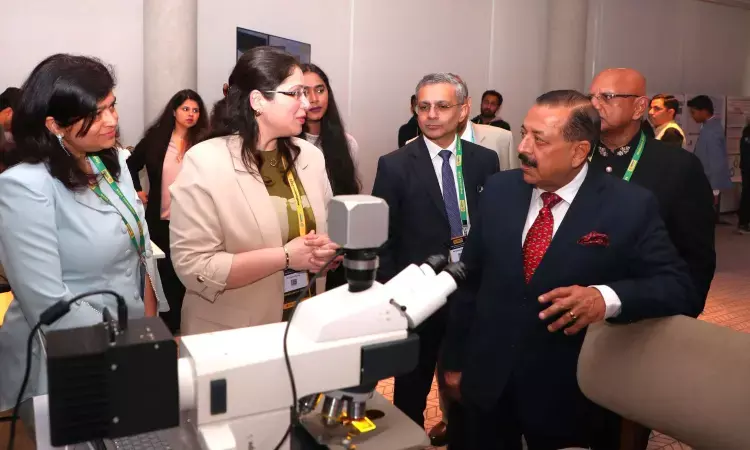


New Delhi: Union Minister of State (Independent Charge) for Science & Technology, Earth Sciences, PMO, Personnel, Public Grievances, Pensions, Atomic Energy and Space, Dr Jitendra Singh, stated that AI-developed tools are set to eliminate subjectivity in medical diagnosis, ensuring more precise and specific treatment for patients.
Delivering the inaugural address at the "Medllumina 2026: International Multi Specialty Medical Conference", the Minister explained that, for example, while a pathologist examining a cancer patient's biopsy slide with naked eye may inadvertently miss a minute but crucial cluster of affected cells, an AI-enabled system can guide him directly to the precise location, minimising human error. Similarly, in clinical examination, AI tools analysing comprehensive patient data can flag findings that may otherwise be overlooked, thereby strengthening diagnostic accuracy and improving treatment outcomes.
Highlighting the importance of integrated medical dialogue, Dr Jitendra Singh said that with increasing super-specialisation, opportunities for cross-disciplinary deliberation often get limited. A multi-speciality academic platform organised by a diagnostics institution represents a forward-looking approach, especially at a time when medicine is becoming deeply interdisciplinary, integrating MedTech, engineering and advanced data sciences, the PIB stated.
Also Read:Dr. Jitendra Singh calls for integrating Allopathy, AYUSH, and Technology
Tracing the evolution of medical science over the past few decades, Dr Jitendra Singh referred to the transition from an era dominated by classical clinical learning to one driven by imaging and molecular tools, ultrasound, CT scan, MRI and now genomics. He said that the dictum of the day has shifted: where earlier medical mastery depended solely on extensive reading, today AI-enabled systems complement and enhance clinical judgement. He also shared that AI-powered language tools are breaking communication barriers in healthcare delivery, enabling wider outreach, including through mobile clinics and digital platforms.
The Minister spoke at length about the changing spectrum of diseases in India. Conditions once region-specific, such as diabetes in southern India or thyroid disorders in Himalayan regions, are now prevalent across the country, reflecting lifestyle changes and the breakdown of rural–urban divides. Increased life expectancy has brought age-related diseases to the forefront, while lifestyle disorders are appearing at younger ages. In this context, early and precise diagnostics have become indispensable to distinguish between closely overlapping clinical entities and to prevent inappropriate treatment protocols.
Dr Jitendra Singh emphasised that India is entering a new era of genomics and gene therapy. Under the Department of Biotechnology, large-scale genome sequencing initiatives are underway, with an initial target of sequencing one million individuals. He referred to successful clinical research in gene therapy for haemophilia conducted in collaboration with premier medical institutions, describing it as a major scientific achievement. He also mentioned the development of India’s first indigenous antibiotic, Nafithromycin, as evidence of the country’s growing life sciences capabilities.
Looking ahead, the Minister said that personalised prescriptions based on genetic profiling, environmental factors and lifestyle determinants will become the norm in the coming decades. AI-driven diagnostic analytics, combined with genomic insights, will allow physicians to tailor treatments to individual patients rather than adopting a one-size-fits-all approach.
Dr Jitendra Singh also spoke about policy reforms aimed at expanding India’s research ecosystem. The government has opened sectors such as space, nuclear medicine, and advanced health research to greater private participation, creating an enabling framework for innovation. He invited leading diagnostic institutions to collaborate with government research initiatives, stating that integrating public and private strengths will accelerate breakthroughs in areas such as nuclear medicine therapy and advanced oncology treatments.
Connecting healthcare to the larger national vision, the Minister said that with over 70 percent of India’s population below the age of 40, safeguarding health and harnessing youthful energy are central to building a “Viksit Bharat.” A robust diagnostics ecosystem, supported by AI, genomics and credible quality standards, will play a decisive role in ensuring that preventive and precision medicine become accessible to all.
The conference concluded with a shared commitment to advancing diagnostics, strengthening interdisciplinary collaboration, and leveraging AI-driven tools to build a future-ready healthcare system for India.