
Multi-Modal AI Cuts Mammography Workload by 43.8% While Preserving 100% Sensitivity: Study Finds
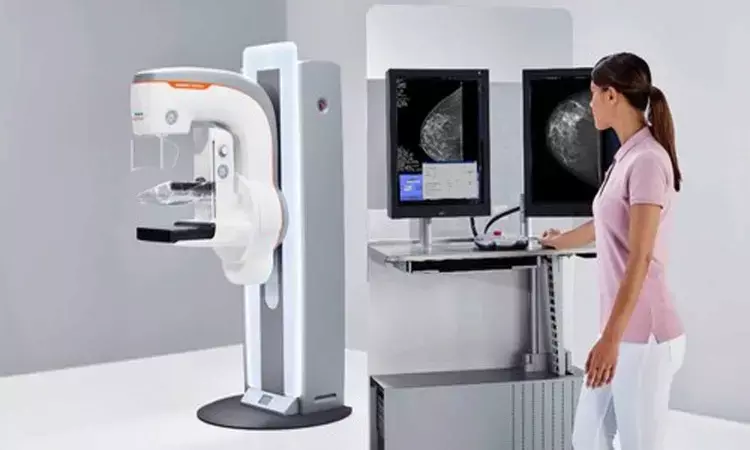


USA: A novel multi-modal artificial intelligence (AI) system integrating two-dimensional (2D) and three-dimensional (3D) mammography significantly improves breast cancer screening efficiency. A prospective multicenter study published in Nature Medicine in February 2024 revealed that the system reduced radiologist workload by 43.8% and unnecessary recalls by 31.7% while maintaining 100% sensitivity.
While screening mammography is essential for early detection, its efficacy is often hindered by tissue masking in dense breasts and high observer variability; therefore, Jungkyu Park and colleagues from the New York University (NYU) Grossman School of Medicine aimed to evaluate if a multi-modal AI system could enhance single-reader workflows by filtering low-risk examinations and localizing suspicious lesions.
For this purpose, a prospective multicenter study evaluated 40,603 four-view screenings across 18 sites by incorporating a multi-modal AI system with Full-Field Digital Mammography (FFDM), synthetic 2D mammography (C-View), and Digital Breast Tomosynthesis (DBT). Primary assessment of the Abnormal Interpretation Rate (AIR) utilized Area Under the Receiver Operating Characteristic (AUROC) and Free-Response Operating Characteristic (FROC) analysis, excluding male patients and those with implants or prior mastectomies
Key Results of the AI Model Include:
- Superior Diagnostic Accuracy: The AI system achieved an impressive AUROC curve of 0.945, confirming high precision in breast cancer detection.
- Optimized Clinical Efficiency: Implementation of the system can potentially slash clinician interpretative workload by 43.8% and reduce the nonessential AIR by 31.7% while maintaining 100% sensitivity.
- Effective Patient Triaging: Prospective clinical data demonstrated a significant reduction in recall rates for low-risk cases, decreasing from 7.6% to 5.7%, which minimizes nonessential follow-up procedures for healthy patients.
- High Clinical Safety Profile: The system maintained a remarkably low false-negative rate of 0.37% within the low-risk triage group, ensuring that the vast majority of malignancies were correctly identified.
- Proven Global Generalizability: Evaluation across seven external datasets from three continents yielded AUROC values between 0.827 and 0.996, underscoring the system's reliability across diverse patient populations and imaging protocols.
The results suggest that integrating this multi-modal AI system into routine mammography screening significantly reduces nonessential patient recalls and the overall interpretive load for radiologists. By accurately localizing suspicious findings and filtering low-risk examinations.
The authors conclude that the AI system facilitates a more efficient, accurate, and patient-centered diagnostic process in mammography screening.
While the results demonstrate significant potential, the authors note that the study did not specifically evaluate whether the implementation of the artificial intelligence system led to a net improvement in clinical outcomes, such as identifying additional malignancies, which indicates that future prospective research is necessary to confirm how these results translate into actual patient benefits and to investigate the potential of incorporating temporal comparisons or complementary diagnostic tools like ultrasound
Reference
Park, J., Witowski, J., Xu, Y., Trivedi, H., Gichoya, J., Brown-Mulry, B., Westerhoff, M., Moy, L., Heacock, L., Lewin, A., & Geras, K. J. (2024). A Multi-Modal AI System for Screening Mammography: Integrating 2D and 3D Imaging to Improve Breast Cancer Detection in a Prospective Clinical Study
