All-endoscopic autologous suspension fixation achieves satisfactory outcomes in chronic Achilles tendon ruptures: study
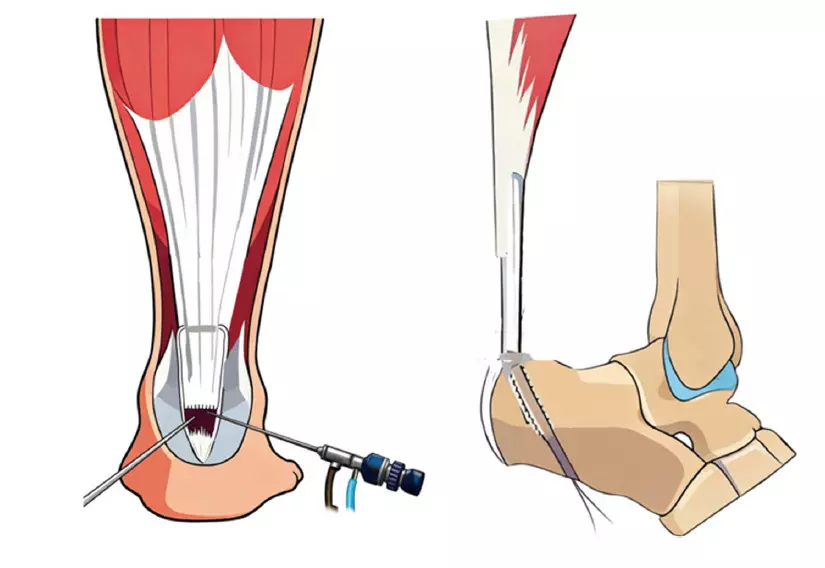


Acute Achilles tendon rupture with delayed treatment more than four weeks is referred to as chronic, which can lead to severe functional impairment. Hao Han et al conducted a study to introduce the technique and clinical outcomes of endoscopic autologous tendon suspension fixation for chronic insertional Achilles tendon rupture.
Twenty-two patients (16 males, 6 females) with a mean age (range) of 49.2 ± 10.3 (30–67) years underwent Achilles tendon reconstruction surgery using all-endoscopic autologous tendon suspension fixation. Patients were evaluated at the last follow-up, with assessment indicators including Visual analogue scale (VAS), American Orthopaedic Foot & Ankle Society Ankle Hindfoot Scale (AOFAS-AH), Achilles tendon total rupture score (ATRS), Foot and Ankle Ability Measure (FAAM), Range of motion (ROM) and maximum calf circumference.
The key findings of the study:
• All patients successfully completed the surgery, with an operation time of 62.91 ± 8.82 (45–80) min, intraoperative blood loss of 15 (5–35) mL, and all surgical approaches healed in one stage, with no damage to important structures such as blood vessels, nerves, and tendons during the operation.
• Twenty-two patients were followed up for 16.23 ± 2.94 (12–23) months.
• Two patients reported weakness in single-leg heel raises, which subsequently improved with heel raise exercises.
• At the last follow-up, the AOFAS-AH score improved from 60.64 ± 8.83 (45–77) preoperatively to 94.18 ± 3.91 (88–100), while the ATRS score increased from 45.59 ± 5.85 (35–57) preoperatively to 93.18 ± 4.68 (83–100), and the VAS score decreased from 6 (1) to 1 (0), with all differences being statistically significant.
• Similarly, the FAAM- Activity of Daily Living (FAAM-ADL) score increased from 44.73 ± 8.79 (30–59) to 90.95 ± 4.62 (83–99), and the FAAM- -Sports (FAAM-S) score increased from 43.55 ± 7.14 (31–55) to 88.27 ± 8.18 (74–99). All differences were statistically significant. (all P < 0.001).
• The dorsiflexion angle of the affected side ankle joint (13.2 ± 1.9°), plantar flexion angle of the ankle joint (44.3 ± 1.6°), and maximum calf circumference (35.6 ± 1.5 cm) were compared with the healthy side (13.3 ± 1.9°, 44.5 ± 1.7°, 35.6 ± 1.6 cm), and there was no statistically significant difference (all P > 0.05).
• According to the Arner-Lindholm scoring assessment: excellent in 19 cases, good in three cases, with an excellent and good rate of 100% (22/22).
The authors concluded – “This study demonstrates that all-endoscopic autologous suspension fixation achieves satisfactory outcomes in patients with chronic Achilles tendon ruptures. This technique effectively restores distal ruptures, making it a viable option for Achilles tendon reconstruction.”
For further details on the article refer to:
All‑endoscopic autologous suspension fixation of semitendinosus tendon and gracilis tendon for insertional chronic Achilles tendo rupture: operative technique and outcomes
Hao Han et al
International Orthopaedics (2026) 50:1059–1067
https://doi.org/10.1007/s00264-026-06805-3