CPAK classification allows TKA surgeons to tailor knee alignment better than one size-fits-all approach: study
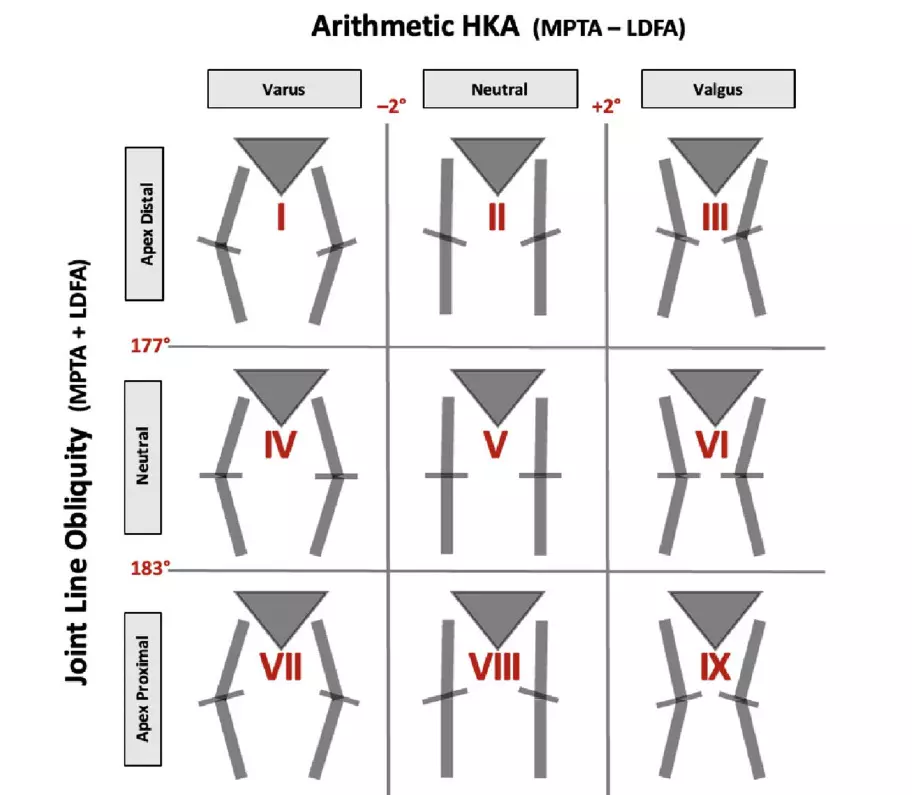


Traditional terminology for coronal alignment of the knee (varus, valgus, or neutral) was inadequate, as it described the patient's limb alignment at a singular moment.
The coronal plane alignment of the knee (CPAK) classification is a practical and straightforward framework to define a patient’s constitutional coronal knee limb alignment and joint line obliquity.
Although Mechanical Alignment (MA) has excellent long-term survivorship, it does not account for individual differences in constitutional alignment using a “1-size-fits-all” approach. To improve outcomes, techniques favoring recreation of patients’ prearthritic alignment have burgeoned, including “kinematic align- ment (KA)” and “functional alignment (FA).”
Patients are assigned to one of nine phenotypes using two straightforward calculations; the arithmetic hip-knee-ankle angle (aHKA) and the arithmetic joint line obliquity (aJLO).
Clinical applications:
• Through measuring the preoperative MPTA and LDFA on LLRs, CPAK algorithms reproduce a patient's aHKA and JLO, providing important information to personalize implant positioning in TKA.
• CPAK enables intuitive, stepwise TKA balancing and highlights the limitations of uniform methods such as MA with varied knee phenotypes.
• There were significantly greater improvements in patient-reported outcome scores when knees (TKA, UKA, HTO) were aligned back to their prearthritic CPAK group, and 5-year survival rates were better.
Limitations –
CPAK describes only coronal alignment and JLO, while sagittal, axial, and patellofemoral alignment are not addressed. Rotational malpositioning and fixed flexion contractures can lead to measurement errors when using LLR to determine CPAK phenotypes.
The authors concluded – “The CPAK classification provides a framework to understand a patient’s constitutional alignment through 2 straightforward algorithms performed on long leg imaging, appreciate the distribution of phenotypes among healthy and osteoarthritic populations, geographical and sex-based variations, and investigate outcomes of different surgical alignment strategies regarding differing prearthritic alignment. The CPAK classification allows surgeons to tailor the alignment strategy to best fit the patient’s constitutional phenotype and avoid the drawbacks of a “onesize-fits-all” approach.”
For further details on the article refer to:
The Coronal Plane Alignment of the Knee Classification How It Works, How to Apply It, and How It can Affect Outcomes in Knee Reconstruction Surgery Samuel Grant et al JBJS Open Access 2025:e25.00165. http://dx.doi.org/10.2106/JBJS.OA.25.00165