The "greta oto" sign for diagnosing axial myopathy with low back pain: a novel MRI sign: Study
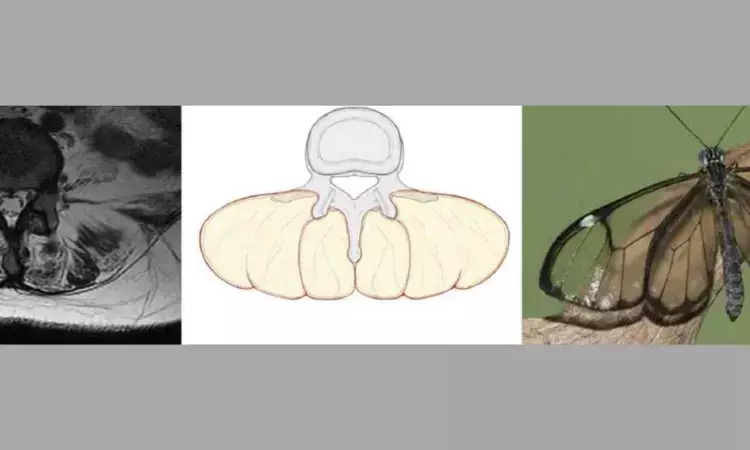


Axial myopathy is a general term for a group of myopathies affecting the axial muscles. Axial myopathy appears to be a grossly underestimated feature of many muscle diseases and often overlooked in clinical practice and research.
Jingming Wang et al conducted a study to elucidate a novel MRI imaging feature, termed “Greta oto” sign, which is a specific sign for detecting axial myopathy patients with low back pain as the major clinical manifestation.
Muscle atrophy and fat infiltration result in extensive fat deposits in the posterior paraspinal muscles, which, when viewed on T2 axial MRI along with the vertebral body and spinous processes, produces a distinctive imaging appearance similar to that of a glassy-winged butterfly (Greta oto), which can be referred to as the “Greta oto” sign.
Four patients with axial myopathy with low back pain as the main clinical manifestation were retrospectively studied. The MRI findings and clinical features were analyzed.
There were three females and one male, aged from 38 to 55 years. MRI examinations showed significant atrophy and fat infiltration of the bilateral erector spinae muscles, as well as varying degrees of atrophy observed in the multifidus muscles. The fatty degeneration in the erector spinae and multifidus muscles, together with the vertebral bodies and spinous processes, produced a distinctive imaging manifestation resembling a “Greta oto” sign on axial T2-weighted MRI scans in all patients. Ultimately, all four patients were referred to the neurology department, where the diagnosis of myopathy was confirmed by muscle biopsy (one myopathy with early-onset Paget disease and frontotemporal dementia type 1 (IBMPFD), one HMGCR antibody-positive myopathy, one myotonic dystrophy and one limb-girdle muscular dystrophy.
The authors concluded – “The Greta Otto sign may be a specific MRI manifestation of axial myopathy with low back pain as the primary clinical manifestation. This sign may help clinicians identify axial myopathy and reduce the likelihood of misdiagnosis as nonspecific low back pain.”
Further reading:
The “greta oto” sign for diagnosing axial myopathy with low back pain as the major clinical manifestation: a novel MRI sign with report of four cases Jingming Wang et al European Spine Journal (2025) 34:5480–5487 https://doi.org/10.1007/s00586-025-09191-3