Double Arthrodesis Viable Alternative to Triple Arthrodesis in Selected Patients, suggests study
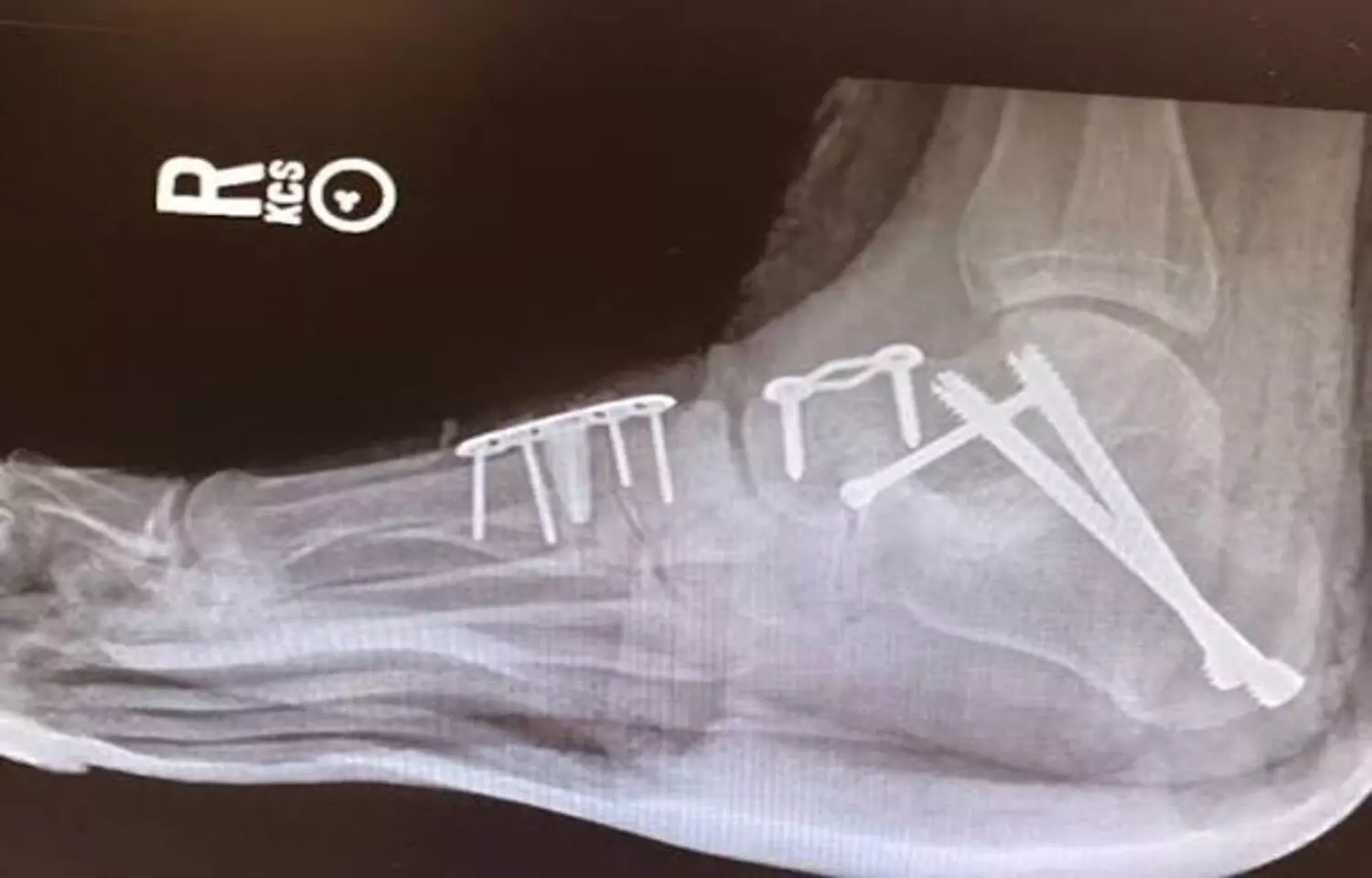


Researchers have found in a recent small cohort study that there are no statistically significant differences between double and triple arthrodesis in terms of short- to mid-term functional outcomes, radiographic results, or plantar pressure distribution. However, double arthrodesis required a shorter operative time, making it a reasonable alternative for carefully selected patients without significant calcaneocuboid joint (CCJ) involvement. As the study was small, these findings are exploratory and should be confirmed through larger prospective studies.
Rigid adult-acquired flatfoot deformity (AAFD) often requires arthrodesis. While triple arthrodesis is standard, double arthrodesis has been proposed as an alternative. However, comparative evidence remains limited. This study compared their clinical efficacy, radiographic correction, and plantar pressure distribution.
Patients who underwent double or triple arthrodesis for rigid AAFD in our department from April 2013 to December 2019 were retrospectively reviewed. Outcomes included AOFAS scores, Foot Function Index (FFI), radiographic parameters (Meary’s angle [MA], talonavicular coverage angle [TCA], talus-first metatarsal angle [T1MA]), and plantar pressure measured via wireless insoles. Inter-group and intra-group comparisons were performed.
Twenty-two patients were included (12 double, 10 triple arthrodesis). Baseline characteristics were comparable (all P > 0.05). Double arthrodesis had significantly shorter operative time (59.42 ± 6.05 vs. 85.80 ± 6.32 min, P < 0.001). Complication rates (16.67% vs. 10.00%, P = 1.0) and fusion time were similar, with 100% fusion in both groups. Both procedures significantly improved all functional and radiographic parameters (P < 0.05). AOFAS midfoot scores improved from 19.82 ± 6.97 to 73.83 ± 12.56 (double) and 23.80 ± 18.47 to 66.70 ± 16.65 (triple); hindfoot scores from 15.55 ± 11.57 to 68.75 ± 17.50 and 19.00 ± 17.83 to 69.60 ± 9.57; FFI decreased from 59.55 ± 13.77% to 22.58 ± 18.60% and 60.00 ± 16.26% to 33.50 ± 12.98%. Postoperative radiographic improvements included MA (23.53 ± 14.13° to 10.51 ± 6.90° double; 21.79 ± 9.24° to 10.32 ± 7.75° triple), TCA (13.20 ± 7.65° to 4.84 ± 4.72°; 9.80 ± 6.98° to 4.84 ± 4.88°), and T1MA (22.83 ± 12.00° to 11.49 ± 8.39°; 24.66 ± 9.41° to 10.26 ± 5.20°), with no significant inter-group differences. Plantar pressure showed postoperative symmetry between operated and healthy feet in both groups, with inter-group differences only in the lateral plantar region (P = 0.037) and entire sole (P = 0.048) before correction for multiple comparisons; neither remained significant after correction.
In this small cohort, no statistically significant differences were detected between the two procedures in short- to mid-term functional, radiographic, or plantar pressure outcomes, although operative time was shorter for double arthrodesis. Double arthrodesis may be considered a reasonable alternative in appropriately selected patients without significant CCJ involvement. However, these findings are exploratory and require confirmation in larger prospective studies.
Reference:
Wang, C., Li, X., Dong, S. et al. Comparative efficacy of double and triple arthrodesis in adult-acquired flatfoot deformity: a retrospective analysis. BMC Surg 26, 446 (2026). https://doi.org/10.1186/s12893-026-04014-8
Keywords:
Double, Arthrodesis, Viable, Alternative, Triple Arthrodesis, Selected Patients, Wang, C., Li, X., Dong, S.