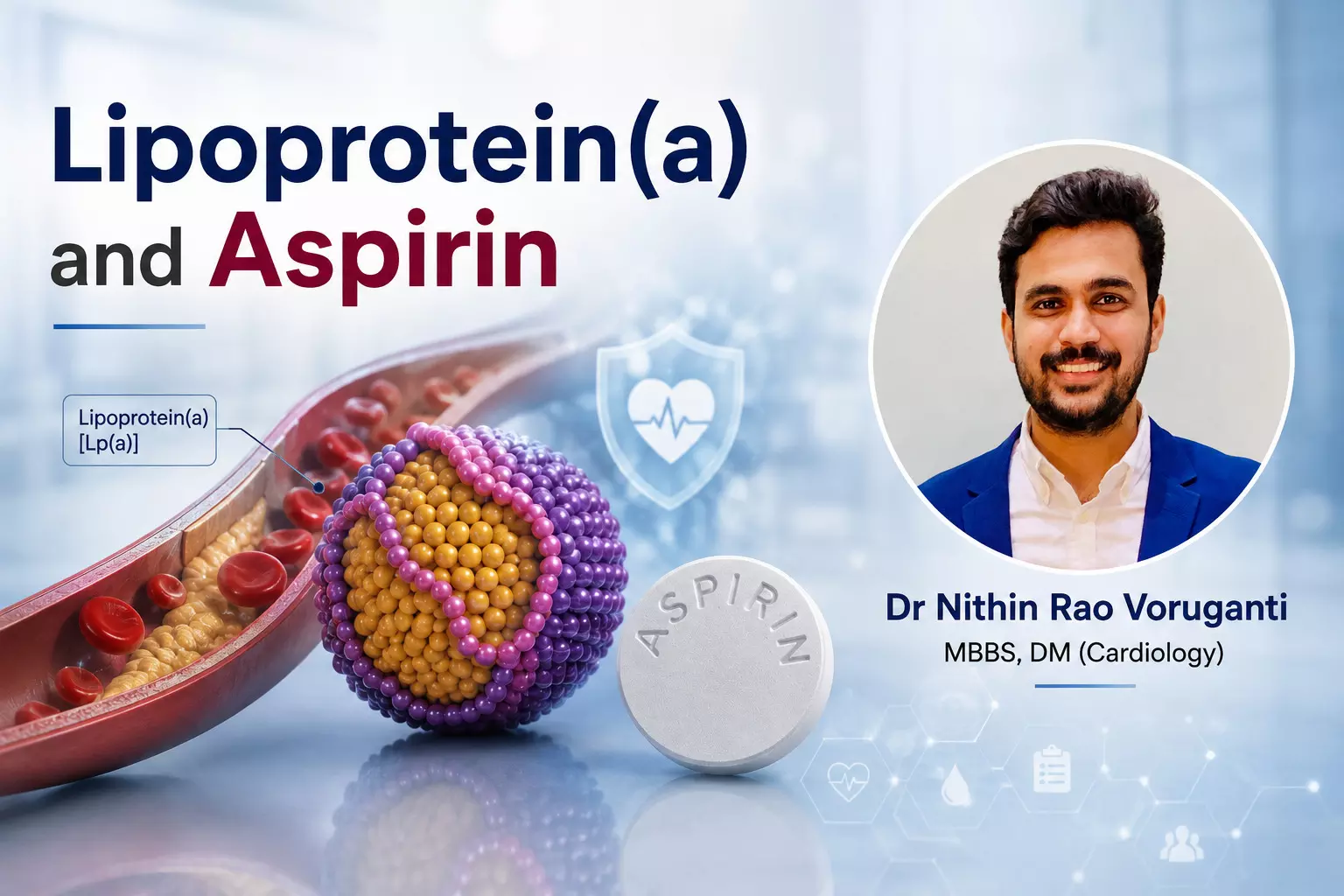
Lipoprotein(a) and Aspirin: A New Perspective on Aspirin for an Emerging Risk Factor- Dr Nithin Rao Voruganti


Patient Profile*
A 52-year-old Indian man, an IT professional from Mumbai, presents for a routine preventive health evaluation. He is a non-smoker with a blood pressure of 132/84 mmHg, BMI of 27 kg/m², LDL-C of 118 mg/dL, HDL-C of 42 mg/dL, triglycerides of 150 mg/dL, and Lp(a) of 95 mg/dL. His father experienced a myocardial infarction at 54 years of age, indicating a family history of premature ASCVD.
Risk Evaluation
Using the AHA PREVENT-ASCVD equations within the 2026 ACC/AHA dyslipidemia guideline's "Calculate–Personalize–Reclassify (CPR)" framework, his 10-year risk based on conventional factors alone falls in the borderline-to-intermediate range (2). His markedly elevated Lp(a) is not captured by PREVENT and should be layered on as a risk-enhancing factor, particularly in the presence of premature family history (2).
DCRM 2.0 allows consideration of low-dose aspirin (75–100 mg/day) for selected primary-prevention individuals with multiple cardiovascular risk factors and low bleeding risk (3).
CAC scoring may help resolve uncertainty if treatment decisions remain unclear after initial risk personalization (2). Regardless of the aspirin decision, the clearer and better-supported action is intensification of LDL-C-lowering therapy and lifestyle modification, since Lp(a)-specific drug therapy remains investigational (2).
Why Does This Matter Now?
Lp(a) has emerged as an important inherited cardiovascular risk factor. Unlike LDL-C, Lp(a) levels are largely genetically determined and remain relatively stable throughout life (1). Elevated Lp(a) independently increases the risk of ASCVD, myocardial infarction, ischemic stroke and calcific aortic valve stenosis through pro-atherogenic, pro-inflammatory and potentially pro-thrombotic mechanisms (6).
No dedicated Lp(a)-lowering therapy is currently approved for routine clinical use; several RNA-targeted therapies are in advanced clinical development (7). In this setting, interest has turned to whether established therapies such as aspirin might offset part of the thrombotic risk associated with elevated Lp(a). The biological rationale is plausible because apolipoprotein(a) shares structural similarity with plasminogen, potentially influencing fibrinolysis and thrombosis (8).
What Does the Evidence Show?
Current guidance recommends measuring Lp(a) at least once in adulthood, with the 2026 ACC/AHA guideline incorporating Lp(a) as a risk-enhancing factor within the CPR framework (1,2).
A 2024 propensity-matched analysis from MESA found that among participants with Lp(a) >50 mg/dL, regular aspirin use was associated with a 46% lower relative risk of CHD events (HR 0.54; 95% CI 0.32–0.94), whereas no significant benefit was seen among those with lower Lp(a) (4). This is an important aspirin-positive signal, although the observational design means that a causal treatment effect cannot be established.
Genetic analyses provide additional support. In the Women's Health Study, carriers of the LPA rs3798220-C variant had fewer major cardiovascular events with aspirin than placebo (HR 0.44; 95% CI 0.20–0.94) (9). Analyses of LPA-associated genetic risk in ASPREE have also suggested a potentially more favourable benefit-risk profile in selected individuals (10).
The emerging evidence is therefore clinically interesting, but not definitive. A 2026 systematic review and meta-analysis of seven studies (6,498 participants) found no overall reduction in MACE with aspirin among people with elevated Lp(a) or LPA-related genetic risk (HR 0.99; 95% CI 0.79–1.24), although a significant reduction was observed among rs3798220-C carriers (HR 0.39; 95% CI 0.19–0.77). The certainty of evidence was rated very low (11).
Thus, the evidence is best viewed as a genuine signal of potential greater aspirin benefit in selected high-Lp(a) populations, rather than proof that elevated Lp(a) itself is an indication for aspirin.
Where Does Aspirin Fit?
Recommendations for aspirin in primary prevention have become more restrictive because the reduction in ischemic events must be balanced against bleeding risk (12). Elevated Lp(a) alone should not automatically trigger aspirin therapy. Instead, it should prompt intensive management of modifiable risk factors, particularly LDL-C/apoB, blood pressure, smoking, weight and diabetes where relevant.
However, in a patient with markedly elevated Lp(a), premature family history and additional risk-enhancing factors, the emerging aspirin data make a discussion of low-dose aspirin reasonable when bleeding risk is low. The decision should be individualized and should explicitly acknowledge that the Lp(a)-specific evidence remains observational/genetic and is not yet supported by a dedicated randomized trial.
Back to the Patient
For this patient, the evidence supports: (1) recognizing Lp(a) of 95 mg/dL as a significant risk-enhancing factor; (2) intensifying LDL-C-lowering therapy and lifestyle modification; (3) considering CAC scoring if uncertainty remains; and (4) discussing aspirin in the context of his overall ASCVD risk, family history and bleeding risk.
The key message is not that aspirin treats Lp(a), but that emerging evidence suggests selected patients with elevated Lp(a) may derive greater cardiovascular benefit from aspirin. Until dedicated randomized evidence is available, this remains an individualized prevention decision rather than an Lp(a)-specific indication.
Key Practice Takeaways
• One-time Lp(a) testing should be considered for all adults, especially those with a premature family history of ASCVD (1,2).
• Elevated Lp(a) identifies higher cardiovascular risk and should primarily drive more intensive management of modifiable risk factors.
• MESA and genetic analyses provide an aspirin-positive signal suggesting potentially greater benefit in selected individuals with elevated Lp(a) (4,9,10).
• Elevated Lp(a) is not yet a standalone indication for aspirin; overall ASCVD risk and bleeding risk remain central to the decision.
• Dedicated randomized trials are needed to establish whether Lp(a) can identify a primary-prevention population with a favourable net benefit from aspirin.
*Composite/fictional case for educational illustration only — not derived from any real patient record.
- 1. A focused update to the 2019 NLA scientific statement on use of lipoprotein(a) in clinical practice. J Clin Lipidol.18308-319
- 2. 2026 ACC/AHA/AACVPR/ABC/ACPM/ADA/AGS/APhA/ASPC/NLA/PCNA guideline on the management of dyslipidemia. Circulation
- 3. DCRM 2.0: Multispecialty practice recommendations for the management of diabetes, cardiorenal, and metabolic diseases. Metabolism
- 4. Aspirin and Cardiovascular Risk in Individuals With Elevated Lipoprotein(a): The Multi-Ethnic Study of Atherosclerosis. J Am Heart Assoc.13
- 5. Lipoprotein a - Lp(a). Indian Heart J.117-120
- 6. A Test in Context: Lipoprotein(a). J Am Coll Cardiol.69692-711
- 7. Lipoprotein(a): Emerging insights and therapeutics. Am J Prev Cardiol.
- 8. Lipoprotein(a): Truly a Direct Prothrombotic Factor in Cardiovascular Disease? J Lipid Res.57745-757
- 9. Polymorphism in the apolipoprotein(a) gene, plasma lipoprotein(a), cardiovascular disease, and low-dose aspirin therapy. Atherosclerosis.203371-376
- 10. Aspirin for primary prevention of cardiovascular events in relation to lipoprotein(a) genotypes. J Am Coll Cardiol.801287-1298
- 11. Efficacy and safety of aspirin for primary prevention in adults with elevated lipoprotein(a) or genetic susceptibility via LPA gene variants: a systematic review and meta-analysis.Eur J Prev Cardiol.
- 12. US Preventive Services Task Force. Aspirin Use to Prevent Cardiovascular Disease: Preventive Medication. JAMA. 20223271577-1584