Functionalized titanium dioxide Nanotubes Improve Bond Strength Without Short-Term Hardness Loss: Study


A new study published in The Journal of Prosthetic Dentistry showed that titanium dioxide nanotubes that were functionalized enhanced tensile bond strength (TBS) while not impacting short-term hardness in a negative way.
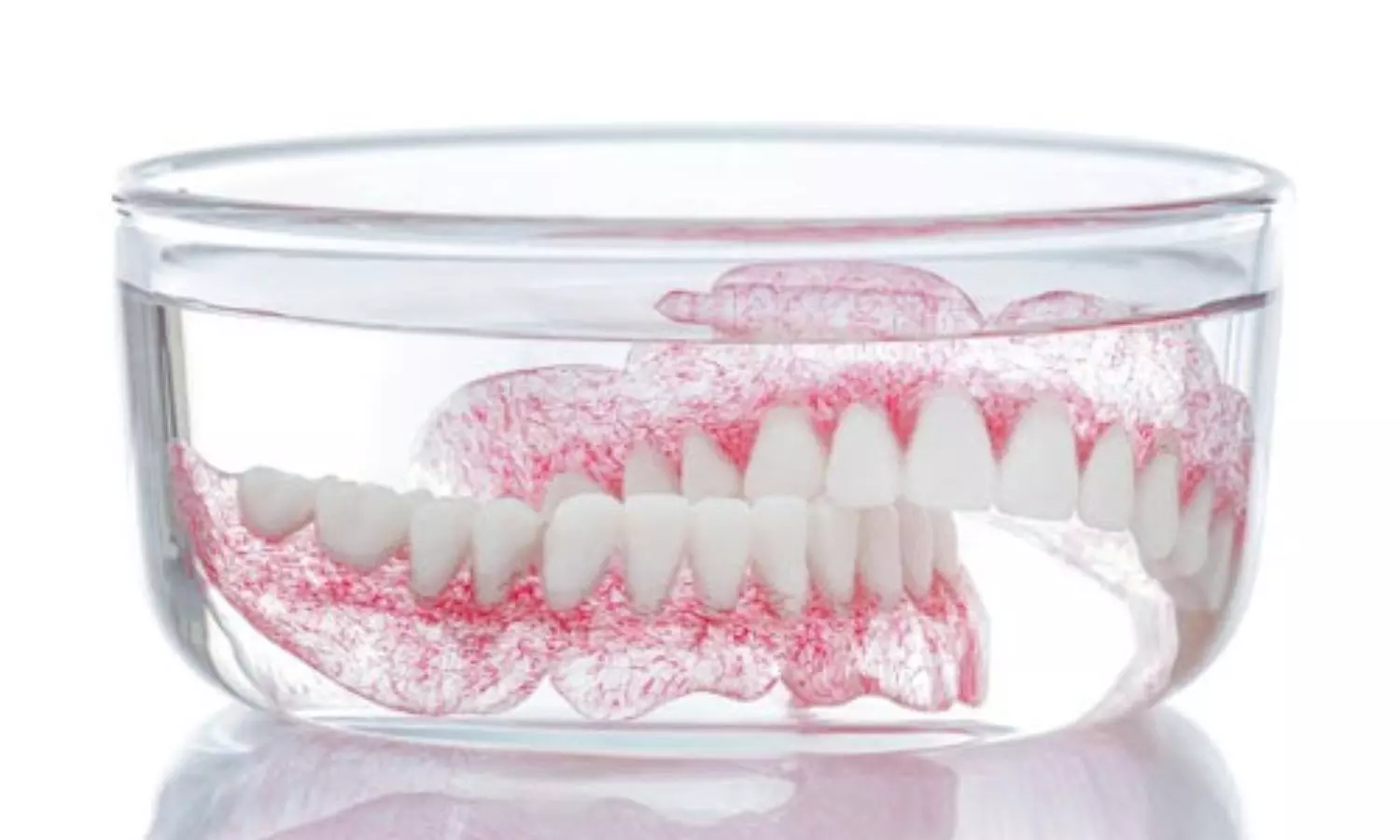
Soft denture liners used temporarily are commonly employed to enhance comfort, distribute biting forces, and support tissue healing in patients with oral mucosal issues related to dentures. However, their effectiveness is hindered by weak bonding, low rigidity, and vulnerability to fungal infections, especially by Candida albicans. Nanotechnology presents promising solutions to address these challenges. Functionalized titanium dioxide (TiO₂) nanotubes exhibit beneficial mechanical, chemical, and antimicrobial characteristics, which could make them valuable additives in denture liner materials.
By adding these nanotubes, it is possible to improve bonding, increase surface hardness, and prevent fungal proliferation. This research aims to explore the impact of functionalized TiO₂ nanotubes on the mechanical properties and antifungal attributes of temporary soft denture liners. The objective of this laboratory investigation was to assess how integrating functionalized and nonfunctionalized TiO₂ nanotubes into a temporary soft denture liner affects TBS, Shore A hardness (SAH), and antifungal activity against Candida albicans.
TiO₂ nanotubes were created, modified with methacrylic acid, and added to a tissue softener (Viscogel; Dentsply Sirona) at a concentration of 1%. Three sets were formed: a control group (without nanotubes), unmodified TiO₂ (nTiO₂), and modified TiO₂ (nTiO₂-MA). The TBS was assessed following the International Organization for Standardization (ISO) 10139–2:2016 standard using acrylic resin samples (n=10/group). Surface roughness was monitored at various time points according to the ISO 10139–1:2018 standard. The antifungal properties against C. albicans ATCC 10231 were qualitatively studied on disks prepared separately. Statistical analysis involved 1-way ANOVA for TBS and 2-way repeated-measures ANOVA for SAH data (α=.05), with further robust analyses conducted as needed.
The nTiO₂-MA group demonstrated notably higher TBS values when compared to the control group (P=.008), whereas non-modified nanotubes had no substantial impact (P=.251). All groups displayed a marked rise in SAH values as time passed (P<.001), with no significant variances among the groups (P=.247). A significant Time × Group interaction (P=.001) suggested variations in the advancement of hardness.
There was no detectable inhibitory antifungal impact against C. albicans seen in the disk-based formulations. Overall, functionalized titanium dioxide nanotubes increased the tensile bond strength without negatively impacting the short-term hardness. Nevertheless, there was no observed inhibitory antifungal impact in the given experimental circumstances.
Source:
Mutlu, G., Kara, A., Baysal, N., Oksal, B. Ş., & Alp Avcı, G. (2026). Effect of functionalized titanium dioxide nanotubes on the bond strength, hardness, and antifungal properties of an interim soft denture liner. The Journal of Prosthetic Dentistry. https://doi.org/10.1016/j.prosdent.2026.09.005