Medical Dialogues
  • Dermatology
Login Register
This site is intended for healthcare professionals only
Login Register
  • MD Brand Connect
  • Webinars
  • Vaccine Hub
  • MDTV
    • Breaking News
    • Medical News Today
    • Health News Today
    • Latest
    • Journal Club
    • Medico Legal Update
    • Latest Webinars
    • MD Shorts
    • Health Dialogues
  • Fact Check
  • Health Dialogues
Medical Dialogues
  • Medical News & Guidelines
      • Anesthesiology
      • Cardiology and CTVS
      • Critical Care
      • Dentistry
      • Dermatology
      • Diabetes and Endocrinology
      • ENT
      • Gastroenterology
      • Medicine
      • Nephrology
      • Neurology
      • Obstretics-Gynaecology
      • Oncology
      • Ophthalmology
      • Orthopaedics
      • Pediatrics-Neonatology
      • Psychiatry
      • Pulmonology
      • Radiology
      • Surgery
      • Urology
      • Laboratory Medicine
      • Diet
      • Nursing
      • Paramedical
      • Physiotherapy
  • Health news
      • Doctor News
      • Government Policies
      • Hospital & Diagnostics
      • International Health News
      • Medical Organization News
      • Medico Legal News
      • NBE News
      • NMC News
  • Fact Check
      • Bone Health Fact Check
      • Brain Health Fact Check
      • Cancer Related Fact Check
      • Child Care Fact Check
      • Dental and oral health fact check
      • Diabetes and metabolic health fact check
      • Diet and Nutrition Fact Check
      • Eye and ENT Care Fact Check
      • Fitness fact check
      • Gut health fact check
      • Heart health fact check
      • Kidney health fact check
      • Medical education fact check
      • Men's health fact check
      • Respiratory fact check
      • Skin and hair care fact check
      • Vaccine and Immunization fact check
      • Women's health fact check
  • AYUSH
    • Ayurveda
    • Homeopathy
    • Siddha
    • Unani
    • Yoga
  • State News
      • Andaman and Nicobar Islands
      • Andhra Pradesh
      • Arunachal Pradesh
      • Assam
      • Bihar
      • Chandigarh
      • Chattisgarh
      • Dadra and Nagar Haveli
      • Daman and Diu
      • Delhi
      • Goa
      • Gujarat
      • Haryana
      • Himachal Pradesh
      • Jammu & Kashmir
      • Jharkhand
      • Karnataka
      • Kerala
      • Ladakh
      • Lakshadweep
      • Madhya Pradesh
      • Maharashtra
      • Manipur
      • Meghalaya
      • Mizoram
      • Nagaland
      • Odisha
      • Puducherry
      • Punjab
      • Rajasthan
      • Sikkim
      • Tamil Nadu
      • Telangana
      • Tripura
      • Uttar Pradesh
      • Uttrakhand
      • West Bengal
  • Medical Education
      • Ayush Education News
      • Dentistry Education News
      • Medical Admission News
      • Medical Colleges News
      • Medical Courses News
      • Medical Universities News
      • Nursing education News
      • Paramedical Education News
      • Study Abroad
  • Industry
      • Health Investment News
      • Health Startup News
      • Medical Devices News
      • Pharma News
      • Pharmacy Education News
      • AI and healthcare
      • Industry Perspective
  • MDTV
      • Health Dialogues MDTV
      • Health News today MDTV
      • Latest Videos MDTV
      • Latest Webinars MDTV
      • MD shorts MDTV
      • Medical News Today MDTV
      • Medico Legal Update MDTV
      • Top Videos MDTV
      • Health Perspectives MDTV
      • Journal Club MDTV
      • Medical Dialogues Show
This site is intended for healthcare professionals only
LoginRegister
Medical Dialogues
LoginRegister
  • Home
  • Medical news & Guidelines
    • Anesthesiology
    • Cardiology and CTVS
    • Critical Care
    • Dentistry
    • Dermatology
    • Diabetes and Endocrinology
    • ENT
    • Gastroenterology
    • Medicine
    • Nephrology
    • Neurology
    • Obstretics-Gynaecology
    • Oncology
    • Ophthalmology
    • Orthopaedics
    • Pediatrics-Neonatology
    • Psychiatry
    • Pulmonology
    • Radiology
    • Surgery
    • Urology
    • Laboratory Medicine
    • Diet
    • Nursing
    • Paramedical
    • Physiotherapy
  • Health news
    • Doctor News
    • Government Policies
    • Hospital & Diagnostics
    • International Health News
    • Medical Organization News
    • Medico Legal News
    • NBE News
    • NMC News
  • Fact Check
    • Bone Health Fact Check
    • Brain Health Fact Check
    • Cancer Related Fact Check
    • Child Care Fact Check
    • Dental and oral health fact check
    • Diabetes and metabolic health fact check
    • Diet and Nutrition Fact Check
    • Eye and ENT Care Fact Check
    • Fitness fact check
    • Gut health fact check
    • Heart health fact check
    • Kidney health fact check
    • Medical education fact check
    • Men's health fact check
    • Respiratory fact check
    • Skin and hair care fact check
    • Vaccine and Immunization fact check
    • Women's health fact check
  • AYUSH
    • Ayurveda
      • Ayurveda Giuidelines
      • Ayurveda News
      • Top Ayurveda News
    • Homeopathy
      • Homeopathy Guidelines
      • Homeopathy News
    • Siddha
      • Siddha Guidelines
      • Siddha News
    • Unani
      • Unani Guidelines
      • Unani News
    • Yoga
      • Yoga Guidelines
      • Yoga News
  • State News
    • Andaman and Nicobar Islands
    • Andhra Pradesh
    • Arunachal Pradesh
    • Assam
    • Bihar
    • Chandigarh
    • Chattisgarh
    • Dadra and Nagar Haveli
    • Daman and Diu
    • Delhi
    • Goa
    • Gujarat
    • Haryana
    • Himachal Pradesh
    • Jammu & Kashmir
    • Jharkhand
    • Karnataka
    • Kerala
    • Ladakh
    • Lakshadweep
    • Madhya Pradesh
    • Maharashtra
    • Manipur
    • Meghalaya
    • Mizoram
    • Nagaland
    • Odisha
    • Puducherry
    • Punjab
    • Rajasthan
    • Sikkim
    • Tamil Nadu
    • Telangana
    • Tripura
    • Uttar Pradesh
    • Uttrakhand
    • West Bengal
  • Medical Education
    • Ayush Education News
    • Dentistry Education News
    • Medical Admission News
    • Medical Colleges News
    • Medical Courses News
    • Medical Universities News
    • Nursing education News
    • Paramedical Education News
    • Study Abroad
  • Industry
    • Health Investment News
    • Health Startup News
    • Medical Devices News
    • Pharma News
      • CDSCO (Central Drugs Standard Control Organisation) News
    • Pharmacy Education News
    • AI and healthcare
    • Industry Perspective
  • Home
  • ENT
  • ENT News
  • Why Does Nasal...

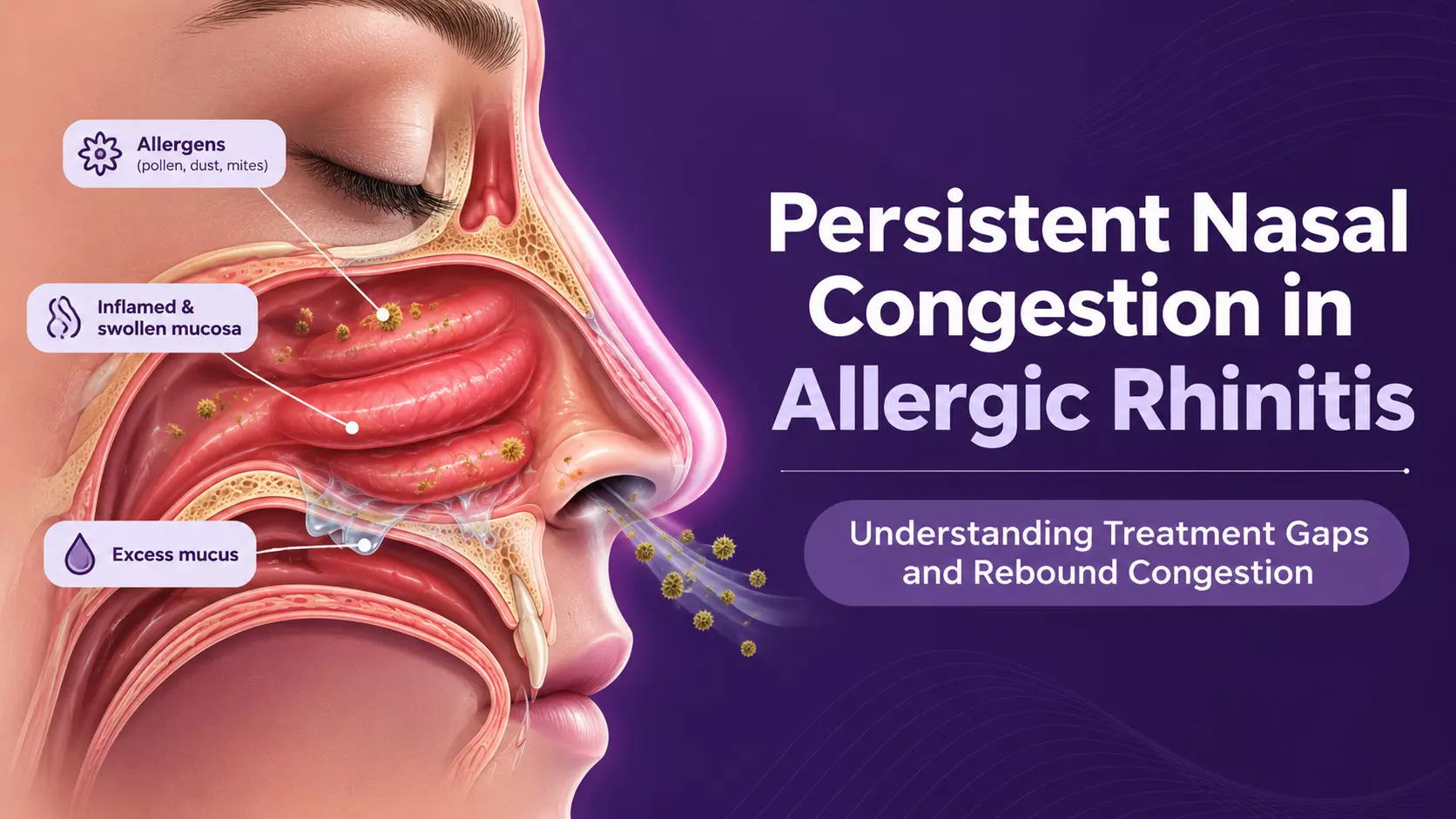
Why Does Nasal Congestion Persist Despite Allergic Rhinitis Treatment? Understanding Treatment Gaps and Rebound Congestion
Written By : Dr. Kamal Kant Kohli Published On 2026-11-21T09:51:33+05:30  |  Updated On 21 Nov 2026 9:51 AM IST
Why Does Nasal Congestion Persist Despite Allergic Rhinitis Treatment? Understanding Treatment Gaps and Rebound Congestion
  • facebook
  • twitter
  • linkedin
  • whatsapp
  • Telegram
  • Email

Among patients with allergic rhinitis (AR), very often sneezing subsides, itching improves, and rhinorrhoea becomes manageable, yet nasal congestion continues to interfere with breathing and sleep. In search of faster relief, patients may repeatedly use over-the-counter nasal decongestant sprays, sometimes without recognising that prolonged use can contribute to the very obstruction they are trying to relieve (1).

Persistent nasal congestion, therefore, warrants careful clinical evaluation to determine whether allergic inflammation remains inadequately controlled or the treatment itself is contributing to the problem. The distinction matters because managing persistent obstruction requires more than simply adding another medication. It calls for reassessing the underlying cause, reviewing existing treatment and identifying patients who may benefit from additional symptom-directed therapy. (1)

Why Does Nasal Obstruction Persist Despite Allergy Treatment?

Nasal congestion is not driven by histamine alone. Allergic inflammation involves several mediators that contribute to mucosal oedema, vascular engorgement and increased nasal airway resistance. Consequently, patients may experience improvement in sneezing, itching and rhinorrhoea with oral H1-antihistamines while continuing to report troublesome obstruction. (1)

Persistent symptoms may also reflect poor treatment adherence, incorrect intranasal spray technique, ongoing allergen exposure or coexisting conditions such as chronic rhinosinusitis, nasal polyps and structural nasal abnormalities (1). For patients with persistent AR, intranasal corticosteroids remain an important treatment option because they address the underlying inflammatory process. Combination intranasal antihistamine–corticosteroid therapy may offer additional symptom control when clinically indicated. (1,2)

However, when patients increasingly rely on rapid-acting decongestant sprays, a different problem warrants attention.

The Decongestant Trap: When Relief Intervention Leads to Rebound Nasal Congestion

Topical nasal decongestants such as oxymetazoline and xylometazoline provide rapid relief by constricting blood vessels in the nasal mucosa (1,3). Their immediate effect can make them particularly appealing to patients struggling with persistent blockage (1). However, repeated or prolonged use may lead to rhinitis medicamentosa, a form of drug-induced rhinitis characterised by rebound nasal congestion (1,3). Patients may initially experience satisfactory relief, but over time, congestion can return as the medication's effect diminishes (1). This may encourage more frequent administration, creating a cycle of recurrent obstruction and repeated spray use (1,3).

The International Consensus Statement on Allergy and Rhinology (ICAR-AR 2023) recognises rhinitis medicamentosa as a complication of prolonged topical decongestant use. Although the precise exposure threshold remains uncertain, rebound effects have been reported after only a few days, and chronic use is discouraged. (1) Importantly, rhinitis medicamentosa may coexist with allergic rhinitis, making it difficult to distinguish uncontrolled allergy from medication-related obstruction without a careful treatment history (1,3).

Recognising and Breaking the Cycle of Nasal Congestion

Persistent nasal obstruction in a patient frequently using topical decongestants should prompt clinicians to assess the duration and frequency of spray use (1,3). Management primarily involves discontinuing the offending decongestant while addressing underlying nasal inflammation. Patients should be counselled that congestion may temporarily worsen during withdrawal. Intranasal corticosteroids are commonly used to help manage rebound symptoms, while saline irrigation may provide supportive relief. Treatment should also address any underlying allergic or anatomical contributors that initially prompted decongestant use. (1,3)

Beyond Topical Sprays: The Role of Oral Fexofenadine–Pseudoephedrine

In selected patients with allergic rhinitis, troublesome congestion may coexist with sneezing, itching and rhinorrhoea, creating a need to address both inflammatory symptoms and nasal obstruction (1,4).

Fexofenadine, a second-generation H1-antihistamine, helps control histamine-mediated allergic symptoms, while pseudoephedrine acts as an oral sympathomimetic decongestant, reducing nasal mucosal swelling through vasoconstriction (4,5,6). Clinical evidence has demonstrated a rapid onset of action with the fexofenadine–pseudoephedrine combination, with improvements in nasal airflow observed as early as 30 minutes and patient-reported relief of nasal obstruction beginning at 60 minutes (7).

Fexofenadine and Pseudoephedrine: Clinical Evidence Examining Complementary Effects

In a randomised, double-blind study involving 651 patients with seasonal allergic rhinitis, Sussman and colleagues evaluated fexofenadine hydrochloride 60 mg and sustained-release pseudoephedrine hydrochloride 120 mg, administered alone or in combination twice daily. The combination demonstrated significantly greater improvement in nasal congestion than fexofenadine monotherapy, while providing better relief of histamine-mediated symptoms than pseudoephedrine alone. (4) These findings suggest that fexofenadine–pseudoephedrine may provide more effective symptomatic relief when both antihistaminic and decongestant effects are required.

However, oral decongestants are not intended for routine long-term management. The 2026 ARIA-EAACI guidance retains earlier recommendations against regular use of oral antihistamine- decongestant combinations (5).

Pseudoephedrine also requires appropriate patient selection because of potential cardiovascular and central nervous system adverse effects. It is contraindicated in certain conditions, including severe hypertension and severe coronary artery disease, and requires caution in patients with other related comorbidities. (6)

Individualised Approach to Persistent Nasal Congestion Requires Clinician’s Acumen

Persistent nasal congestion does not always indicate inadequate antihistamine efficacy. It may reflect uncontrolled allergic inflammation, coexisting nasal disease or rebound congestion associated with topical decongestant overuse (1,3). For clinicians, distinguishing these possibilities is essential to avoiding unnecessary treatment escalation. While fexofenadine–pseudoephedrine may have a role in short-term symptom management for appropriately selected patients (4,5,6), sustained control depends on treating underlying inflammation, recognising decongestant overuse and individualising therapy according to clinical need and safety considerations (1,2,3,5).

Key Points

  • Persistent nasal congestion in allergic rhinitis may result from uncontrolled inflammation, coexisting nasal conditions or medication overuse, highlighting the need for careful clinical evaluation.
  • Prolonged use of topical nasal decongestants may cause rhinitis medicamentosa, leading to rebound congestion. Management involves discontinuing the offending spray and addressing underlying inflammation.
  • Fexofenadine–pseudoephedrine may provide short-term relief of allergic symptoms and nasal obstruction in selected patients with allergic rhinitis.


References:
  • 1.Wise SK, Damask C, Roland LT, Ebert C, Levy JM, Lin SY, et al.2023. International consensus statement on allergy and rhinology: allergic rhinitis-2023.Int Forum Allergy Rhinol.13293-859
  • 2.Sousa-Pinto B, Bousquet J, Vieira RJ, et al.2026. Allergic Rhinitis and Its Impact on Asthma (ARIA)-EAACI Guidelines-2024-2025 Revision: Part I-Guidelines on intranasal treatments.Allergy81954-976
  • 3.Dykewicz MS, Wallace DV, Amrol DJ, Baroody FM, Bernstein JA, Craig TJ, et al.2020. Rhinitis 2020: a practice parameter update.J Allergy Clin Immunol.146721-767
  • 4.Sussman GL, Mason J, Compton D, Stewart J, Ricard N. 1999. The efficacy and safety of fexofenadine HCl and pseudoephedrine, alone and in combination, in seasonal allergic rhinitis.J Allergy Clin Immunol.104100-106
  • 5.Vieira RJ, Sousa-Pinto B, Bousquet J, et al.2026. Allergic Rhinitis and Its Impact on Asthma (ARIA)-EAACI Guidelines-2024-2025 Revision: Part II-Guidelines on oral and ocular treatments.Allergy
  • 6. Sanofi. Allegra D (fexofenadine hydrochloride and pseudoephedrine hydrochloride): prescribing information. India.
  • 7.Nakamura Y, Yokoyama Y, Koyama S, Fujiwara K, Nakamori M, Fujii T, et al.2024. Effect of fexofenadine/pseudoephedrine combination tablet on nasal obstruction in patients with allergic rhinitis using rhinomanometry: A randomized controlled trial.Asian Pac J Allergy Immunol.42147-153

Medical Survey

Dr. Kamal Kant Kohli

Dr Kamal Kant Kohli-MBBS, DTCD- a chest specialist with more than 30 years of practice and a flair for writing clinical articles, Dr Kamal Kant Kohli joined Medical Dialogues as a Chief Editor of Medical News. Besides writing articles, as an editor, he proofreads and verifies all the medical content published on Medical Dialogues including those coming from journals, studies,medical conferences,guidelines etc. Email: drkohli@medicaldialogues.in. Contact no. 011-43720751

Print Article
Show Full Article
Next Story
Recommended For You
NO DATA FOUND

Editorial

Why Does Nasal Congestion Persist Despite Allergic Rhinitis Treatment? Understanding Treatment Gaps and Rebound Congestion

Why Does Nasal Congestion Persist Despite Allergic Rhinitis Treatment? Understanding Treatment Gaps...

Dapagliflozin Metformin in T2D: Five Evidence Insights Relevant for Clinicians

Dapagliflozin Metformin in T2D: Five Evidence Insights Relevant for Clinicians

Jural Exploitation of Healthcare Professionals and Institutions in the PM-RAHAT Scheme - Dr Rajeev Joshi

Jural Exploitation of Healthcare Professionals and Institutions in the PM-RAHAT Scheme - Dr Rajeev...

Metformin - Eight Points on a Metabolic Anchor in T2D: World Diabetes Day Special

Metformin - Eight Points on a Metabolic Anchor in T2D: World Diabetes Day Special

Clinical Insights for Allergic Rhinitis Management with Fexofenadine and Pseudoephedrine Combination - Dr. Makarand Damle

Clinical Insights for Allergic Rhinitis Management with Fexofenadine and Pseudoephedrine Combination...

View All

Journal Club Today

Sun Pharma Introduces Cognitgrey, a Nutritional Supplement for Childrens Cognitive Development

Sun Pharma Introduces Cognitgrey, a Nutritional Supplement for Children's Cognitive Development

View All
© 2022 All Rights Reserved.
Powered By: Hocalwire
X
We use cookies for analytics, advertising and to improve our site. You agree to our use of cookies by continuing to use our site. To know more, see our Cookie Policy and Cookie Settings.Ok
