Resin Composites with S-PRG fillers may increase surrounding PH: Study
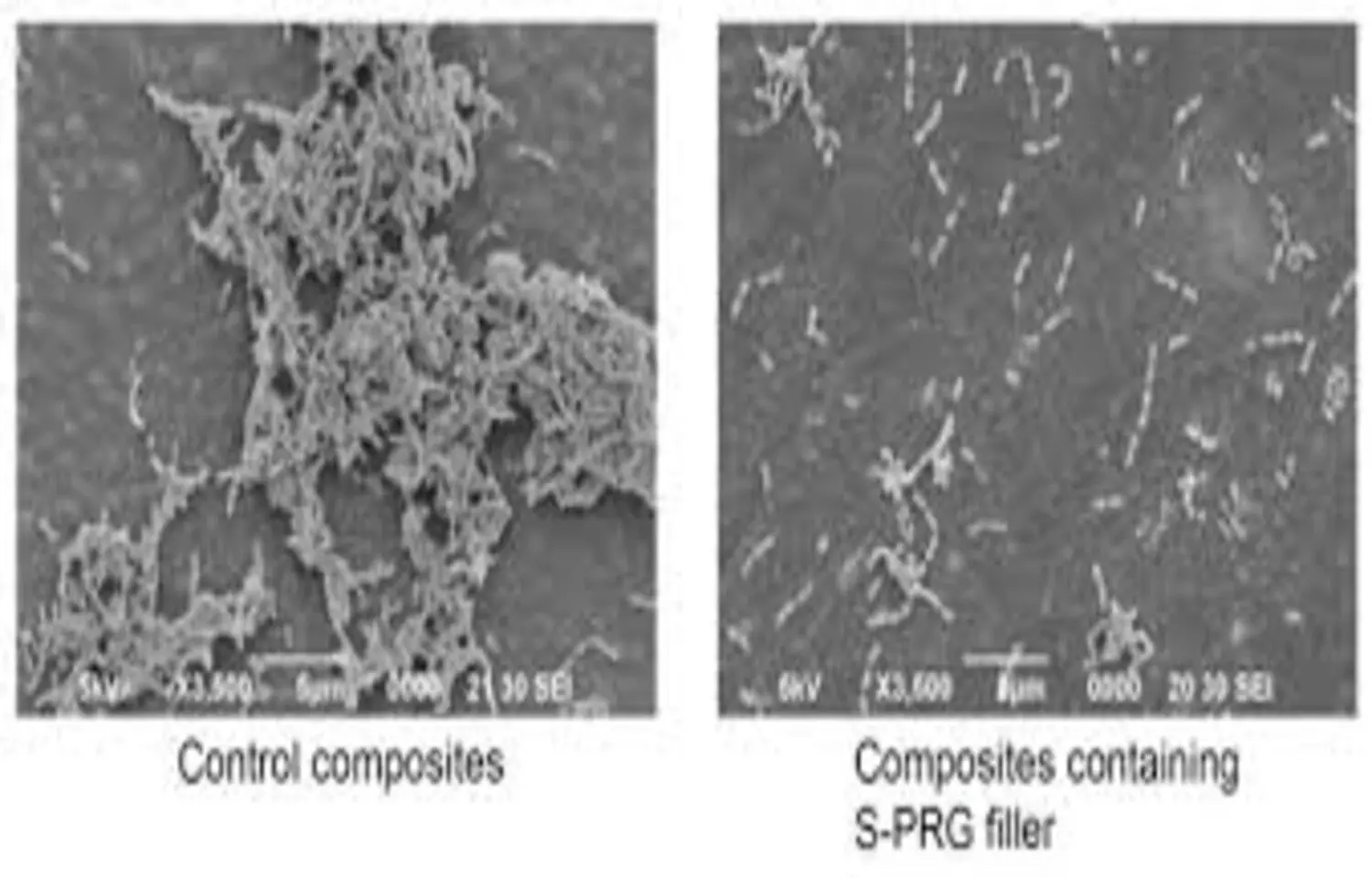


Researchers have found in a new study that resin composites with S-PRG fillers caused a slight, time-dependent increase in the surrounding pH. After erosive and abrasive challenges, surface roughness increased, but the gloss of S-PRG–containing composites showed improvement despite the rougher surface.
Composite resins containing S-PRG fillers may degrade under pH fluctuations and abrasion, influenced by their composition, particle size, exposure time, and solution acidity.
Objective: This study evaluated the ability of resin composites containing S-PRG fillers to modulate the pH of the surrounding medium, as well as their surface roughness and gloss following an erosive/abrasive challenge. Methodology: Resin disks (⌀4mm × 2mm) (n=15) were prepared using Filtek Z350 XT (control), Beautifil II, Beautifil II Enamel, and Beautifil II LS (the latter three containing S-PRG fillers). To assess buffering capacity, disks (n=5) were immersed in a demineralizing solution, and pH was measured at baseline and after 1, 3, 7, 14, and 21 days. Separate specimens (n=10) underwent daily erosion cycles using 0.3% citric acid, combined with abrasion via toothbrushing, conducted over a 5-day period to simulate an acidic diet and twice-daily oral hygiene. Surface roughness (Ra) and gloss (GU) were assessed at baseline, after polishing, and following the challenge; surface topography was analyzed by a scanning electron microscope (SEM).
Data were analyzed using a generalized linear mixed model for repeated measures over time, in addition to Tukey–Kramer, Kruskal–Wallis, Dunn, Friedman, and Nemenyi tests (α=0.05). Results: All materials showed a significant increase in the pH of the surrounding medium over time (p<0.05). After 24 hours, Beautifil II exhibited a significantly higher pH than the others (p<0.05). Filtek Z350 XT demonstrated lower surface roughness than the other materials after the erosive/abrasive challenge (p<0.0001). Following the challenge, Beautifil II and Beautifil II Enamel presented higher gloss values (p<0.05). Conclusions: Resin composites containing S-PRG fillers slightly increased the pH of the surrounding medium over time. Surface roughness increased after the erosive/abrasive challenge, although the gloss of the S-PRG-containing composites also improved.
Reference:
Oliveira Neto, C. A. C. de, Dal Picolo, M. Z., do Amaral, F. L., Torres, C. R. G., Kantovitz, K. R., Attin, T., & Basting, R. T. (2025). Resin composites containing S-PRG fillers: Effects on pH modulation of the surrounding medium, surface roughness, and gloss following erosive/abrasive challenge. Journal of Applied Oral Science, 33, e20250365. https://doi.org/10.1590/1678-7757-2025-0365