
- Home
- Medical news & Guidelines
- Anesthesiology
- Cardiology and CTVS
- Critical Care
- Dentistry
- Dermatology
- Diabetes and Endocrinology
- ENT
- Gastroenterology
- Medicine
- Nephrology
- Neurology
- Obstretics-Gynaecology
- Oncology
- Ophthalmology
- Orthopaedics
- Pediatrics-Neonatology
- Psychiatry
- Pulmonology
- Radiology
- Surgery
- Urology
- Laboratory Medicine
- Diet
- Nursing
- Paramedical
- Physiotherapy
- Health news
- Fact Check
- Bone Health Fact Check
- Brain Health Fact Check
- Cancer Related Fact Check
- Child Care Fact Check
- Dental and oral health fact check
- Diabetes and metabolic health fact check
- Diet and Nutrition Fact Check
- Eye and ENT Care Fact Check
- Fitness fact check
- Gut health fact check
- Heart health fact check
- Kidney health fact check
- Medical education fact check
- Men's health fact check
- Respiratory fact check
- Skin and hair care fact check
- Vaccine and Immunization fact check
- Women's health fact check
- AYUSH
- State News
- Andaman and Nicobar Islands
- Andhra Pradesh
- Arunachal Pradesh
- Assam
- Bihar
- Chandigarh
- Chattisgarh
- Dadra and Nagar Haveli
- Daman and Diu
- Delhi
- Goa
- Gujarat
- Haryana
- Himachal Pradesh
- Jammu & Kashmir
- Jharkhand
- Karnataka
- Kerala
- Ladakh
- Lakshadweep
- Madhya Pradesh
- Maharashtra
- Manipur
- Meghalaya
- Mizoram
- Nagaland
- Odisha
- Puducherry
- Punjab
- Rajasthan
- Sikkim
- Tamil Nadu
- Telangana
- Tripura
- Uttar Pradesh
- Uttrakhand
- West Bengal
- Medical Education
- Industry
Root Canal Treatment Significantly Improves Oral Health-Related Quality of Life: Study
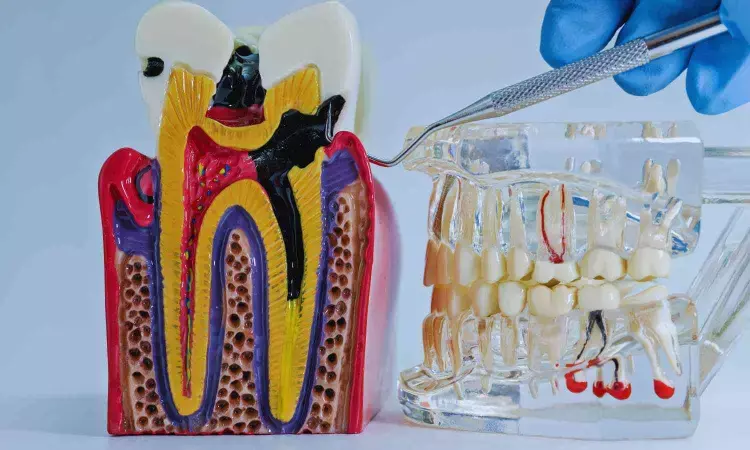
Researchers have found in a new study that an RCT showed moderate to large improvements in all OHIP-14 domains after root canal treatment (RCT). Before treatment, factors such as female gender, mixed race or Afro-descendant background, and extensive crown destruction were associated with poorer oral health–related quality of life.
The objective of this study was to assess the impact of root canal treatment (RCT) in single-rooted teeth with asymptomatic apical periodontitis on oral health-related quality of life (OHRQoL). As a secondary objective, the impact of factors such as age, gender, ethnicity, tooth groups, arch position, crown destruction, postoperative pain, edema, and use of analgesics after procedure were also noted. A prospective cohort study was designed and enrolled in a sample of 105 patients who needed root canal treatment in single-rooted maxillary or mandibular teeth with asymptomatic apical periodontitis, without preoperative symptoms.
RCT was performed in one session. The impact of the OHRQoL was recorded using the Oral Health Impact Profile (OHIP-14) at baseline and after seven and 30 days. Predictor variables were also collected: age, gender, ethnicity, tooth groups, arch position, destruction of the crown, postoperative pain, edema, and the use of analgesics. Data were tabulated and analyzed in SPSS software, with alpha value set at 0.05. All domains of the OHIP-14 questionnaire revealed a statistically significant difference between the times evaluated (p < 0.001), showing the positive impact of the RCT on OHRQoL, with moderate and large effects.
There was a significant difference in the total score for gender (p = 0.001), ethnicity (p = 0.010), and crown destruction (p = 0.002). RCT improved OHRQoL scores in all domains assessed by OHIP-14, with moderate and large effects. Factors such as female gender, mixed race and afrodescendant participants, and extensive crown destruction negatively influenced the OHRQoL of patients pre-RCT.
Guimarães, L. S., & da Silva, E. A. B. (2025). Impact of root canal treatment on oral health-related quality of life: a prospective cohort study. Brazilian Oral Research, 39, e126. https://doi.org/10.1590/1807-3107bor-2025.vol39.126

Dr. Shravani Dali has completed her BDS from Pravara institute of medical sciences, loni. Following which she extensively worked in the healthcare sector for 2+ years. She has been actively involved in writing blogs in field of health and wellness. Currently she is pursuing her Masters of public health-health administration from Tata institute of social sciences. She can be contacted at editorial@medicaldialogues.in.
Dr Kamal Kant Kohli-MBBS, DTCD- a chest specialist with more than 30 years of practice and a flair for writing clinical articles, Dr Kamal Kant Kohli joined Medical Dialogues as a Chief Editor of Medical News. Besides writing articles, as an editor, he proofreads and verifies all the medical content published on Medical Dialogues including those coming from journals, studies,medical conferences,guidelines etc. Email: drkohli@medicaldialogues.in. Contact no. 011-43720751

