Diabetes Increases the Risk of Multiple Nerve Entrapment Disorders: Study
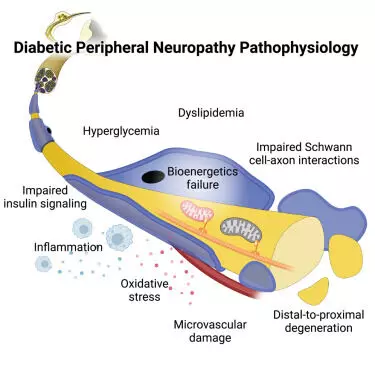


Researchers have found in a new study that Diabetes is associated with an increased risk of developing multiple anatomically distinct nerve entrapment syndromes, suggesting a generalized vulnerability of peripheral nerves in individuals with diabetes. The association appears to be particularly strong in younger adults with diabetes, identifying them as a potentially high-risk subgroup that may benefit from enhanced clinical surveillance and early recognition of nerve compression disorders.
Entrapment neuropathies are common peripheral nerve disorders where a swollen nerve is compressed at tight transition points along its course. This compression results in pain, loss of function and large healthcare and societal costs. Carpal tunnel syndrome (CTS) is the most prevalent and extensively studied neuropathy. A study was done to evaluate the association between diabetes and four peripheral nerve entrapment syndromes: carpal tunnel syndrome (CTS), ulnar nerve entrapment (UNE), radial nerve entrapment (RNE), and tarsal tunnel syndrome (TTS).
This retrospective cohort study used the Merative™ MarketScan® Commercial Database (2007–2023). Adults ≥18 years were classified as having diabetes or serving as controls. Incident-only cohorts excluded individuals with prior diagnoses during a washout period. Propensity score matching (1:1, sex-stratified) reduced confounding, and Cox proportional hazards regression estimated time to incident diagnosis.
After matching, cohort sizes ranged from 6.5 to 6.8 million individuals. Diabetes was significantly associated with increased risk of all four entrapment neuropathies. The strongest associations were observed in adults younger than 40 years with CTS and TTS.
Diabetes is associated with increased risk across multiple anatomically distinct nerve entrapments, supporting generalized nerve vulnerability. Younger adults with diabetes may represent a high-risk subgroup warranting enhanced clinical surveillance.
Reference:
Mattias Rydberg, Devi Lakhlani, Brian Jonathan Sutjiadi, Paige M. Fox, Catherine Curtin,
Diabetes and the risk of entrapment neuropathies of the upper and lower extremity - A propensity score-matched cohort study, Journal of Diabetes and its Complications,
2026, 109364, ISSN 1056-8727, https://doi.org/10.1016/j.jdiacomp.2026.109364.
(https://www.sciencedirect.com/science/article/pii/S1056872726001091)
Keywords:
Carpal tunnel syndrome, Complications, Entrapment neuropathy, Radial nerve entrapment, Tarsal tunnel syndrome, Ulnar nerve entrapment, Rydberg, Devi Lakhlani, Brian Jonathan Sutjiadi, Paige M. Fox, Catherine Curtin