
Noninvasive Glucose Monitor Shows Accuracy Comparable to Needle-Based CGMs: Study
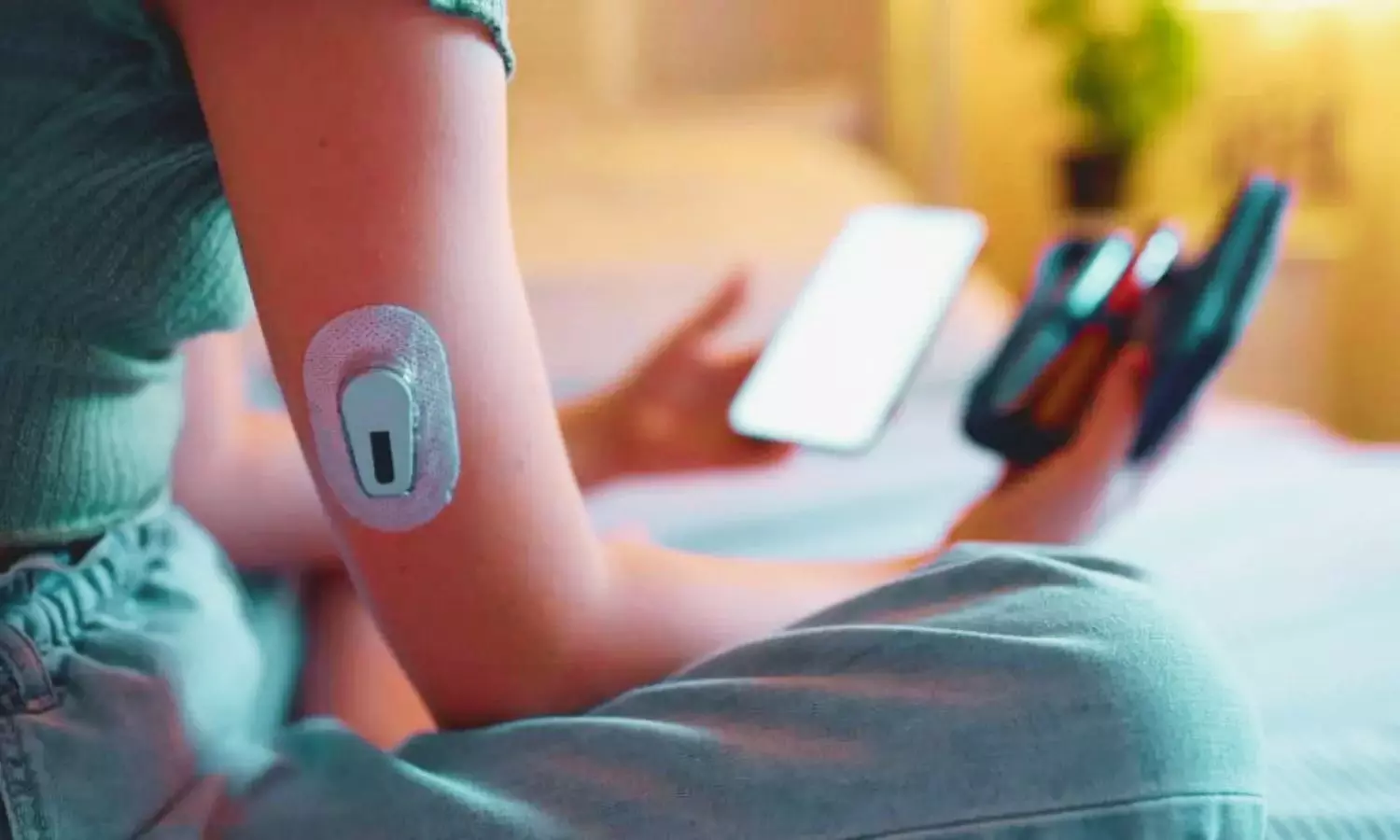


USA: A noninvasive continuous glucose monitoring (CGM) device developed by MIT and Apollon demonstrated accuracy comparable to leading needle-based CGMs in a study published in the Journal of Diabetes Science and Technology. Using band-pass Raman spectroscopy to measure glucose levels without skin insertion or consumables, the device achieved a mean absolute relative difference (MARD) of 11.3% and an agreement rate of 87.35%, highlighting its potential as a painless alternative for continuous glucose monitoring. The study was conducted by Arianna Bresci and colleagues.
While CGM has improved diabetes management, most current systems require sensors to be inserted under the skin, which can cause discomfort and require regular replacement. To overcome these challenges, researchers developed a portable, noninvasive CGM device based on transdermal band-pass Raman (BPR) spectroscopy, which measures glucose-related molecular signals through the skin.
Unlike conventional Raman systems that rely on complex full-spectrum analysis, the BPR-CGM targets three glucose-specific Raman bands, enabling accurate glucose tracking with simpler and more compact hardware. This approach reduces cost and complexity while maintaining sensitivity, making it suitable for point-of-care applications and future wearable devices.
The technology was evaluated in a clinical study involving six healthy participants undergoing a standard oral glucose tolerance test. Glucose measurements from the BPR-CGM were compared with those from a conventional blood glucometer and two commercially available needle-based CGM systems.
The following were the key findings:
- Glucose trends measured by the noninvasive BPR-CGM closely matched reference blood glucose values during the oral glucose tolerance test.
- The device accurately tracked glucose changes without requiring algorithmic lag compensation.
- The BPR-CGM achieved a mean absolute relative difference (MARD) of 11.34 ± 1.96%.
- The accuracy of the BPR-CGM was statistically comparable to that of two commercially available needle-based CGM systems, which recorded MARD values of 10.42 ± 2.46% and 12.93 ± 4.69%, respectively.
- All glucose readings generated by the BPR-CGM fell within the clinically acceptable Zones A and B of the Parkes Consensus Error Grid.
- The findings indicate that BPR-CGM measurements are suitable for clinical decision-making.
- No adverse skin reactions were observed during the study.
- No device-related safety concerns were reported.
The researchers noted that the study was conducted in a small group of individuals without diabetes and over a relatively limited range of glucose fluctuations. As a result, larger studies involving people with diabetes, broader glucose ranges, and more diverse skin types will be necessary to confirm the technology's performance across real-world settings.
Overall, the findings demonstrate that band-pass Raman spectroscopy can provide accurate, reproducible, and completely noninvasive glucose monitoring using compact optical hardware. The authors believe that continued advances in calibration methods, miniaturization, low-power laser systems, and integrated photodetection could help transform the technology into a wearable, needle-free CGM solution for routine diabetes management.
Reference:
Bresci, A., Kim, Y., Jue, M., Foglia, L. P., Moores, E., C. So, P. T., & Kang, J. W. Clinical Validation on Healthy Humans of a Portable Non-invasive Continuous Glucose Monitor Based on Transdermal Band-Pass Raman Spectroscopy. Journal of Diabetes Science and Technology. https://doi.org/10.1177/19322968261445056

Next Story