Hyponatremia at Thiazide Initiation Linked to Increased Mortality Risk: Study


A new study has revealed that patients who develop hyponatremia soon after starting thiazide diuretics face a higher risk of death later.
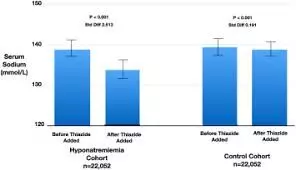
There are likely over 42 million patients with hypertension taking thiazides in the United States and many more worldwide. Hyponatremia is a common complication of thiazide therapy. It is not currently known if thiazide-associated hyponatremia is also associated with increased mortality. The objective of this study was to determine if outpatients who start thiazide diuretic treatment and develop early hyponatremia are at increased risk of mortality when compared with those who do not develop hyponatremia after starting a thiazide. This study used data from the TriNetX federated health research network comprising deidentified electronic medical records of ∼93 million patients from 76 health care organizations located primarily in the United States. The study population was adult patients 40-90 years old, with essential hypertension and who started on a thiazide diuretic between January 1, 2010, and December 31, 2021. The patients were then subdivided into a hyponatremia cohort and a control cohort. 22,057 patients met the inclusion criteria for the hyponatremia cohort, and 234,466 patients met the inclusion criteria for the control cohort. After propensity score matching, 22,052 remained in both cohorts. The primary outcome is one-year mortality. The hyponatremia cohort developed early hyponatremia defined as a serum sodium≤135mmol/L within 6 months after initiation of thiazide versus a control that had a serum sodium 136-144mmol/L after initiation of thiazide. Primary outcome is mortality. Secondary outcomes include development of sepsis, pneumonia, urinary tract infection, cellulitis, myocardial infarction, stroke, congestive heart failure, ataxia, fall, and hip fracture. The design is a retrospective cohort study, propensity score matched. Results: Patients in the hyponatremia cohort had a higher hazard of mortality than patients in control, HR 1.96 (95% CI, 1.72-2.28; P<0.001). In addition, patients in the hyponatremia cohort had higher hazard of developing sepsis, pneumonia, urinary tract infection, cellulitis, myocardial infarction, stroke, congestive heart failure, ataxia, and hip fracture. Patients who develop early hyponatremia (serum sodium≤135mmol/L) following initiation of a thiazide diuretic have a higher risk of mortality when compared with those who do not develop hyponatremia after initiation of a thiazide diuretic.
Reference:
Thiazide-Associated Hyponatremia and Mortality Risk: A Cohort Study Achinger, Steven G. et al. Kidney Medicine, Volume 7, Issue 2, 100941
Keywords:
Hyponatremia, Thiazide, Initiation, Linked, Increased, Mortality, Risk, Study, Hyponatremia, thlazide diuretics, mortality, sodium