
- Home
- Medical news & Guidelines
- Anesthesiology
- Cardiology and CTVS
- Critical Care
- Dentistry
- Dermatology
- Diabetes and Endocrinology
- ENT
- Gastroenterology
- Medicine
- Nephrology
- Neurology
- Obstretics-Gynaecology
- Oncology
- Ophthalmology
- Orthopaedics
- Pediatrics-Neonatology
- Psychiatry
- Pulmonology
- Radiology
- Surgery
- Urology
- Laboratory Medicine
- Diet
- Nursing
- Paramedical
- Physiotherapy
- Health news
- Fact Check
- Bone Health Fact Check
- Brain Health Fact Check
- Cancer Related Fact Check
- Child Care Fact Check
- Dental and oral health fact check
- Diabetes and metabolic health fact check
- Diet and Nutrition Fact Check
- Eye and ENT Care Fact Check
- Fitness fact check
- Gut health fact check
- Heart health fact check
- Kidney health fact check
- Medical education fact check
- Men's health fact check
- Respiratory fact check
- Skin and hair care fact check
- Vaccine and Immunization fact check
- Women's health fact check
- AYUSH
- State News
- Andaman and Nicobar Islands
- Andhra Pradesh
- Arunachal Pradesh
- Assam
- Bihar
- Chandigarh
- Chattisgarh
- Dadra and Nagar Haveli
- Daman and Diu
- Delhi
- Goa
- Gujarat
- Haryana
- Himachal Pradesh
- Jammu & Kashmir
- Jharkhand
- Karnataka
- Kerala
- Ladakh
- Lakshadweep
- Madhya Pradesh
- Maharashtra
- Manipur
- Meghalaya
- Mizoram
- Nagaland
- Odisha
- Puducherry
- Punjab
- Rajasthan
- Sikkim
- Tamil Nadu
- Telangana
- Tripura
- Uttar Pradesh
- Uttrakhand
- West Bengal
- Medical Education
- Industry
AHA Updates Emergency Department Guidelines for Acute Migraine Treatment
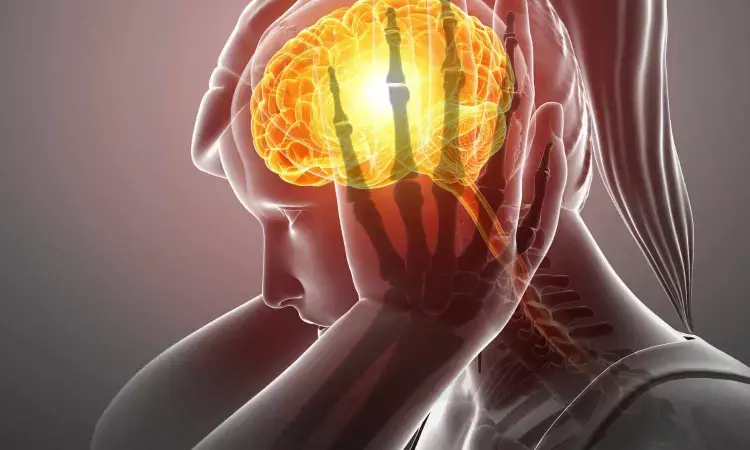
USA: The American Headache Association has updated its guidelines for managing migraine in the emergency department. The strongest evidence supports the use of intravenous prochlorperazine and greater occipital nerve blocks as effective treatments for acute migraine, according to recommendations published in Headache: The Journal of Head and Face Pain.
The updated 2025 guideline represents a major revision of the American Headache Society’s 2016 recommendations and reflects nearly a decade of new clinical trial evidence. The evidence assessment was led by Jennifer Robblee from the Department of Neurology, Lewis Headache Clinic, Barrow Neurological Institute, Dignity Health, Phoenix, along with a multidisciplinary panel of headache neurologists and emergency medicine specialists. The update aims to standardize and improve acute migraine care in emergency departments (EDs), where treatment approaches often vary widely.
Migraine remains one of the most common neurological reasons for ED visits, yet many patients receive therapies that are either unsupported by evidence or associated with unnecessary risks. To address this, the guideline authors conducted a comprehensive systematic review and meta-analysis using the same rigorous methodology as the 2016 guideline, while expanding the scope to include nerve blocks and sphenopalatine ganglion (SPG) blocks. Major databases, including Medline, Embase, Cochrane, ClinicalTrials.gov, and the WHO International Clinical Trials Registry Platform, were searched through February 10, 2025.
The review identified 26 new randomized controlled trials evaluating 20 injectable or procedural treatments for adults presenting to the ED with migraine. Study quality was assessed using American Academy of Neurology criteria, and interventions were categorized based on the likelihood of effectiveness. Clinical recommendations were then graded using the AAN guideline development framework.
A key shift in the 2025 update is the introduction of level A “must offer” and “must not offer” recommendations—categories that were absent in the earlier guideline. Intravenous prochlorperazine and greater occipital nerve blocks emerged as the only therapies with the highest level of supporting evidence and are now recommended as first-line parenteral options for eligible patients without contraindications. In contrast, intravenous hydromorphone received a level A “must not offer” designation due to consistent evidence showing poor efficacy and potential harm.
The guideline also reclassifies several commonly used treatments. Non-opioid options such as dexketoprofen, ketorolac, metoclopramide, and subcutaneous sumatriptan were upgraded to stronger recommendations, while intravenous paracetamol (acetaminophen) was downgraded and is no longer recommended for migraine-related pain relief in the ED.
Although newer agents such as the CGRP monoclonal antibody eptinezumab show promise, the authors caution that most supporting data come from outpatient settings. As a result, eptinezumab received a conditional recommendation limited to patients closely matching clinical trial populations, with no general ED-specific endorsement.
Key takeaways from the 2025 guideline update include:
- Level A – Must offer:
- Intravenous prochlorperazine
- Greater occipital nerve blocks
- Level B – Should offer when appropriate:
- Intravenous dexketoprofen
- Intravenous ketorolac
- Intravenous metoclopramide
- Subcutaneous sumatriptan
- Supraorbital nerve blocks
- Level C – May offer:
- Intravenous chlorpromazine
- Intravenous dexamethasone
- Intravenous valproate
- Not recommended:
- Intravenous paracetamol (level C – should not offer)
- Intravenous hydromorphone (level A – must not offer)
- Insufficient evidence (level U):
- Caffeine, ketamine, lidocaine, magnesium, propofol, SPG blocks, and several other agents

The authors highlight ongoing gaps in evidence, including the lack of large, ED-specific trials, inconsistent outcome measures, and limited data on combination therapies commonly used in practice. They call for future research aligned with International Headache Society recommendations, emphasizing earlier outcome time points and better representation of diverse patient populations.
Overall, the updated guideline provides clearer, evidence-based direction for emergency clinicians and reinforces a move away from opioids toward safer, more effective therapies for acute migraine management in the emergency department.
Reference:
Robblee, J., Minen, M. T., Friedman, B. W., Cortel-LeBlanc, M. A., Cortel-LeBlanc, A., & Orr, S. L. 2025 guideline update to acute treatment of migraine for adults in the emergency department: The American Headache Society evidence assessment of parenteral pharmacotherapies. Headache: The Journal of Head and Face Pain. https://doi.org/10.1111/head.70016
Dr Kamal Kant Kohli-MBBS, DTCD- a chest specialist with more than 30 years of practice and a flair for writing clinical articles, Dr Kamal Kant Kohli joined Medical Dialogues as a Chief Editor of Medical News. Besides writing articles, as an editor, he proofreads and verifies all the medical content published on Medical Dialogues including those coming from journals, studies,medical conferences,guidelines etc. Email: drkohli@medicaldialogues.in. Contact no. 011-43720751

