
Rajnath Singh inaugurates India's first military medicine dept at Command Hospital Lucknow
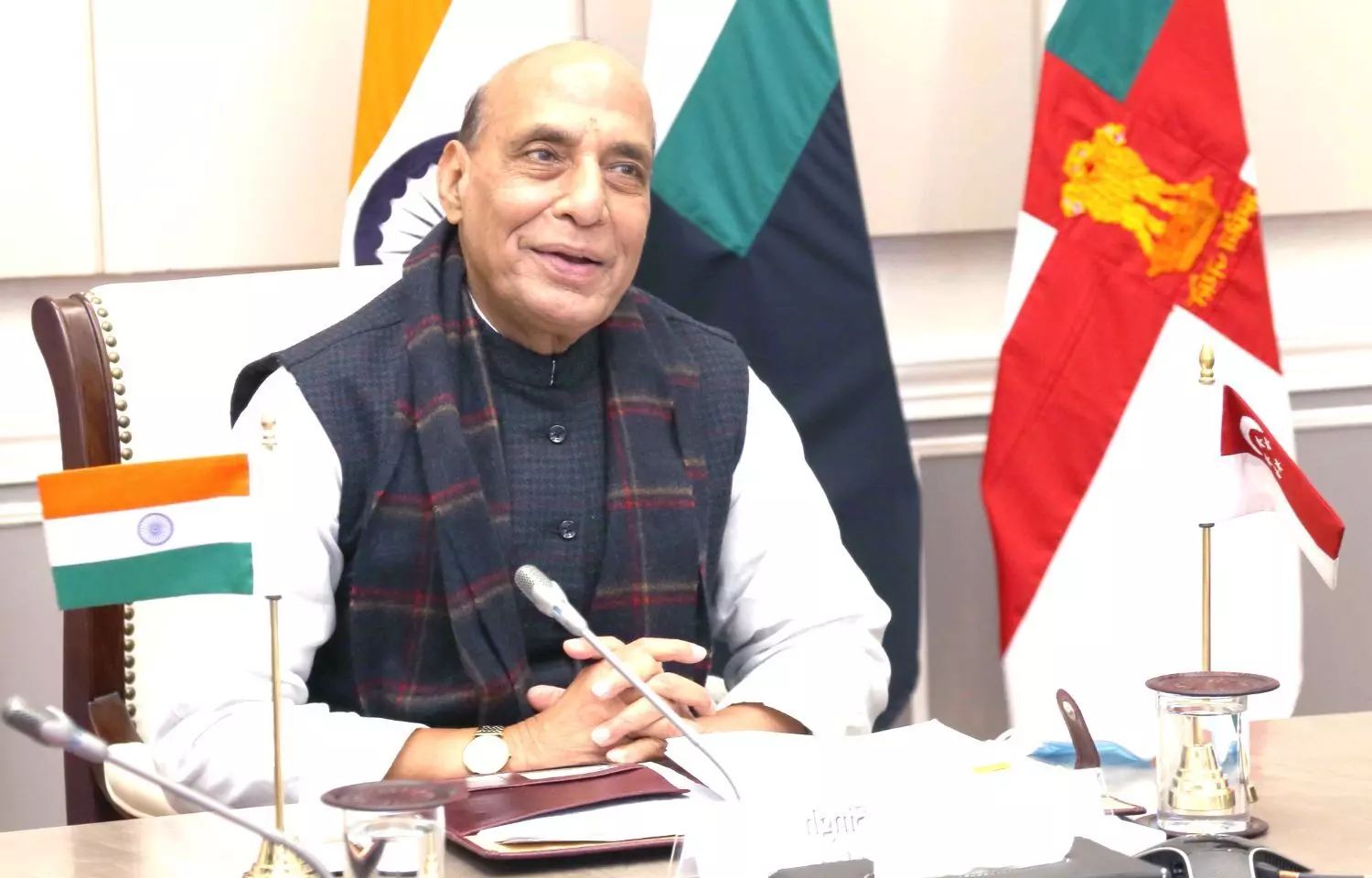


New Delhi: Defence Minister Rajnath Singh on Wednesday inaugurated the country's first academic and operational facility exclusively for military medicine at the Command Hospital (Central Command) in Lucknow, highlighting that the threat of weapons of mass destruction persists in the current era.
The defence minister virtually inaugurated the department, asserting it will serve as a hub for research and development, preparing the nation to deal with "emerging threats".
Highlighting the growing importance of military medicine, Singh said the discipline studies the physical and mental stresses on soldiers during combat situations.
"Our soldiers are deployed in some of the world's most complex regions and harshest climates, exposed to diverse challenges. This new department will develop medical protocols tailored for these operational environments," he said, news agency PTI reported.
The defence minister emphasised that alongside traditional weaponry, the threat of weapons of mass destruction persists in the current era. "In such a situation, the department will serve as a hub for research and development, equipping the nation to deal with emerging threats arising out of rapid technological advancements," he added.
As the world's largest democracy and a responsible power, India is one of the largest military contributors to United Nations' peacekeeping missions, and at the forefront of Humanitarian Assistance and Disaster Relief (HADR) operations far beyond national borders, the defence ministry said.
The Department of Military Medicine will prove invaluable in enhancing expertise in disaster response, field hospital deployment, mass casualty management and epidemic control, it added.
The newly-established department has been conceived as a centre of excellence in military medicine and will serve as the principal academic, research and doctrinal hub for Armed Forces Medical Services (AFMS).
According to the defence ministry, it will provide structured education and training in military and operational medicine, facilitate postgraduate programmes in domains such as combat medicine, combat surgery and trauma care, and promote indigenous research tailored to India's operational requirements.
Singh expressed hope that the department will act as a training facility for young doctors of the Army Medical Corps in battlefield healthcare and advanced life support.
"The department will open up a new career pathway for young medical professionals. Students will now be able to pursue super-specialisation in military medicine. This will not only enhance intellectual capital within the military, but also elevate India's stature in medical research on the international stage," he added, reports PTI.
The Department of Military Medicine aims to enhance combat medical readiness, advancing research, developing indigenous doctrines and creating specialised expertise for future battlefields and humanitarian contingencies.
Established under the aegis of the Directorate General of Medical Services (Army), it marks a significant step in strengthening the operational medical preparedness of the AFMS, the ministry statement said.
In his address, Singh emphasised that while economic and social development are essential aspects of nation-building, the fundamental basis of any nation's sovereignty and progress rests on the strength and morale of its military.
He asserted that the establishment of the Department of Military Medicine reflects a "revolutionary shift" in the country's defence capabilities, exuding confidence that the newly-established facility would strengthen national security by ensuring advanced medical support for the troops, while reinforcing their confidence that they would receive timely care during operations.
Underscoring the critical need for preventive healthcare, Singh asserted that it should be viewed as the first line of defence.
He called for developing a system that can identify and mitigate health risks at early stages through disease surveillance, vaccination, sanitation, nutrition, physical fitness, occupational health and regular health screenings.
"Preventive healthcare is directly linked to combat readiness and national security. We can leverage technologies such as AI, wearable devices, predictive analytics, and advanced diagnostics to enhance real-time monitoring of soldiers' health and the early identification of potential health risks," he said.
The department will focus on key disciplines including military trauma and damage control, combat psychiatry and resilience, environmental and operational medicine, military medical logistics, chemical, biological, radiological, nuclear and explosive (CBRNe) medical response, emergency medicine and critical care, disaster medicine and humanitarian assistance and disaster relief (HADR) as well as research, audit and data analytics, the ministry said.
The ministry added that the department will also foster innovation in technology-enabled battlefield medicine, simulation-based training, telemedicine, prolonged field care and medical decision support.
The department will be developed in a phased manner, with the initial phase focusing on establishment and commencement of academic programmes, followed by creation of centres of excellence in HADR and CBRNe medicine, it added.
