
Activity-Related Low back pain Flares Do Not Impact Long-Term Outcomes: JAMA
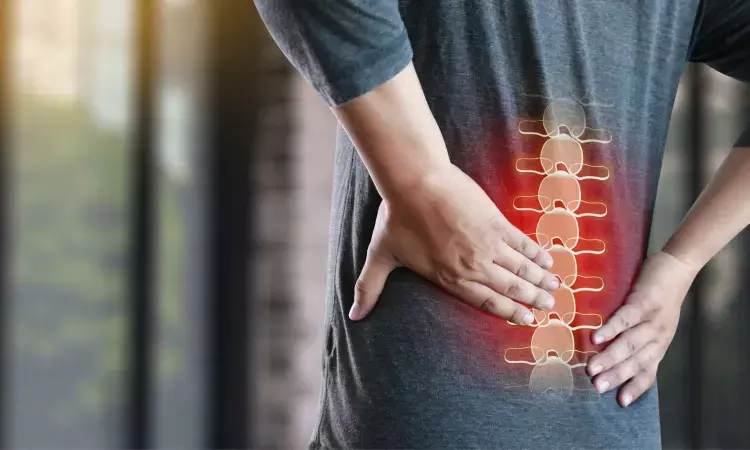


A new study published in the Journal of American Medical Association showed that after a year, certain activities do not affect functional results, even if they may cause brief, transient flare-ups of low back pain (LBP).
Exercise is thought to affect LBP in both negative and positive ways. On the one hand, people who have personally experienced lower back pain frequently believe that certain activities might cause LBP to start or worsen (flares), and certain occupational health studies link tasks like lifting and bending to negative consequences.
Variations in the direction and/or size of the transitory (short-term) vs. long-term hazards of activities on LBP outcomes may be the cause of differing opinions on whether physical activities are detrimental or helpful for people with LBP. Thus, this study investigared the cumulative (long-term) risks of each activity with LBP-related functional limitations at a one-year follow-up and to determine the relationship between the transient (short-term) risk of ten common physical activities and participant-reported LBP exacerbations (flares).
From March 25, 2021, to September 21, 2023, persons who had recently visited Veterans Affairs primary care outpatient clinics for LBP were recruited for this prospective, longitudinal case-crossover investigation nested in a cohort study. The participants were monitored for a full year. The primary exposure for this study was the amount of time spent on each activity during the previous 24 hours. A participant-reported LBP flare and functional impairments due to LBP at the one-year follow-up were the primary outcomes.
During the one-year follow-up, 416 individuals (mean [SD] age, 47.5 [10.9] years; 306 [75%] male) answered 9757 questionnaires. Lifting more than 10 pounds (odds ratio per hour, 1.05; 95% CI, 1.03-1.07), bending, twisting, pushing/pulling, and squatting were all linked to an increased risk of future flares for every extra hour that an activity was undertaken at least once in that hour.
A decreased incidence of flare-ups was linked to the total amount of time spent sitting (odds ratio per extra hour sitting, 0.96; 95% CI, 0.94-0.98). At the one-year follow-up, however, there was no correlation between the mean hours spent in each activity during the first eight weeks of the trial and long-term functional impairments.
Overall, for several of the ten typical activities examined in this study of individuals with LBP, this research discovered temporary hazards on LBP flares. However, at the one-year follow-up, there were no significant correlations between these activities and functional limits.
Source:
Suri, P., Timmons, A. K. I., Korpak, A. M., Tanus, A. D., Brubeck, H. F., Daniels, C. J., Scott, H., Morelli, D., Costa, N., Hodges, P. W., Day, M. A., Friedly, J. L., Heagerty, P. J., Jensen, M. P., & FLAReS Collaborators. (2025). Transient and long-term risks of common physical activities in people with low back pain. JAMA Network Open, 8(12), e2547915. https://doi.org/10.1001/jamanetworkopen.2025.47915

