
Arthroscopic Subacromial Decompression Shows No Long-Term Benefit in Subacromial Pain Syndrome: Study
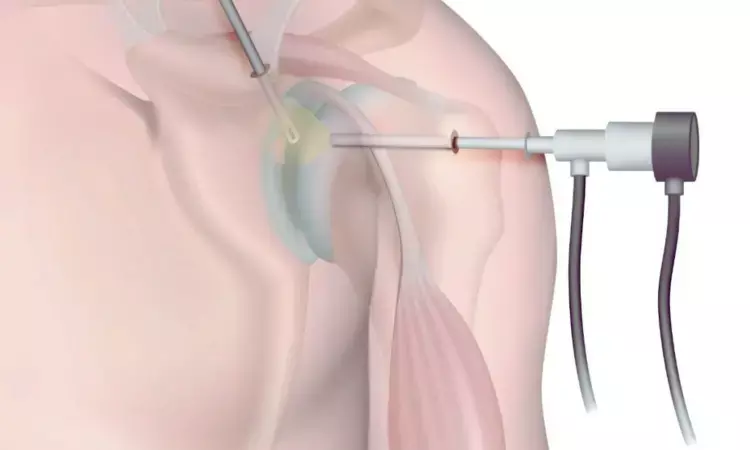


Finland: Researchers have found in a randomized controlled trial that arthroscopic subacromial decompression (ASD) does not offer clinically meaningful long-term improvement for patients with subacromial pain syndrome.
This conclusion is from the 10-year follow-up of the Finnish Subacromial Impingement Arthroscopy Trial (FIMPACT), published in The BMJ. The study was led by Kari Kanto, consultant orthopaedic surgeon at the Finnish Centre for Evidence-Based Orthopaedics (FICEBO), University of Helsinki, Finland, and colleagues. The trial provides some of the longest and most robust evidence to date on the effectiveness of arthroscopic subacromial decompression, a commonly performed elective shoulder procedure worldwide.
Subacromial pain syndrome is one of the most frequent causes of shoulder pain in middle-aged adults and has traditionally been managed with a combination of exercise therapy, injections, and surgery. Despite accumulating evidence questioning its effectiveness, ASD has remained widely used in clinical practice. The FIMPACT trial was designed to rigorously evaluate whether the procedure offers any meaningful long-term benefit beyond placebo surgery or structured exercise therapy.
The randomized, placebo surgery–controlled trial was conducted across orthopaedic departments in three public hospitals in Finland. A total of 210 adults aged 35 to 65 years with symptoms of subacromial pain syndrome lasting longer than three months were enrolled starting in February 2005.
Participants were randomly allocated in equal proportions to undergo ASD, placebo surgery consisting of diagnostic arthroscopy without decompression, or exercise therapy, which served as a pragmatic comparator. Importantly, both participants and outcome assessors were blinded to treatment allocation in the primary comparison between ASD and placebo surgery.
The primary outcomes were shoulder pain at rest and pain during arm activity, measured using a 100-point visual analogue scale at 10 years. A difference of 15 points was predefined as the minimum clinically important threshold. Of the original cohort, 168 participants, representing 87% of those enrolled, completed the decade-long follow-up.
The study led to the following notable findings:
- At the 10-year follow-up, no clinically meaningful differences were observed between the arthroscopic subacromial decompression and placebo surgery groups.
- Differences in pain scores between these two groups were minimal and well below the predefined threshold for clinical relevance, both for pain at rest and pain during arm activity.
- Comparisons between arthroscopic subacromial decompression and exercise therapy showed no significant benefit of surgery.
- No significant differences were found among the groups for secondary outcomes or the incidence of adverse events.
- Patients in all three treatment groups demonstrated sustained improvements in shoulder pain and function over time.
- The long-term improvement observed across groups suggests that recovery may largely reflect the natural course of subacromial pain syndrome or the effects of non-surgical management rather than surgical intervention.
The authors conclude that ASD does not provide additional benefit over placebo surgery or exercise therapy, even over a 10-year horizon. They highlight that the consistency of findings across randomized trials points to a clear lack of efficacy for ASD in subacromial pain syndrome. Despite this, the procedure continues to be performed, reflecting what the authors describe as a medical reversal driven by entrenched practices and systemic factors.
Based on the current evidence, the researchers argue that ASD should not be routinely offered outside well-designed clinical trials, and they call for a shift toward less invasive, evidence-based approaches in managing subacromial pain syndrome.
Reference:
BMJ 2025;391:e086201

Next Story