Carpal Tunnel Release vs Steroid Injection: Similar Outcomes in First 6 Months, reveals study
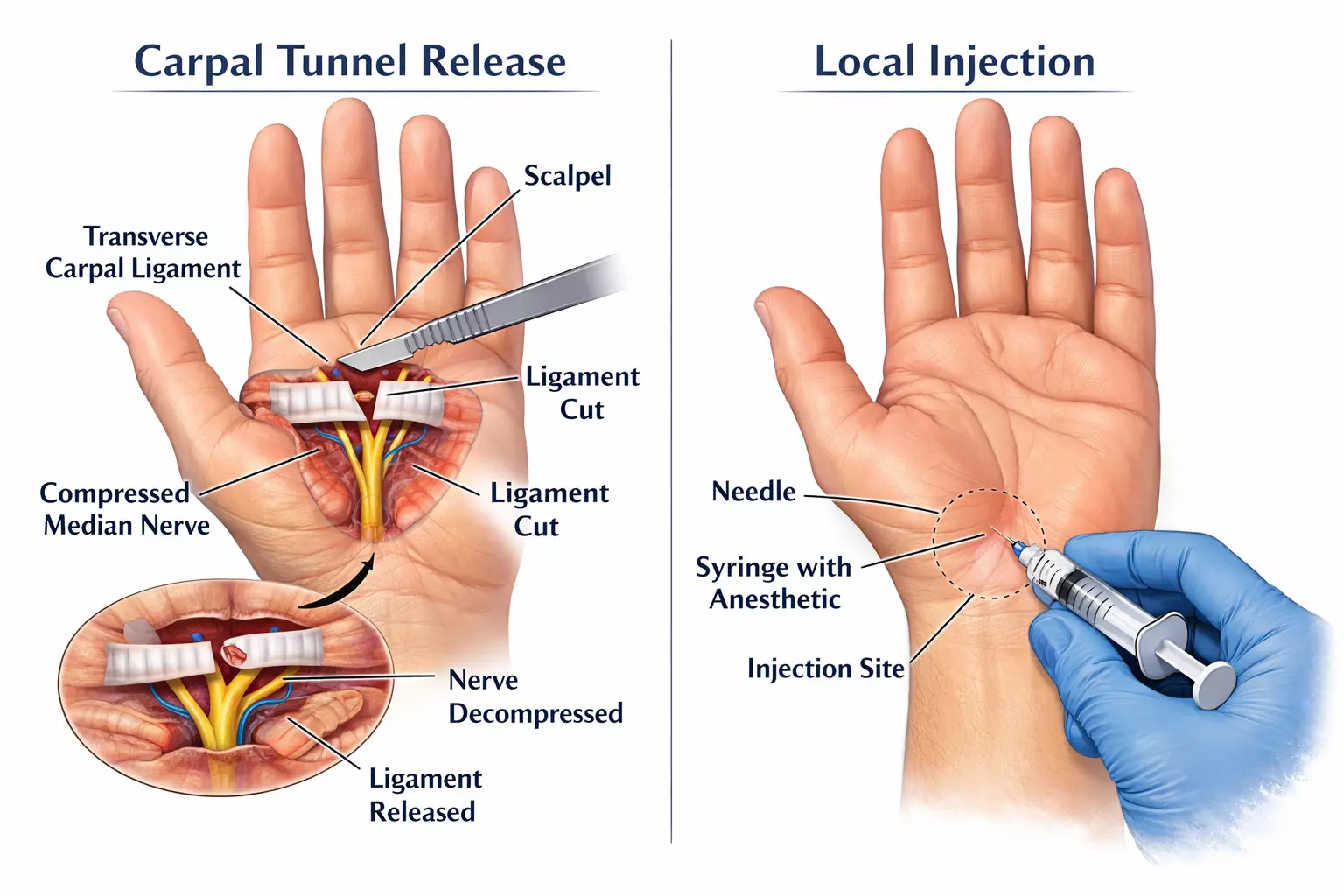


Carpal tunnel syndrome (CTS) is the most prevalent entrapment neuropathy with an estimated prevalence of 0.6% to 5.8%.Carpal tunnel release (CTR) or local corticosteroid injection (LCI) is used for the management of carpal tunnel syndrome (CTS). While some practitioners start with CTR right away, others tend to begin with LCI. Both approaches are widely used, and individual randomized controlled trials (RCTs) have disagreed about the superiority of one approach over the other for CTS management. Remy Daou et al conducted a meta-analysis of RCTs and published in ‘JBJS Open Access’.
PubMed, Cochrane, and Google Scholar were searched up until August 8, 2025. Inclusion criteria consisted of English or non-English language RCTs comparing CTR with LCI in the management of CTS. The studied outcomes were management failure, improvement in symptoms, and improvement in function at several postoperative timepoints. Two authors independently assessed the bias using the Cochrane Risk of Bias tool. ReviewManager5.4 (The Cochrane Collaboration) was used for the statistical analysis.
The key findings of the study were:
• Twelve RCTs representing a total of 1799 patients, with 880 undergoing CTR and 919 undergoing LCI, were included.
• There was no difference in failure rates between the 2 groups at 1, 3, and 6 months; function improvement at 3 and 6 months; and symptoms improvement at 3 months.
• However, the LCI group had a higher rate of failure at 1 year (odds ratio [OR] = 18.41; p = 0.01) and latest follow-up (OR = 5.38; p = 0.003), and the CTR group had a better improvement in symptoms at 6 months (standardized means difference [SMD] = 0.39; p = 0.03) and 1 year (SMD = 0.30; p = 0.01).
The authors concluded – “The results of this meta-analysis revealed that while CTR and LCI were equivalent in terms of patient-reported outcomes measures and failure rates for the first 6 months after treatment, CTR was superior after this period of time. Future large-scale trials are needed to identify if the difference in outcomes in patients undergoing CTR with a previous LCI and patients opting for CTR as the first management option.”
Level of Evidence: Level I.
For further details on the article refer to:
Carpal Tunnel Release Versus Local Corticosteroid Injection for Carpal Tunnel Syndrome
A Meta-Analysis of Randomized Controlled Trials
Remy Daou et al
JBJS Open Access 2025:e25.00211. http://dx.doi.org/10.2106/JBJS.OA.25.00211