
PEEK Emerges as a Bone-Like Alternative to Metal Implants in Orthopaedic Surgery: Review
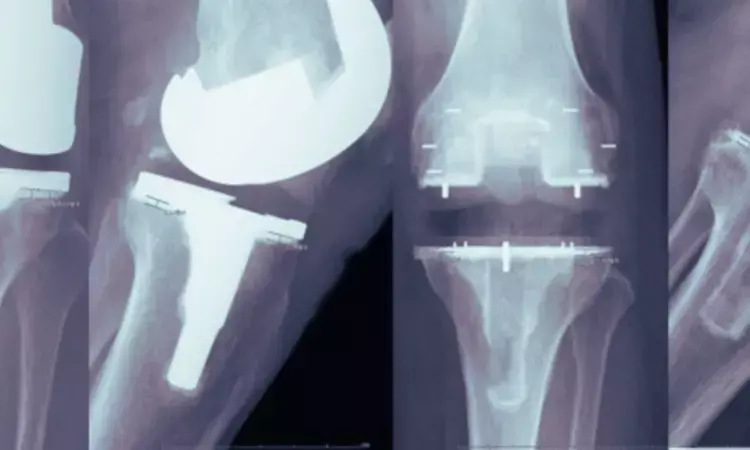


India: Polyetheretherketone (PEEK) is emerging as a promising alternative to conventional metallic implants in orthopaedics, particularly in arthroplasty. A recent review published in the European Journal of Orthopaedic Surgery & Traumatology by Dr (Prof.) Raju Vaishya of the Department of Orthopaedics and Joint Replacement Surgery, Indraprastha Apollo Hospitals, New Delhi, and colleagues evaluated the biomechanical properties, surface modifications, and clinical outcomes associated with PEEK-based implants.
Orthopaedic implants have long depended on metals such as cobalt- chromium (Co-Cr) and titanium alloys. While mechanically strong, these materials are far stiffer than human bone, often leading to stress shielding and subsequent bone loss around implants. PEEK, by contrast, has an elastic modulus (EM) of approximately 3–4 GPa, closely resembling that of cortical bone. Emphasising this advantage, Dr (Prof) Raju Vaishya told Medical Dialogues, “PEEK is emerging as a viable, ‘bone-like’ alternative to traditional metallic implants. By closely matching the elastic modulus of human cortical bone, it significantly reduces stress shielding, which remains a major cause of implant failure.”
The authors conducted a comprehensive literature review using Web of Science, Scopus, and Embase databases, including randomised controlled trials, cohort studies, preclinical research, and systematic reviews. Preclinical evidence consistently demonstrated favourable biomechanical behaviour and biocompatibility of PEEK. However, the review noted that most available clinical studies report only short- to mid-term outcomes.
A key clinical advantage of PEEK highlighted in the review is its radiolucency. Unlike metal implants, PEEK does not create imaging artefacts on CT or MRI scans, allowing clearer visualisation of the bone–implant interface, and is light-weight. Coauthor Dr Abhishek Vaish explained, “The radiolucent nature of PEEK enables early detection of complications such as loosening or infection and improves postoperative monitoring.” He added that in procedures such as total knee arthroplasty, PEEK’s flexibility may promote more physiological load transfer and help preserve periprosthetic bone density.
PEEK may also offer a valuable solution for patients with metal hypersensitivity. An estimated 1–2% of individuals undergoing joint replacement exhibit sensitivity to metals such as nickel, cobalt, or chromium. In these patients, PEEK provides a low-allergy alternative without compromising structural integrity, explains Dr (Prof.) Raju Vaishya.
Despite these benefits, the authors caution that several challenges limit broader clinical adoption. Corresponding author Dr (Prof.) Filippo Migliorini from the Academic Hospital of Bolzano, Italy, pointed out that “most clinical evidence is limited to short- and mid-term follow-up, with a critical lack of long-term data on implant survivorship, particularly in high-load applications such as hip arthroplasty.” He also noted that unmodified PEEK is biologically inert and does not inherently promote bone cell adhesion.
To address this limitation, significant research efforts have focused on surface modification techniques such as hydroxyapatite (HA) coatings, nanopatterning, and bioactive treatments to enhance osseointegration. Commenting on the material’s versatility, Prof. Abid Haleem of Jamia Millia Islamia University, New Delhi, described PEEK as a “super-engineered” material. “Carbon fibre–reinforced PEEK can be tailored to achieve metal-like strength while maintaining bone-matched elasticity. Its ability to withstand repeated sterilisation without degradation makes it particularly suitable for hospital environments,” he said.
Overall, the review concludes that PEEK holds substantial promise in arthroplasty and orthopaedics. However, long-term clinical data, optimised bioactive surfaces, and advances in manufacturing technologies such as 3D printing will be essential to support its wider adoption in routine orthopaedic practice.
Reference:
Vaishya R, Vaish A, Dubey A, Vishwanathan K, Haleem A, Javaid M, Migliorini F. Role of polyetheretherketone (PEEK) in arthroplasty and orthopaedics: a review of biomechanical properties, surface modifications, and clinical outcomes. Eur J Orthop Surg Traumatol. 2026 Jan 7;36(1):69. doi: 10.1007/s00590-025-04630-9. PMID: 41498949; PMCID: PMC12779741.
