
Study Reports First Successful Non-Surgical Treatment of Postoperative Lung Torsion


China: A recent case report published in BMC Surgery has documented the first successful conservative management of postoperative lung torsion, offering a potential alternative to high-risk reoperation while demonstrating favorable outcomes over two years.
Lung torsion is an uncommon but serious complication following thoracic surgery. Traditionally, it has required urgent surgical intervention, either through video-assisted thoracoscopic surgery (VATS) or open thoracotomy, procedures associated with higher mortality and extended hospital stays compared to routine thoracic surgeries. Until now, no reports have described the successful conservative treatment of this condition, leaving reoperation as the default management strategy.
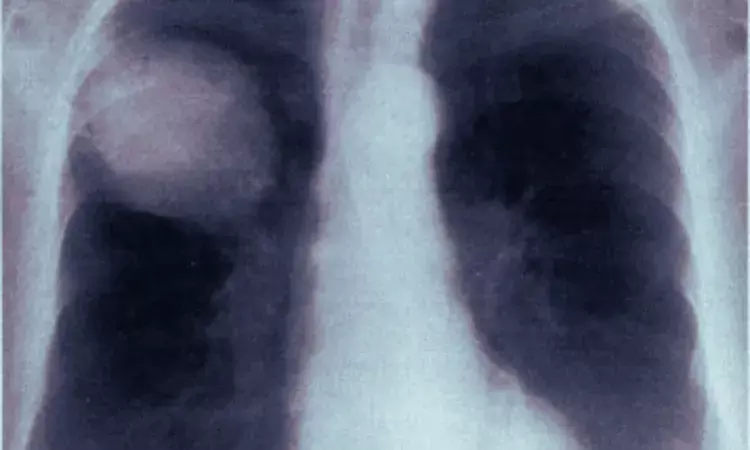
The case involved a 52-year-old male who underwent dual-port VATS for right upper lobectomy and right lower lobe superior segmentectomy to treat invasive pulmonary adenocarcinoma. On the second postoperative day, just two hours after chest tube removal, the patient experienced a sudden onset of profuse sweating, chest tightness, and difficulty breathing. Emergency chest X-rays showed complete lung atelectasis, and subsequent multidetector CT scans with flexible bronchoscopy confirmed incomplete torsion affecting the right middle and lower lobes.
Rather than proceeding directly to high-risk surgical reintervention, the medical team implemented a novel multimodal conservative strategy. This included selective intrabronchial air insufflation every 48 hours, noninvasive positive pressure ventilation via BiPAP, and maintenance of closed thoracic drainage. By postoperative day seven, three-dimensional imaging showed marked resolution of atelectasis, allowing safe removal of the chest tube. Follow-up imaging at three months demonstrated full re-expansion of the residual right lung, and two-year follow-up confirmed sustained lung function without any long-term complications.
The case highlights the potential for conservative management in carefully selected patients with early-diagnosed, incomplete lung torsion who remain hemodynamically stable and show no signs of tissue infarction. Intensive monitoring and immediate surgical backup were critical to the patient’s successful outcome, underscoring that while conservative therapy can be effective, surgical intervention remains the standard of care.
The authors emphasize that this approach, though promising, is currently limited to a single case. Larger studies are needed to validate its safety, effectiveness, and applicability, and to develop standardized protocols for patient selection and treatment.
In conclusion, this first-of-its-kind report demonstrates that multimodal conservative therapy can successfully manage postoperative lung torsion, achieving excellent long-term results and potentially reducing the need for high-risk reoperations. This case opens the door for future research into less invasive options for managing rare thoracic complications, while highlighting the importance of early diagnosis, careful patient selection, and rigorous monitoring.
Reference:
Dai, K., Zhang, Y., Zhang, Y. et al. Conservative management of postoperative incomplete lung torsion without reoperation: first case report with 2-year favorable outcomes. BMC Surg (2025). https://doi.org/10.1186/s12893-025-03427-1

Next Story