Barrier First Approach for Optimising Periprocedural Skin Care: Key Takeaways from PRO-SUMMIT 2026
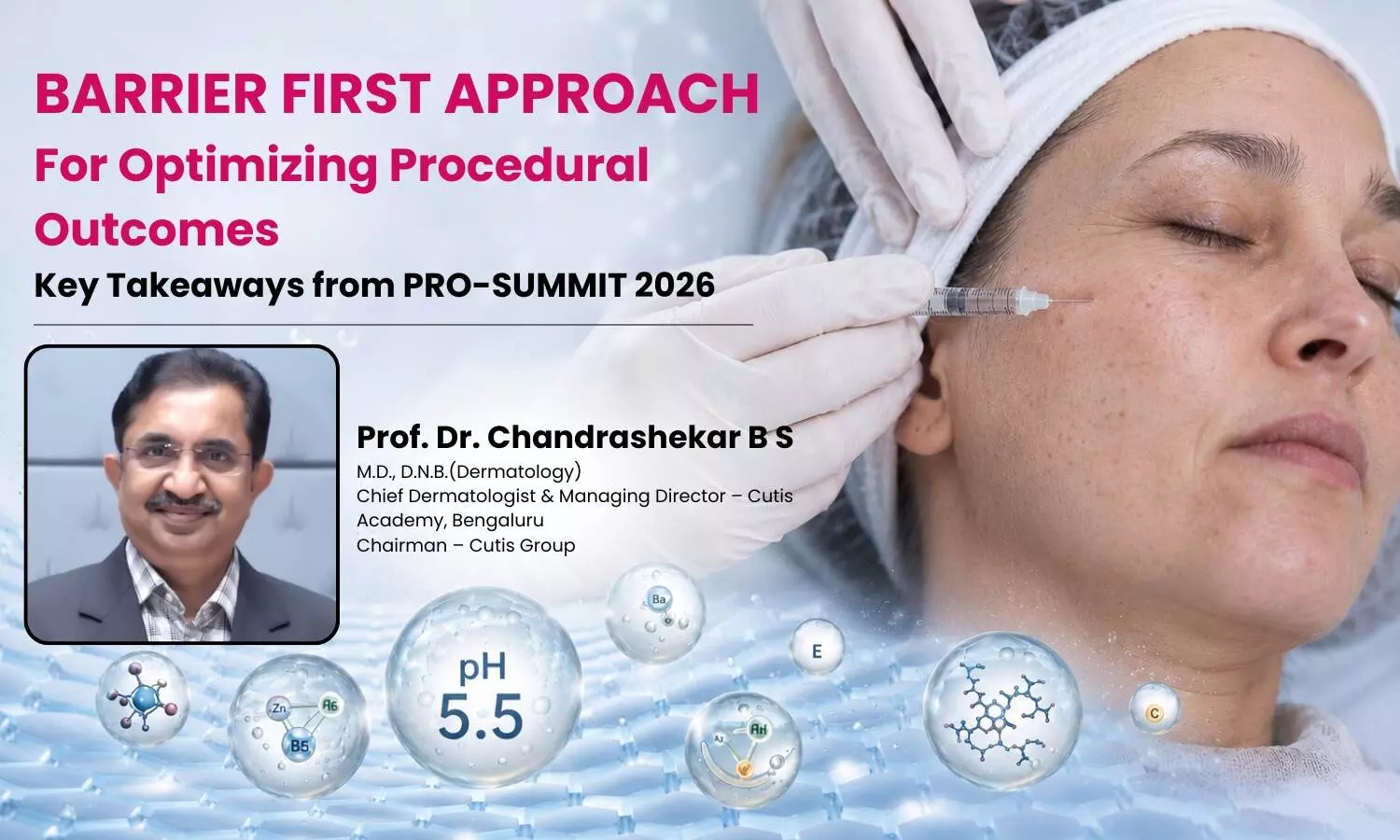


Indian aesthetic patients present a distinct risk profile. Indian skin (Fitzpatrick IV-VI)brings unique procedural challenges, elevated PIH risk, a strong inflammation–pigmentation link, heightened sensitivity to chemical peels, and significant psychosocial impact, necessitating individualised protocols and pre/post barrier care.
The PRO-SUMMIT 2026, Bengaluru, addressed a barrier-first peri-procedural framework built for Indian clinical realities. Here are the key takeaways from this scientific summit.
1. Barrier readiness is the most modifiable determinant of skin procedural outcome: Procedural outcomes depend on patient biology, technique, baseline skin condition, and aftercare quality. Of these, skin barrier status is among the most actionable lever.
2. Every aesthetic procedure disrupts the barrier - degree matters more than modality: Aesthetic procedures create controlled procedural injury leading to transient barrier dysfunction. Procedural interventions induce transient barrier disruption with increased TEWL and inflammation; the magnitude depends on procedure depth, energy settings, and baseline barrier status. The priority is aligning care intensity to the degree of skin barrier disruption, not the procedure type alone.
3. In Indian skin, inflammation control is outcome control: Indian skin (Fitzpatrick IV–VI) presents unique procedural challenges, with increased risk of post-inflammatory hyperpigmentation (PIH), strong inflammation–pigmentation link, and significant psychosocial impact. Barrier protection is not a comfort measure; it is a critical pigmentation-prevention strategy, requiring customized protocols and pre/post barrier care.
4. The Skin barrier–microbiome–pH axis is a mechanistic core of Recovery: The skin barrier functions as an integrated axis; the stratum corneum (lipids, corneocytes) controls TEWL, the cutaneous microbiome maintains pH regulation and barrier maintenance, and the acid mantle at pH ~5.5 is essential for barrier integrity and antimicrobial defence. The pH ~5.5 formulations may help prevent skin dysbiosis, protect and maintain the skin barrier, and support barrier repair following procedural disruption. Optimising the skin barrier–microbiome–pH axis (~5.5) seems an important therapeutic concept to enhancing healing, reducing complications, and improving overall outcomes.
5. The 'Prime-Protect-Preserve' (PPP) three-phase framework optimises periprocedural care.
- Prime (2–4 weeks before): Build pH-balanced (~5.5) hydration to optimize barrier readiness; consider a gentle, non-irritating, mild, non-stripping cleanser at pH ~5.5 to help maintain hydro-lipid balance and reduce skin sensitivity.
- Protect (Days 0–7): Prioritise TEWL reduction and inflammation control with gentle, pH-aligned formulations. A pH ~5.5 cleanser, triple hyaluronic acid for multi-layer hydration, and SPF50+ could form the core post-procedural regimen consideration.
- Preserve (Day 7+): Support lipid replenishment and skin barrier regeneration; reintroduce actives guided by degree of disruption and recovery status, through an individualised approach.
Figure 1: Peri-Procedural Skin Care Framework: Prime · Protect · Preserve
6. Aftercare quality often determines patient satisfaction more than any intra-procedural variable: Barrier-conscious peri-procedural aftercare may help reduce erythema, lower PIH risk, and support faster recovery, and is not optional but essential. A structured, phase-wise pH-balanced (~5.5) aftercare approach, maintained consistently by the patient, could support faster recovery and better aesthetic outcomes.
7. SPF 50+ photoprotection, initiated 3–4 weeks before the procedure, is non-negotiable in Indian practice: Broad-spectrum photoprotection, reapplied every two hours, is the single most impactful non-procedural intervention for managing PIH risk in Fitzpatrick IV–VI skin. Early evidence suggests SPF 100+ may further improve outcomes.
8. Peri-procedural ingredient selection complements procedural technology in optimising outcomes: For post-procedure barrier regeneration, including in periorbital concerns such as vascular and structural dark circles, a pH ~5.5 CoQ10 formulation supports antioxidant defence through mitochondrial antioxidant effect, stimulates collagen synthesis and dermal repair, and reduces post-procedure inflammation. CO₂ resurfacing represents one of the most severe degrees of barrier disruption, necessitating intensive barrier protection and occlusive moisturisers in the immediate post-procedure phase, transitioning to lighter formulations after 5–7 days.
9. Ingredient Selection Guidance Aligned to 'Prime-Protect-Preserve' (PPP) Framework: Considering ingredients aligned to the PPP framework and skin physiology is central to maximising outcomes. Below is a quick-reference guide. [1,2,3,4,5,6,7,8]
pH-Balanced Cleanser- Barrier Integrity:
- Maintains acid mantle integrity; removes debris without stripping lipids
- Prepares skin at physiological pH (~5.5), optimising penetration of subsequent actives across all three PPP phases.
CoQ10 (Ubiquinone)- Inflammation Regulator, Skin Repairer & Antioxidant:
- Antioxidant defense along with cellular repair, modulates neurogenic inflammation
- Apply twice daily pre-procedure to reduce sensitivity; ideal before and after CO₂ laser to preserve skin barrier integrity.
Triple HA (Multi-Molecular Weight Hyaluronic Acid)- Across Skin Layer Protection:
● High molecular weight HA binds moisture on the skin's surface; medium molecular weight HA penetrates the upper layer of the skin; low molecular weight HA penetrates into deeper layers
● Synergistic effect: immediate hydration (HMW) + sustained dermal effect (LMW); for PIH-prone skin, combining with tinted sunscreen for visible light protection is suggested based on clinical experience.
Probiotic Complex Serum-Skin Dysbiosis Management:
● Restores microbial balance; accelerates skin repair and prevents dysbiosis
● Lactococcus Ferment Lysate supports dysbiosis reduction and microbiome stabilisation under procedural stress.
Taken together, barrier-first conscious periprocedural skin care, structured, pH 5.5-aligned, and individualised within the Prime-Protect-Preserve framework, is central to supporting skin barrier readiness, inflammation control, hydration, and photoprotection, ensuring long-term recovery and patient satisfaction post-dermo-aesthetic procedures.
Abbreviations: AHA-Alpha-hydroxy acid, BHA: Beta-hydroxy acid, CAGR: Compound annual growth rate, CO2: Carbon dioxide (fractional laser), CoQ10: Coenzyme Q10 (ubiquinone), GA: Glycolic acid, HA: Hyaluronic acid, HMW-HA: High molecular weight hyaluronic acid (1,000–1,800 kDa), JAAD: Journal of the American Academy of Dermatology, kDa: Kilodalton, LMW-HA: Low molecular weight hyaluronic acid (5–100 kDa), MMW-HA: Medium molecular weight hyaluronic acid (100–1,000 kDa), MNRF: Microneedling radiofrequency, mJ: Millijoule, OTC: Over-the-counter, PDRN: Polydeoxyribonucleotide, PIH: Post-inflammatory hyperpigmentation, PRP: Platelet-rich plasma, RF: Radio frequency, SPF: Sun protection factor, TEWL: Trans-epidermal water loss
- 1. The clinical relevance of maintaining the functional integrity of the stratum corneum in both healthy and disease-affected skin. J Clin Aesthet Dermatol. 9 S44-S52
- 2. Skin barrier function in psoriasis and atopic dermatitis: transepidermal water loss and temperature as useful tools to assess disease severity J Clin Med 10 359-
- 3. The skin barrier and moisturization: function, disruption, and mechanisms of repair Skin Pharmacol Physiol 36 174-185
- 4. Transepidermal water loss (TEWL): environment and pollution—A systematic review Int J Cosmet Sci -
- 5. Skin Barrier Repair and Nursing Care in Patients with Atopic Dermatitis: A Narrative Review -
- 6. Skin Barrier Function in Psoriasis and Atopic Dermatitis: Transepidermal Water Loss and Temperature as Useful Tools to Assess Disease Severity J Clin Med. 10 359-
- 7. Risk factors of skin barrier dysfunction in older adults: A systematic review Geriatr Nurs -
- 8. Skin Barrier Parameters in Acne Vulgaris versus Normal Controls: A Cross-Sectional Analytic Study Clin Cosmet Investig Dermatol -
- 9. Bioengineering of the skin: water and the stratum corneum. Boca Raton: CRC Press -
- 10. Stratum corneum defensive functions: an integrated view 125 183-200
- 11. Clinical Measurement of Transepidermal Water Loss Exp Dermatol 15 92-483
- 12. pH directly regulates epidermal permeability barrier homeostasis, and stratum corneum integrity/cohesion J Invest Dermatol 12153-345
- 13. Ex vivo histological characterization of a novel ablative fractional resurfacing device Lasers Surg Med 39 87-99
- 14. Chemical peels: what's new and what isn't new but still works well Dermatol Res Pract. 1-7
- 15. A practical algorithm for integrating skincare to improve patient outcomes and satisfaction with energy-based dermatologic procedures. J Drugs Dermatol. 23 353-359
- 16. Recommendations on periprocedural skincare for energy-based dermatologic procedures. Aesthet Surg J Open Forum -
- 17. Hyper- and hypopigmentation in dark skin after aesthetic procedures. 17. Veronese S, et al. 2024 -J Clin Med.