Medical Dialogues
  • Dermatology
Login Register
This site is intended for healthcare professionals only
Login Register
  • MD Brand Connect
  • Webinars
  • Vaccine Hub
  • MDTV
    • Breaking News
    • Medical News Today
    • Health News Today
    • Latest
    • Journal Club
    • Medico Legal Update
    • Latest Webinars
    • MD Shorts
    • Health Dialogues
  • Fact Check
  • Health Dialogues
Medical Dialogues
  • Medical News & Guidelines
      • Anesthesiology
      • Cardiology and CTVS
      • Critical Care
      • Dentistry
      • Dermatology
      • Diabetes and Endocrinology
      • ENT
      • Gastroenterology
      • Medicine
      • Nephrology
      • Neurology
      • Obstretics-Gynaecology
      • Oncology
      • Ophthalmology
      • Orthopaedics
      • Pediatrics-Neonatology
      • Psychiatry
      • Pulmonology
      • Radiology
      • Surgery
      • Urology
      • Laboratory Medicine
      • Diet
      • Nursing
      • Paramedical
      • Physiotherapy
  • Health news
      • Doctor News
      • Government Policies
      • Hospital & Diagnostics
      • International Health News
      • Medical Organization News
      • Medico Legal News
      • NBE News
      • NMC News
  • Fact Check
      • Bone Health Fact Check
      • Brain Health Fact Check
      • Cancer Related Fact Check
      • Child Care Fact Check
      • Dental and oral health fact check
      • Diabetes and metabolic health fact check
      • Diet and Nutrition Fact Check
      • Eye and ENT Care Fact Check
      • Fitness fact check
      • Gut health fact check
      • Heart health fact check
      • Kidney health fact check
      • Medical education fact check
      • Men's health fact check
      • Respiratory fact check
      • Skin and hair care fact check
      • Vaccine and Immunization fact check
      • Women's health fact check
  • AYUSH
    • Ayurveda
    • Homeopathy
    • Siddha
    • Unani
    • Yoga
  • State News
      • Andaman and Nicobar Islands
      • Andhra Pradesh
      • Arunachal Pradesh
      • Assam
      • Bihar
      • Chandigarh
      • Chattisgarh
      • Dadra and Nagar Haveli
      • Daman and Diu
      • Delhi
      • Goa
      • Gujarat
      • Haryana
      • Himachal Pradesh
      • Jammu & Kashmir
      • Jharkhand
      • Karnataka
      • Kerala
      • Ladakh
      • Lakshadweep
      • Madhya Pradesh
      • Maharashtra
      • Manipur
      • Meghalaya
      • Mizoram
      • Nagaland
      • Odisha
      • Puducherry
      • Punjab
      • Rajasthan
      • Sikkim
      • Tamil Nadu
      • Telangana
      • Tripura
      • Uttar Pradesh
      • Uttrakhand
      • West Bengal
  • Medical Education
      • Ayush Education News
      • Dentistry Education News
      • Medical Admission News
      • Medical Colleges News
      • Medical Courses News
      • Medical Universities News
      • Nursing education News
      • Paramedical Education News
      • Study Abroad
  • Industry
      • Health Investment News
      • Health Startup News
      • Medical Devices News
      • Pharma News
      • Pharmacy Education News
      • AI and healthcare
      • Industry Perspective
  • MDTV
      • Health Dialogues MDTV
      • Health News today MDTV
      • Latest Videos MDTV
      • Latest Webinars MDTV
      • MD shorts MDTV
      • Medical News Today MDTV
      • Medico Legal Update MDTV
      • Top Videos MDTV
      • Health Perspectives MDTV
      • Journal Club MDTV
      • Medical Dialogues Show
This site is intended for healthcare professionals only
LoginRegister
Medical Dialogues
LoginRegister
  • Home
  • Medical news & Guidelines
    • Anesthesiology
    • Cardiology and CTVS
    • Critical Care
    • Dentistry
    • Dermatology
    • Diabetes and Endocrinology
    • ENT
    • Gastroenterology
    • Medicine
    • Nephrology
    • Neurology
    • Obstretics-Gynaecology
    • Oncology
    • Ophthalmology
    • Orthopaedics
    • Pediatrics-Neonatology
    • Psychiatry
    • Pulmonology
    • Radiology
    • Surgery
    • Urology
    • Laboratory Medicine
    • Diet
    • Nursing
    • Paramedical
    • Physiotherapy
  • Health news
    • Doctor News
    • Government Policies
    • Hospital & Diagnostics
    • International Health News
    • Medical Organization News
    • Medico Legal News
    • NBE News
    • NMC News
  • Fact Check
    • Bone Health Fact Check
    • Brain Health Fact Check
    • Cancer Related Fact Check
    • Child Care Fact Check
    • Dental and oral health fact check
    • Diabetes and metabolic health fact check
    • Diet and Nutrition Fact Check
    • Eye and ENT Care Fact Check
    • Fitness fact check
    • Gut health fact check
    • Heart health fact check
    • Kidney health fact check
    • Medical education fact check
    • Men's health fact check
    • Respiratory fact check
    • Skin and hair care fact check
    • Vaccine and Immunization fact check
    • Women's health fact check
  • AYUSH
    • Ayurveda
      • Ayurveda Giuidelines
      • Ayurveda News
      • Top Ayurveda News
    • Homeopathy
      • Homeopathy Guidelines
      • Homeopathy News
    • Siddha
      • Siddha Guidelines
      • Siddha News
    • Unani
      • Unani Guidelines
      • Unani News
    • Yoga
      • Yoga Guidelines
      • Yoga News
  • State News
    • Andaman and Nicobar Islands
    • Andhra Pradesh
    • Arunachal Pradesh
    • Assam
    • Bihar
    • Chandigarh
    • Chattisgarh
    • Dadra and Nagar Haveli
    • Daman and Diu
    • Delhi
    • Goa
    • Gujarat
    • Haryana
    • Himachal Pradesh
    • Jammu & Kashmir
    • Jharkhand
    • Karnataka
    • Kerala
    • Ladakh
    • Lakshadweep
    • Madhya Pradesh
    • Maharashtra
    • Manipur
    • Meghalaya
    • Mizoram
    • Nagaland
    • Odisha
    • Puducherry
    • Punjab
    • Rajasthan
    • Sikkim
    • Tamil Nadu
    • Telangana
    • Tripura
    • Uttar Pradesh
    • Uttrakhand
    • West Bengal
  • Medical Education
    • Ayush Education News
    • Dentistry Education News
    • Medical Admission News
    • Medical Colleges News
    • Medical Courses News
    • Medical Universities News
    • Nursing education News
    • Paramedical Education News
    • Study Abroad
  • Industry
    • Health Investment News
    • Health Startup News
    • Medical Devices News
    • Pharma News
      • CDSCO (Central Drugs Standard Control Organisation) News
    • Pharmacy Education News
    • AI and healthcare
    • Industry Perspective
  • Home
  • Diabetes and Endocrinology
  • Diabetes and Endocrinology Perspective
  • ...

Dapagliflozin-Sitagliptin in T2D: Moving Beyond HbA1c Towards a Broader Orbit of Care
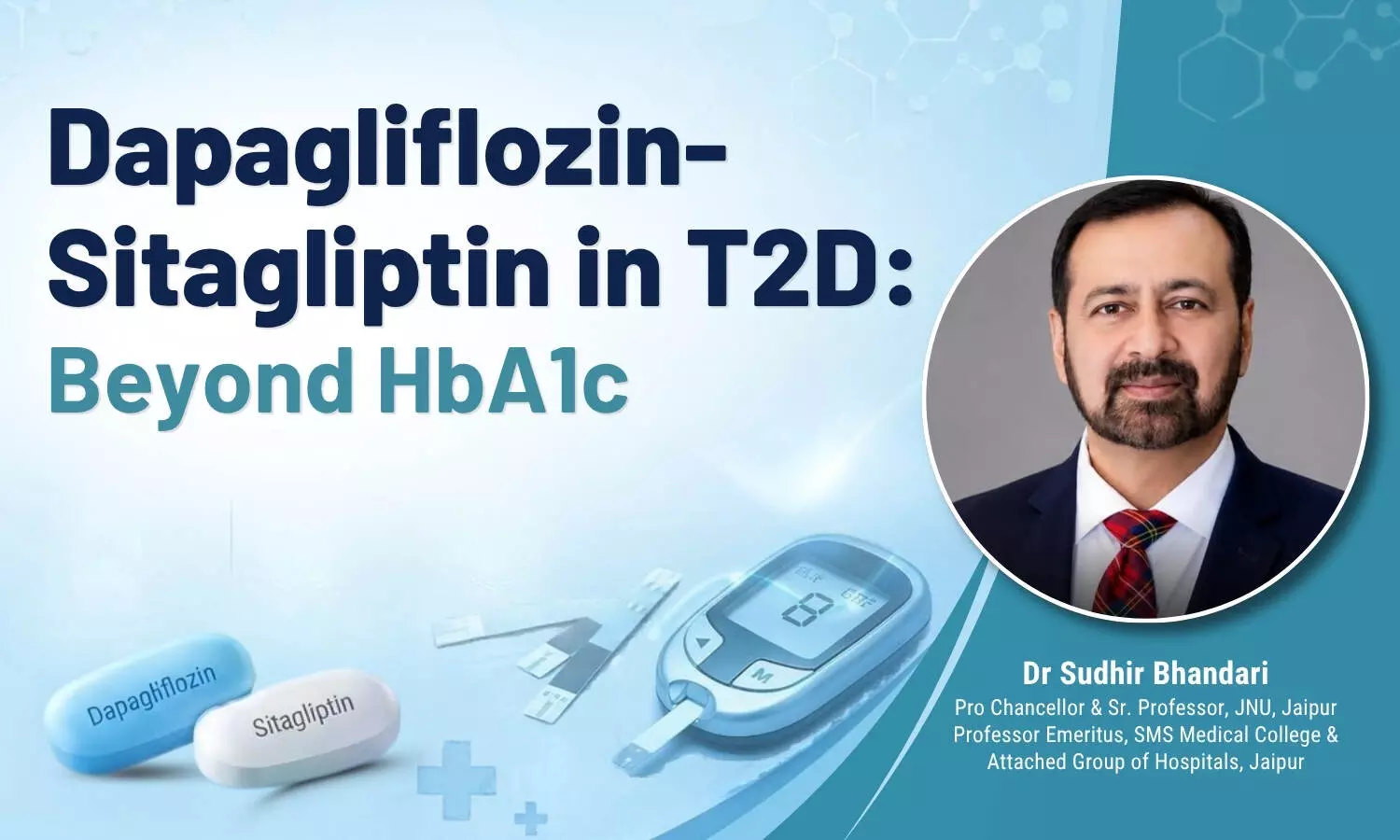
Written By : Dr. Sudhir Bhandari Published On 2026-11-06T11:00:12+05:30  |  Updated On 6 Nov 2026 11:00 AM IST
Dapagliflozin-Sitagliptin in T2D: Moving Beyond HbA1c Towards a Broader Orbit of Care
  • facebook
  • twitter
  • linkedin
  • whatsapp
  • Telegram
  • Email

Type 2 diabetes (T2D) is increasingly recognised as a complex gluco-cardio-metabolic disease requiring more than glycaemic control alone. India has nearly 89.8 million adults living with diabetes, with an age-adjusted prevalence of 10.5%; approximately 43% remain undiagnosed, while over 107 million adults have impaired fasting glucose. Importantly, cardiovascular risk is already substantial at diagnosis; In a study including 5,080 newly diagnosed Indian patients with T2D, 39.5% were classified as high and 60.5% as very high ASCVD risk, with a mean QRISK3-estimated 10-year cardiovascular risk of 15.3%. This reinforces the need for early treatment strategies addressing glycaemic, metabolic, and cardiorenal risk together in T2D care. Consequently, treatment goals have evolved towards durable glycaemic control, weight and metabolic benefits, cardiorenal protection, while ensuring low hypoglycaemia risk, treatment simplicity, and sustained adherence. 1-3

Beyond HbA1c: Defining the Modern Treatment Goals in T2D

Contemporary T2D management is no longer defined by achieving HbA1c targets alone. The ADA Standards of Care 2026 advocate a person centred approach, recommending that therapeutic decisions be guided by individualized glycaemic and weight goals, the presence of cardiovascular, kidney, and other metabolic comorbidities, hypoglycaemia risk, treatment burden, and medication complexity.

These attributes now represent the modern treatment checklist for optimizing outcomes in people with T2D. 4, 5

Dapagliflozin & Sitagliptin - Complementary Potential of Two Widely Experienced Agents

The complementary pharmacological profiles of dapagliflozin and sitagliptin enable a multidimensional approach to diabetes management by targeting distinct yet synergistic pathophysiological pathways. Dapagliflozin, a sodium-glucose cotransporter-2 (SGLT2) inhibitor, lowers plasma glucose through insulin-independent urinary glucose excretion, while sitagliptin, a dipeptidyl peptidase-4 (DPP-4) inhibitor, enhances endogenous incretin activity to stimulate glucose-dependent insulin secretion and suppress glucagon release. Both these agents have wide clinical experience globally and in India.

Together, these complementary mechanisms provide effective and durable glycaemic control with a low intrinsic risk of hypoglycaemia. Beyond glycaemic efficacy, dapagliflozin offers additional benefits on body weight reduction, blood pressure lowering, and cardiorenal health, whereas sitagliptin provides sustained glucose lowering with established cardiovascular safety and weight neutrality.

Furthermore, the availability of the combination as a fixed-dose formulation reduces pill burden, simplifies treatment, and may improve long-term adherence. By addressing multiple contemporary treatment priorities within a single regimen, the dapagliflozin–sitagliptin combination represents a rational and patient centred therapeutic strategy for the comprehensive management of T2D. 4, 6

Figure 1: Dapagliflozin and Sitagliptin: Individual & Complementary Strengths in the T2D Orbit of Care 4, 6-9

Dapagliflozin & Sitagliptin: Promising Recent Indian Clinical Evidence

The growing role of the dapagliflozin–sitagliptin fixed-dose combination (FDC) in Indian T2D management is supported by recent expert consensus and real-world evidence.

Dapagliflozin Sitagliptin FDC – AACE 2026 Update: At the AACE 2026 Annual Meeting, the DIMETRIC Consensus Mapping, representing over 2,000 cumulative clinician-years of experience was presented, showed strong agreement on the FDC’s complementary glycaemic effects across diverse T2D phenotypes (weighted score [WS] 121.3), early use in patients at high cardiovascular risk (WS 125.9), effectiveness and tolerability in Indian practice (WS 124.7), and potential to reduce therapeutic inertia (WS 117.2). Together, these findings support the dapagliflozin–sitagliptin FDC as a practical option for holistic metabolic management with benefits extending across glycemic, renal, weight and blood pressure parameters in routine Indian T2D care.7

These recommendations are reinforced by the BRIDGE-DS studies published over the last year.

BRIDGE-DS Indian Study 1 – T2D with High CV Risk: In a multi-centre retrospective study of 1,093 Indian patients with T2D and established ASCVD or high cardiovascular risk, 3 months of therapy reduced HbA1c from 8.9% to 7.4% (-1.5%), fasting glucose from 173.0 to 129.3 mg/dL (43.7 mg/dL reduction), postprandial glucose from 257.2 to 185.2 mg/dL (72.0 mg/dL reduction), systolic blood pressure from 150.5 to 131.5 mmHg (19.0 mmHg reduction), and Framingham Risk Score from 15.9% to 9.4% (6.5% reduction) (all P<0.001). 8

BRIDGE-DS Indian Study 2 – T2D with HF: In a higher CV risk cohort including 168 patients with T2D and heart failure, HbA1c declined from 8.9% to 7.4% (1.5% reduction), NT-proBNP from 306.7 to 184.0 pg/mL (122.7 pg/mL reduction), and blood pressure SBP/DBP from 151/98 to 133/87 mmHg (18/11 mmHg reduction) over 3 months. LVEF increased from 43.1% to 46.0% (2.9% increase) and eGFR from 63.1 to 74.0 mL/min/1.73 m² (10.9 mL/min/1.73 m² increase) (all P<0.0001), with acceptable tolerability. 9

Altogether, these findings connect expert consensus with measurable real-world outcomes, supporting the dapagliflozin-sitagliptin FDC as a practical consideration for integrated glycaemic and cardiorenal management in Indian patients with T2D.

Key Takeaway Message

  • Contemporary T2D care must move beyond HbA1c reduction to simultaneously address weight, hypoglycaemia risk, cardiorenal vulnerability, treatment burden, and long-term adherence. 1, 2
  • Through complementary insulin-independent and incretin-based mechanisms, dapagliflozin–sitagliptin provides a rational fixed-dose strategy approach for integrated glycaemic, metabolic, and cardiorenal management. 4, 6
  • Recent Indian evidence published over last two years further reinforces its effectiveness, tolerability, and practical relevance across high-risk T2D phenotypes, provided treatment is individualized to renal function, comorbidities, safety, and patient preference. 7-9

**Abbreviations: T2D: Type 2 Diabetes; HbA1c: Glycated Haemoglobin; CV: Cardiovascular; ASCVD: Atherosclerotic Cardiovascular Disease; SGLT2: Sodium-Glucose Cotransporter-2; DPP-4: Dipeptidyl Peptidase-4; FDC: Fixed-Dose Combination; ADA: American Diabetes Association; AACE: American Association of Clinical Endocrinology; DIMETRIC: Dapagliflozin–Sitagliptin Consensus Mapping; WS: Weighted Score; HF: Heart Failure; CKD: Chronic Kidney Disease; eGFR: Estimated Glomerular Filtration Rate; NT-proBNP: N-terminal pro-B-type Natriuretic Peptide; LVEF: Left Ventricular Ejection Fraction; SBP: Systolic Blood Pressure; DBP: Diastolic Blood Pressure; IR: Insulin Resistance; QRISK3: Third version of the QRISK cardiovascular risk prediction algorithm; FPG: Fasting Plasma Glucose; PPG: Postprandial Glucose.

References:
  • 1. International Diabetes Federation. IDF Diabetes Atlas, 11th Edition. Brussels, Belgium: International Diabetes Federation; 2025.
  • 2. International Diabetes Federation. India Country Report. IDF Diabetes Atlas 11th Edition. 2025.
  • 3.Unnikrishnan AG, Sahay RK, Phadke U, Sharma SK, Shah P, Shukla R, Viswanathan V, Wangnoo SK, Singhal S, John M, Kumar A, Dharmalingam M, Jain S, Shaikh S, Verberk WJ. Cardiovascular risk in newly diagnosed type 2 diabetes patients in India.PLoS One.
  • 4. American Diabetes Association Professional Practice Committee for Diabetes*; 9. Pharmacologic Approaches to Glycemic Treatment: Standards of Care in Diabetes—2026.Diabetes Care
  • 5. American Diabetes Association Professional Practice Committee for Diabetes*; 4. Comprehensive Medical Evaluation and Assessment of Comorbidities: Standards of Care in Diabetes—2026.Diabetes Care
  • 6.Bhattacharyya A, Arun N, Makkar B, Erukulapati RS, Ghosh I, Sanyal D, et al. Consensus mapping of 2,000 clinician years of experience on dapagliflozin–sitagliptin combination therapy in Indian type 2 diabetes.Endocr Pract.
  • 7.Das S, Ramachandran A, Wangnoo S, et al. (October 01, 2025) Real-World Evaluation of Early Initiation of Dapagliflozin and Sitagliptin Combination Therapy in the Management of Type 2 Diabetes Mellitus (REALIZE Study).Cureus
  • 8.Bhamri N, Kumar A, Mishra C, Devarbhavi PK, Prasad S, Rudach DS, Potdar A, Patil SN, Tewari AK, Jagdish PS, Gayan R, Bansal S, Maheshbabu CR, Asalkar AH, Chitale M, Kesarkar RN, Prasad A, Pednekar A. BRIDGE-DS study: a multicenter, observational, retrospective analysis of dapagliflozin and sitagliptin combination on modifiable cardiovascular risk factors in T2DM patients with ASCVD or high cardiovascular risk.Cardiovasc Endocrinol Metab.
  • 9.Kumar KPNS, Variam MT, S BV, Nath K, Goyal KK, Beswal G, Arun P, Narayan K, Kumar SPS, Ravindranath V, Tripathy N, Kalra BK, Ray P, Garg P, Laul A, Dhand S, Kamat S, Kesarkar RN, Prasad A, Pednekar A. BRIDGE-DS study: evaluating the effectiveness and safety of dapagliflozin/sitagliptin combination in type 2 diabetes mellitus patients with heart failure.Cardiovasc Endocrinol Metab.
dapagliflozinsitagliptindiabetest2dhba1cdr sudhir bhandarisglt2ifixed dose combinationfdccv risk in t2dmt2dmindian t2ddiabetes managementglycemic controldiabetes complicationsweight loss

Medical Survey

Dr. Sudhir Bhandari
Dr. Sudhir Bhandari

    Dr Sudhir Bhandari is Pro Chancellor & Senior Professor at Jaipur National University Institute for Medical Sciences, Jaipur, and Professor Emeritus at SMS Medical College & Attached Group of Hospitals, Jaipur. He is a Consultant Physician – Internal Medicine, Diabetes & Endocrinologist. He is a Fellow of the National Academy of Medical Sciences (FAMS), Fellow American College of Endocrinology (FACE), Fellow American College of Physicians (FACP), Fellow Indian College of Physicians (FICP), and Fellow Research Society for the Study of Diabetes in India (FRSSDI).

    Print Article
    Show Full Article
    Next Story
    Recommended For You
    NO DATA FOUND

    Editorial

    Dapagliflozin-Sitagliptin in T2D: Moving Beyond HbA1c Towards a Broader Orbit of Care

    Dapagliflozin-Sitagliptin in T2D: Moving Beyond HbA1c Towards a Broader Orbit of Care

    Allergic Rhinitis (AR) with Nasal Congestion: Why Antihistamine Monotherapy May Not Be Enough

    Allergic Rhinitis (AR) with Nasal Congestion: Why Antihistamine Monotherapy May Not Be Enough

    NMC Introduces New Ethical Rules for Healthcare Advertising: Compliance and Enforcement Challenges for Hospitals in India

    NMC Introduces New Ethical Rules for Healthcare Advertising: Compliance and Enforcement Challenges...

    Metformin Effect on Biological Aging in Prediabetes: Latest 2026 Published Indian Research

    Metformin Effect on Biological Aging in Prediabetes: Latest 2026 Published Indian Research

    Resting Heart Rate and CV Outcomes in Hypertension: Revisiting the Accessible Clinical Marker

    Resting Heart Rate and CV Outcomes in Hypertension: Revisiting the Accessible Clinical Marker

    View All

    Journal Club Today

    Kids Who Eat More Ultra-Processed Foods Show Stronger Brain Reward Signals: Study

    Kids Who Eat More Ultra-Processed Foods Show Stronger Brain Reward Signals: Study

    View All
    © 2022 All Rights Reserved.
    Powered By: Hocalwire
    X
    We use cookies for analytics, advertising and to improve our site. You agree to our use of cookies by continuing to use our site. To know more, see our Cookie Policy and Cookie Settings.Ok