
Higher CT-Derived Aortic Arch Calcification Score Linked to Increased Mortality in Maintenance Hemodialysis Patients: Study
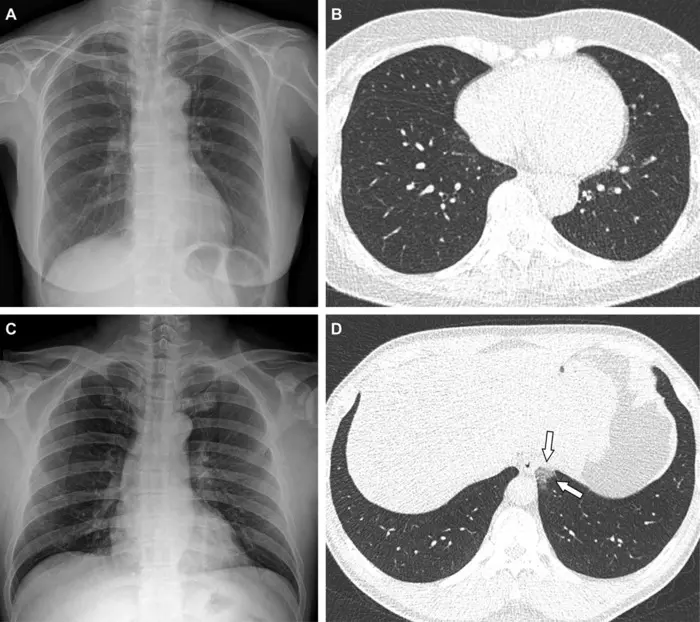
Representative cases showing pneumonia extents and patterns on chest X-ray (CXR) and CT images. (A and B) A 65-year-old female with breakthrough infection 2 months after a second dose of the Pfizer vaccine (fully vaccinated). The patient had a history of hypertension. (A) CXR obtained at admission showing no abnormal opacification in both lung zones. The CXR extent of pneumonia was scored as 0 (no evidence of pneumonia). (B) Axial chest CT image at the lower lobe level (obtained on the same day) showing negatively for pneumonia; CT extent of pneumonia was scored as 0 (no evidence of pneumonia). (C and D) A 48-year-old male with 1 month after a first dose of the AstraZeneca vaccine (partially vaccinated). The patient had no history of comorbidity. (C) CXR obtained at admission showing no abnormal opacification in both lung zones. The CXR extent of pneumonia was scored as 0 (no evidence of pneumonia). (D) Axial chest CT image obtained on the same day showing unilateral ground-glass opacity with a non-rounded morphology in the left lower lobe (arrows). CT extent of pneumonia was scored as 1 (1-25% involvement) and this case was classified as indeterminate appearance of COVID-19 according to the RSNA chest CT classification system.
CREDIT
Radiological Society of North America


A new study published in the journal of BMC Nephrology showed that an elevated computed tomography (CT)-derived score for aortic arch calcification (AoACS) was linked to higher rates of cardiovascular and overall mortality among maintenance hemodialysis patients, even after accounting for included variables.
The presence of aortic arch calcification (AAC) on chest CT scans can indicate widespread vascular problems and offer important predictive insights. By using CT scans to examine the extent and location of calcification, there is a potential to enhance the assessment of cardiovascular risk beyond traditional clinical measures. Nevertheless, the precise predictive value of CT-detected AAC in patients on hemodialysis is not yet fully understood.
This research explored how CT-detected AAC is linked to cardiovascular events and overall mortality, aiming to determine its effectiveness as a predictive tool through imaging in this high-risk group. This study assessed the predictive power of AAC detected through chest CT scans in foreseeing cardiovascular events and overall mortality in patients undergoing hemodialysis treatment.
A study was carried out retrospectively involving 205 individuals undergoing hemodialysis who had chest CT scans from January to December 2019. The patients were monitored until August 31, 2024, with an average follow-up period of 61 months. The extent of aortic arch calcification (AoAC) was measured using a density-weighted calcification score derived from the Agatston weighting method for non-gated, standard-thickness chest CT scans.
Increased AoACS was linked to a higher risk of death, leading to a significant decrease in cardiovascular and overall survival rates (p < 0.001). After conducting a multivariable analysis, it was found that log(AoACS + 1) was autonomously connected to cardiovascular mortality (HR 1.935, 95%CI 1.148–3.263, p = 0.013) and all-cause mortality (HR 1.641, 95%CI 1.156–2.329, p = 0.006). Additionally, diabetes and levels of serum albumin were identified as independent predictors of all-cause mortality.
Overall, elevated CT-derived AoACS showed a correlation with cardiovascular and overall mortality even after accounting for the covariates considered. The results from individuals undergoing maintenance hemodialysis indicate that AoACS could potentially serve as a tool to recognize patients at an increased risk. However, further research involving larger populations and external validation is necessary to confirm its added predictive capacity and clinical usefulness.
Source:
Gao, Y., Ding, K., Wu, Y., Xia, Q., & Xu, P. (2026). Chest CT-estimated aortic arch calcification and its prognostic value for cardiovascular and all-cause mortality in maintenance hemodialysis patients. BMC Nephrology. https://doi.org/10.1186/s12882-026-05445-4

