Medical fraternity raises concern over SC verdict allowing negligence claims against doctors' legal heirs
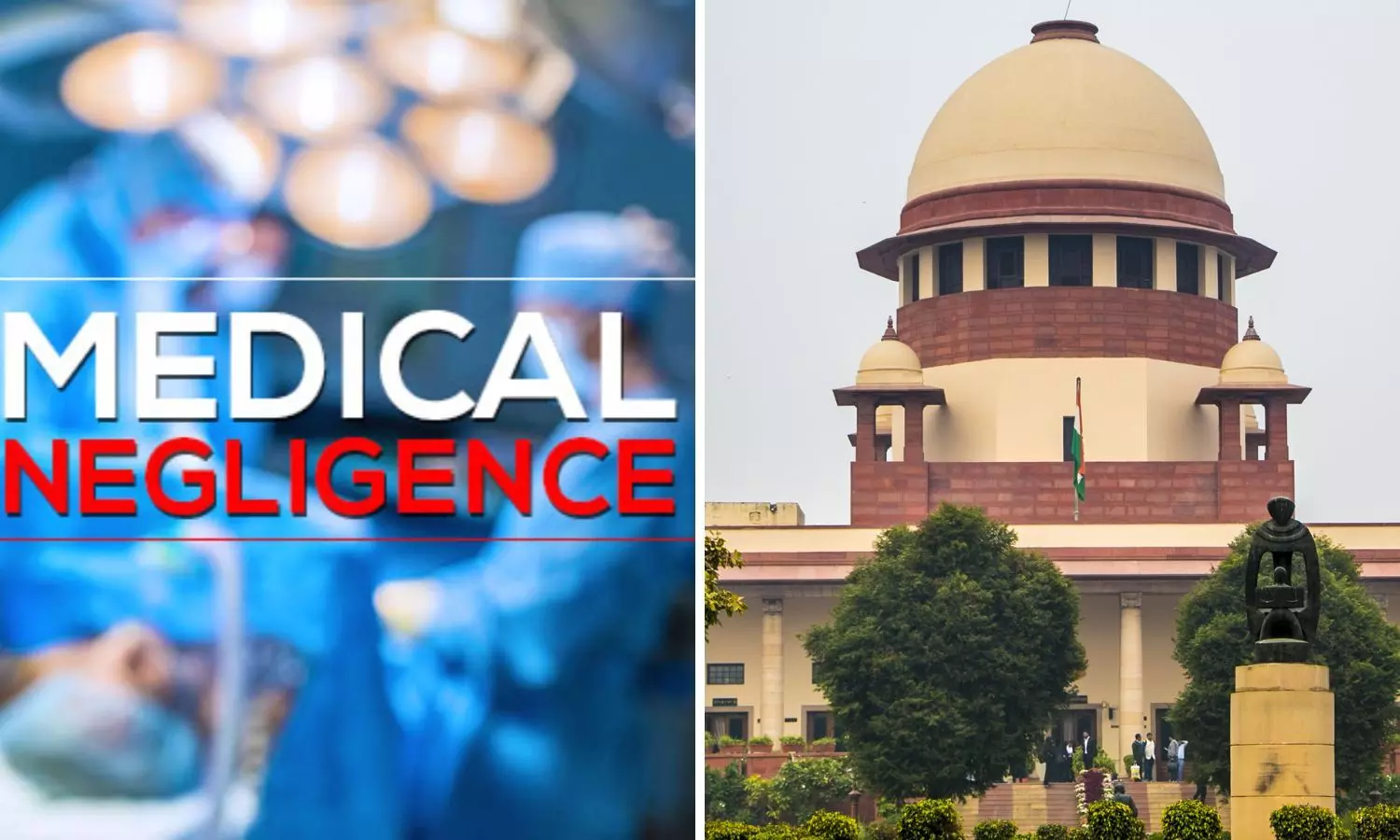


New Delhi: The Supreme Court's recent landmark judgment, which extended the claims liability in medical negligence cases to the legal heirs of doctors, has raised concerns among a section of the medical fraternity.
Doctors have highlighted the social and psychological impact of this ruling on the legal heirs of medical professionals, along with how this judgment may affect the field of medicine.
While some doctors have expressed the need for a more balanced approach, clearly limiting such liability strictly to the estate of the deceased, others have opined that a balanced legal framework is required to address both the genuine victims of medical negligence and sincere doctors.
Medical Dialogues had earlier reported that the Supreme Court held that under the law, the legal heir of a doctor, who is facing any medical negligence case, can be proceeded against after the doctor's death.
The Court clarified that the “right to sue” survives, allowing complainants to pursue legal remedies even after the concerned doctor's demise.
“...in view of the preceding discussion and the statutory framework provided in 1986 Act as well as 2019 Act, we conclude that upon the death of the alleged medically negligent doctor, his/her legal heirs can be impleaded and brought on record”, observed the apex court bench while approving the NCDRC's findings that "the legal heirs shall be liable to satisfy the decretal amount to the extent payable from the estate left behind, on conclusion of the proceedings."
The Apex Court bench of Justices JK Maheshwari and AS Chandurkar answered a question of law in a more than three-decade-old case, where a doctor, now deceased, had operated on the wife of the complainant (also now deceased) after which she lost her vision.
Supreme Court's Observations:
The bench said that, in the context of Rule 4 of Order XXII of CPC, one has to understand and see whether the right to sue against such an alleged medically negligent doctor survives or not upon his death.
It said the ‘right to sue’ means the right to seek relief through legal proceedings, and such proceedings, in a general sense, are instituted against the opposite party/defendant(s), who possess a corresponding right to defend, as opposed to the claimant’s right to prosecute.
“The right to defend is intrinsically linked to, and arises from, the right to prosecute, and vice versa. Therefore, for the continuation of proceedings, it is essential that both rights co-exist," observed the bench.
“Nonetheless, in view of the preceding discussion and the statutory framework provided in the 1986 Consumer Protection Act as well as the 2019 Consumer Protection Act, we conclude that upon the death of the alleged medically negligent doctor, his/her legal heirs can be impleaded and brought on record," it further noted.
“Consequently, the extent of liability will be determined based on the pleadings and evidence presented. The question is answered accordingly,” the Apex Court held.
However, the top court bench also observed the necessity to state that the question regarding what claim can be attributed to the accretion of the deceased defendant's estate needs to be carefully analyzed by NCDRC, as the Court only dealt with the question of law.
"Of course, exhaustive list of these items cannot be given, since it would depend upon pleadings and proof brought before the Court. It may be relevant to note that the Claimant has the duty to first establish the negligence of the deceased doctor and the claims on the estate recoverable as per Section 306 of the 1925 Act," it noted.
"We may add that the Impugned Order II confuses claims attributable to estate and holds that any adjudication on merits can be recoverable from the estate of the deceased doctor. Rather, the Court has to only look at claims which are maintainable as against the estate, rather than adjudicating personal claims which have elapsed with the death of the doctor," the bench further observed.
Reactions from Medical Fraternity:
Referring to the landmark judgment, the Chief Patron of FAIMA Doctors Association and a Health Activist, Dr Rohan Krishnan, told Medical Dialogues, "Personally, I feel that the Honourable Supreme Court was trying to balance two competing concerns- patient rights and continuity of remedy. If proceedings automatically abated on the doctor’s death, a long-pending negligence case could collapse entirely. In many cases, especially where proceedings continue for years, this could deny compensation to genuinely affected patients."
Explaining that the judgment does not create "hereditary negligence liability", but it creates "estate-linked survivability of compensation claims", Dr. Rohan said that the distinction is crucial.
"The Court appears to have consciously limited liability to the inherited estate. So the widow/children are not being punished personally for the doctor’s conduct. This is closer to civil succession liability than moral or criminal culpability," he said.
"Legally, the judgment is also interesting because it weakens the older rigid application of the maxim: actio personalis moritur cum persona (a personal action dies with the person). The Court seems to be moving toward a modern compensation-oriented approach under consumer law and succession principles. That said, I do think there are important concerns for the medical community, as the doctors may feel that litigation exposure has become virtually endless, which may increase defensive medicine further. Families of deceased doctors may face prolonged harassment even when ultimate liability is limited. There is also a psychological issue: heirs who had nothing to do with the treatment may still be dragged into proceedings for years," added Dr. Rohan, while discussing the possible consequences of this judgment.
He also opined that it needs to be discussed whether the judgment will increase the importance of professional indemnity insurance, structured asset planning, faster adjudication of medical negligence disputes, and statutory caps or clearer standards for negligence.
Dr. Krishnan called the judgment ethically understandable, legally defensible, but potentially anxiety-inducing for the medical fraternity unless procedural safeguards evolve alongside it.
"FAIMA stand is clear that any policy which is not neutral is usually misused and doctors suffer greatly as they read medicine not law or consumerism. FAIMA will challenge this in the Supreme Court," he added.
The National Vice President of FAIMA, Dr. Lakshya Kumar Jha, expressed his concerns regarding the effects of the judgment, both in principle and in its practical implications for the medical profession.
He agreed that the law has traditionally allowed civil claims to survive against the estate of a deceased person, ensuring that aggrieved parties are not left remediless. However, according to Dr. Jha, applying this principle in the context of medical negligence demands far greater caution.
"Medicine is not a mechanical profession; it is inherently uncertain, dependent on clinical judgement, and often exercised in high-pressure, resource-constrained environments. To extend liability beyond the lifetime of a doctor risks oversimplifying this complexity," he said.
"One of the most troubling aspects of this approach is that it effectively places the burden of defending a professional decision on individuals who neither possess the clinical knowledge nor were involved in the treatment. Legal heirs are in no position to meaningfully contest allegations of negligence, especially in cases that hinge on nuanced medical judgment, evolving standards of care, or documentation that may itself be subject to interpretation. This creates an asymmetry that is fundamentally unfair," he added.
Dr. Jha opined that such an interpretation may have a chilling effect on the medical community. According to him, doctors already practice under the constant shadow of litigation and, at times, criminal prosecution.
"The possibility that their families could be drawn into prolonged legal battles even after their demise adds another layer of psychological and professional stress. It risks fostering a more defensive style of medicine, where decision-making is guided less by patient interest and more by legal self-preservation," he said.
Speaking about the moral dimension of the judgment, he explained that liability in alleged negligence cases is not merely financial, but it carries reputational implications and questions of professional accountability. "Extending this to heirs, who had no role in the alleged act, blurs the line between accountability and undue burden," he said.
"A more balanced approach would be to clearly limit such liability strictly to the estate of the deceased, with robust safeguards. These could include higher thresholds for establishing negligence in the absence of the doctor’s testimony, mandatory reliance on independent expert medical boards, and time-bound adjudication to prevent prolonged harassment of families. The intent of protecting patient rights is legitimate and must be upheld. However, this must not come at the cost of fairness to medical professionals and their families. The legal framework must recognize that while justice for patients is essential, so too is justice for those who dedicate their lives to saving others. In its current form, this extension risks unsettling that balance and may ultimately do more harm than good to both the medical profession and the healthcare system at large," Dr. Jha added.
Further, Dr. Meet Ghonia, the National General Secretary of the Federation of Resident Doctors Association (FORDA), said, "The recent extension of medical negligence liability to the legal heirs of deceased doctors raises important ethical and legal concerns. While patient rights and accountability are essential, medicine is a profession where outcomes are not always fully controllable despite best efforts and evidence based care."
"Extending liability beyond the lifetime of a doctor may create fear, defensive medical practice, and additional psychological stress on families who were never directly involved in patient care. At the same time, transparency, proper documentation, informed consent, and institutional responsibility become even more important in modern medical practice. The need of the hour is a balanced legal framework that protects genuine victims of negligence without discouraging sincere doctors working in high risk specialties and resource limited settings," he added.
Telangana-based Healthcare Reforms Doctors Association (HRDA) has also expressed its concern regarding the Apex Court's ruling. According to the association, the wider implications of this judgment on the medical profession, particularly on the families of doctors, require urgent national discussion and legislative reconsideration.
"Medical practice is a highly specialized and individual professional responsibility involving complex clinical decision-making under stressful and emergency conditions. HRDA Telangana feels that extending litigation against family members who were never involved in patient care may create severe emotional, financial, and psychological distress to the dependents of deceased doctors," the association mentioned in a release.
"The association is deeply concerned that this development may further aggravate the already prevailing atmosphere of fear and insecurity among healthcare professionals. Doctors across the country are increasingly facing violence, criminal prosecution, prolonged litigations, social media harassment, and professional burnout. Such judgments, though delivered within the framework of law, may unintentionally contribute to defensive medical practice and discourage young doctors from entering high-risk specialties and underserved rural healthcare sectors," it further added.
HRDA expressed that medical negligence cannot be viewed purely on the same footing as ordinary commercial disputes, as clinical outcomes are influenced by multiple factors, including disease severity, patient condition, emergency circumstances, infrastructure limitations, and inherent medical risks.
"Retrospective continuation of proceedings after the demise of a doctor raises important ethical and practical concerns regarding fair defense and natural justice," it said.
Accordingly, HRDA has urged the Union Health Ministry, National Medical Commission (NMC), and all stakeholders to carefully examine the long-term implications of this judgment on healthcare delivery systems in India.
"There is an urgent need for a balanced legal framework that safeguards patient rights while also protecting medical professionals and their families from disproportionate hardship," HRDA added, further appealing to all national and state medical organizations to collectively deliberate on this issue and pursue constructive legal and policy remedies through democratic and constitutional means.