Cardio-Selective Beta-blockers in COPD: Five Key Points Clinicians Need to Know from Latest 2026 Published Review



Chronic obstructive pulmonary disease (COPD) commonly coexists with cardiovascular diseases, including hypertension, coronary artery disease, heart failure, and cardiac arrhythmias. Despite well-established cardiovascular indications, beta-blockers may be underutilized in patients with COPD because of concerns regarding bronchoconstriction, deterioration in pulmonary function, and potential worsening of respiratory symptoms.
A 2026 review published in Current Medical Research and Opinion examined the available clinical evidence on cardio-selective beta-blockers in patients with COPD. The review concluded that cardio-selective beta-blockers can generally be used safely in patients with COPD when there is an established cardiovascular indication, while also highlighting clinically relevant differences among individual beta-blockers that may influence treatment selection.
Importantly, the evidence discussed in the review suggests that the degree of β1-adrenoceptor selectivity may influence beta-blocker choice, particularly when pulmonary tolerability is a concern.
Here are five key points for clinicians from this latest published paper.
1. COPD alone should not preclude indicated beta-blocker therapy
A key concern with β-blockers in COPD is pulmonary β2-adrenoceptor blockade, which may impair bronchodilation. However, COPD alone should not lead to withholding β-blockers when a clear cardiovascular indication exists.
Although a single dose of a cardio-selective β-blocker may cause a modest reduction in FEV1, continued therapy has generally not been associated with deterioration in baseline FEV1, increased respiratory symptoms, or greater β2-agonist use.
Thus, cardio-selective β-blockers can be considered in patients with COPD and concomitant CAD, heart failure or arrhythmias, with careful attention to agent selection, β1-selectivity and dose.
2. Bisoprolol has substantially greater β1-selectivity than metoprolol
Cardio-selective β-blockers are not pharmacologically homogeneous. The 2026 review highlights substantial differences in β1:β2-adrenoceptor selectivity, with experimental data demonstrating approximately 13.5-fold selectivity for bisoprolol versus 2.3-fold for metoprolol. Importantly, β1-selectivity is relative and dose-dependent, and may diminish as β-blocker exposure increases.
This distinction is particularly relevant in patients with COPD, where unintended pulmonary β2-adrenoceptor blockade may promote bronchoconstriction and attenuate β2-agonist–mediated bronchodilation. The greater β1-selectivity of bisoprolol therefore provides a pharmacological basis for preferential cardiac β1 blockade with potentially less interference with pulmonary β2-adrenoceptor function.
Clinically, this may be important in patients with heart failure, coronary artery disease, or arrhythmias who require sustained or higher-dose β-blockade. In such patients, greater β1-selectivity may contribute to improved respiratory tolerability and facilitate continuation of guideline-directed cardiovascular therapy.
3. In heart failure with COPD, pulmonary-function findings favour bisoprolol
In patients with chronic heart failure and concomitant COPD, selection of an appropriate β-blocker is clinically important to preserve the established cardiovascular benefits of β-blockade while minimizing potential adverse effects on pulmonary function.
In a randomized, open-label, triple-crossover study of 51 patients with chronic heart failure, including 35 with coexisting COPD, treatment with carvedilol, metoprolol succinate and bisoprolol produced measurable differences in airway function. Among patients with COPD, FEV1 was highest with bisoprolol (2.00 L), intermediate with metoprolol (1.94 L) and lowest with carvedilol (1.85 L; p<0.001). Compared with carvedilol, FEV1 was approximately 150 mL higher with bisoprolol in patients with HF and COPD. No significant difference in FEV1 was observed between bisoprolol and metoprolol.
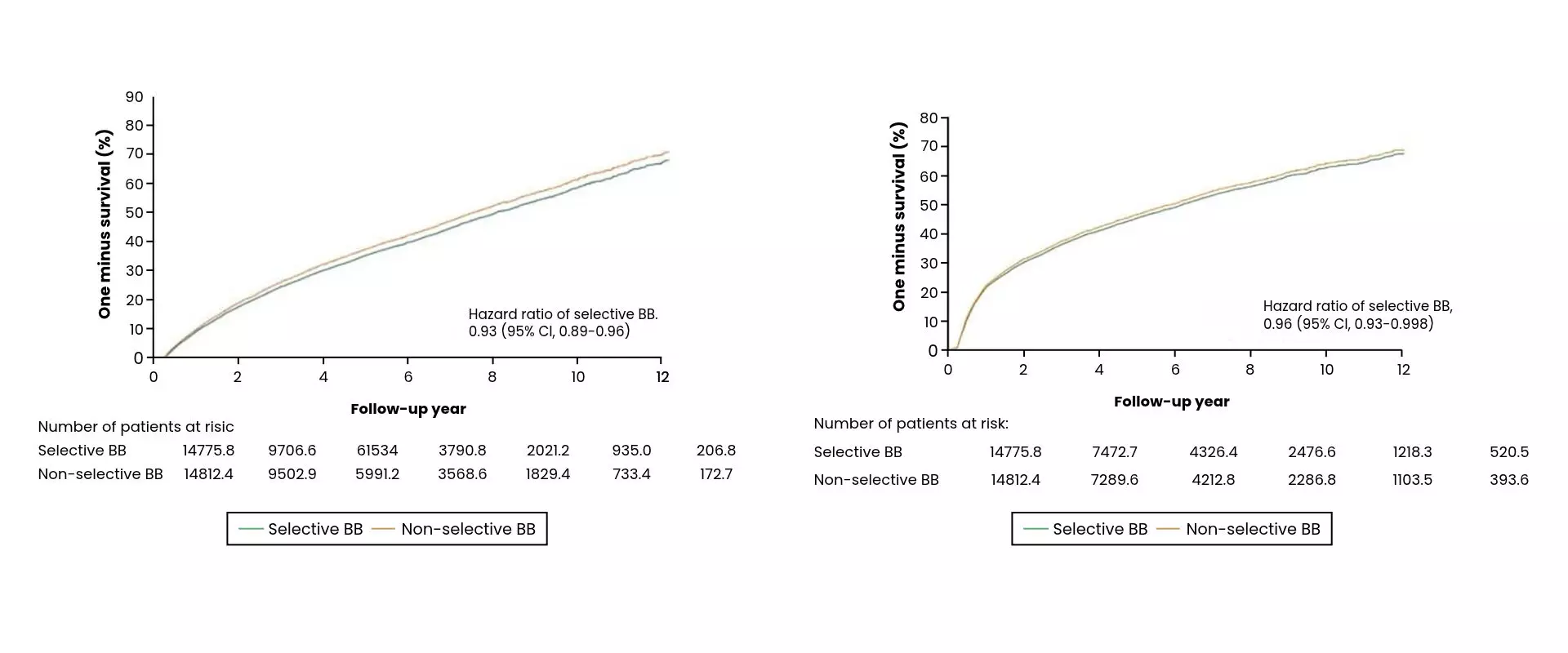
Interestingly, in earlier published evidence not included in this current review, a nationwide population-based observational study by Su et al. involving 11,558 patients with coexisting HF and COPD found that bisoprolol use was associated with a dose-dependent reduction in mortality risk (adjusted HR 0.76 at low doses and 0.40 at high doses) compared with non-use. In contrast, carvedilol and metoprolol did not demonstrate statistically significant survival benefits, providing additional observational evidence supporting the consideration of bisoprolol in patients with concomitant HF and COPD (2).
These findings demonstrate that β-blocker choice can influence pulmonary function in patients with HF and COPD, with the greatest reduction in FEV1 observed with the non-selective β-blocker carvedilol. Together with its high β1-selectivity, the available evidence provides a clinical rationale for preferentially considering bisoprolol or another β1-selective β-blocker when β-blockade is indicated in patients with HFrEF and concomitant COPD, particularly when preservation of airway function is an important therapeutic consideration.
4. Bisoprolol has reassuring randomised safety evidence at studied doses
The review also examines recent randomised evidence evaluating bisoprolol in patients with COPD.
In the PACE trial, patients with COPD received bisoprolol, titrated to doses of up to 5 mg/day, or placebo. The study did not identify significant differences between groups in outcomes including all-cause mortality, cardiorespiratory hospitalisation, major adverse cardiac events, moderate or severe COPD exacerbations, FEV1, COPD symptoms, quality of life or adverse events. Similarly, the BICS study did not demonstrate a significant increase in COPD-related hospitalisations or exacerbations with bisoprolol compared with placebo.
Bisoprolol has demonstrated reassuring pulmonary safety in patients with COPD at the doses evaluated in clinical trials, particularly at doses up to 5 mg/day in the PACE and BICS studies. Accordingly, careful dose selection and appropriate clinical monitoring remain relevant when bisoprolol is prescribed to patients with COPD and concomitant cardiovascular disease.
5. Beta-blockers should not be initiated solely to prevent COPD exacerbations
Pulmonary safety does not imply that beta-blockers should be used to treat COPD itself. Randomised trials of metoprolol and bisoprolol have not shown a significant benefit in preventing COPD exacerbations in patients without an established cardiovascular indication. In BLOCK COPD, metoprolol did not reduce overall exacerbation risk and increased exacerbations requiring hospitalisation, while bisoprolol similarly failed to significantly reduce exacerbation rates. Therefore, beta-blocker use in COPD should remain guided by an established cardiovascular indication rather than COPD exacerbation prevention.
Final Takeaway
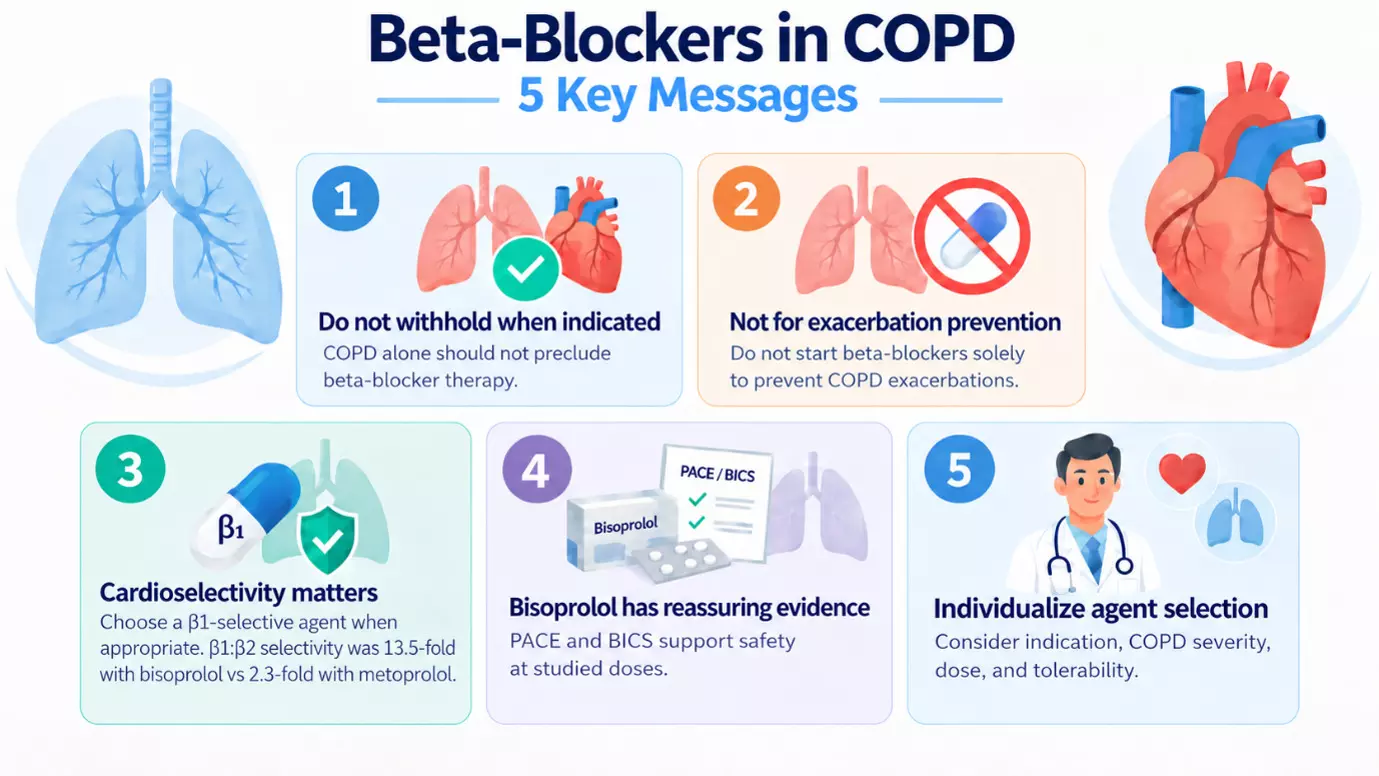
- COPD alone should not deter beta-blocker use when there is a clear cardiovascular indication; appropriately selected cardio-selective agents can be used safely in most patients.
- Agent selection matters; greater β1-selectivity may help minimise pulmonary effects, making cardio-selective options particularly relevant when respiratory tolerability is a concern.
- Bisoprolol demonstrates substantially greater β1-adrenoceptor selectivity than metoprolol. Comparative evidence in chronic heart failure patients with COPD showed higher FEV1 with bisoprolol than with metoprolol. Randomised safety data with bisoprolol is reassuring in COPD patients.

Beta-blocker selection in COPD patients with cardiovascular disease and the role of highly β1-selective bisoprolol
Speaking to Medical Dialogues, Dr. Somashekhara G., MBBS,MD,DM (Cardiology), Sr. Consultant & Interventional Cardiologist, Anuradha Heart Care Centre, Bellary, said "COPD must never prevent life-saving cardiovascular therapy, but non-selective options risk bronchospasm. Beta selectivity and lung tolerability drive my choice. Bisoprolol is my cornerstone betablocker in this cohort, its higher beta1-selectivity protects pulmonary function, yielding superior FEV1 compared to alternatives. Supported by evidence showing dose-dependent mortality benefits in heart failure with COPD, bisoprolol uniquely balances airway preservation with robust cardiovascular survival outcomes."

Real-world comparison of bisoprolol and other beta-blockers in COPD patients regarding tolerability, dosing, and treatment persistence.
Speaking to Medical Dialogues, Dr. Rahul Sawant, Consultant Interventional Cardiologist & Director- Hridyamitra Cardia Clinic, Pune, Maharashtra, said "I have regularly used Bisoprolol in all my heart failure and hypertensive patients over last 22 years.Using Bisoprolol in mild to moderate COPD and asthma patients have using regular patients and not been any respiratory symptoms in these patients. I continue to use bisoprolol without any hesitation in the group of theses patients."

Clinical scenarios and factors guiding beta-blocker dose adjustment, switching, or discontinuation in COPD patients
Speaking to Medical Dialogues, Dr. Vijay Pathak, Senior Interventional Cardiologist & HOD of Rajasthan Hospital, Jaipur, said, "In patients with COPD and cardiovascular disease, beta-blocker doses may be up-titrated when cardiovascular control is inadequate and the patient tolerates treatment. Down-titration may be considered if symptomatic bradycardia, hypotension, excessive fatigue, or worsening respiratory symptoms occur. Switching to a more β1-selective agent, such as bisoprolol, may be considered when pulmonary tolerability is a concern. Discontinuation or temporary withholding may be necessary in serious adverse events or significant clinical instability. Decisions should consider cardiovascular indications, heart rate, blood pressure, respiratory symptoms, lung function, β1-selectivity, and concomitant medications. COPD alone should not prompt discontinuation of an indicated cardio-selective beta-blocker."

Challenges of beta-blocker use with COPD therapies and their impact on treatment selection
Speaking to Medical Dialogues, Dr. S. Raghothaman, MD., DNB.,DM., Senior Assistant Professor of Cardiology, Chengalpattu Medical College Hospital, Chengalpattu, said, "The review highlights that COPD alone should not prevent beta-blocker therapy when cardiovascular indications exist. Bisoprolol demonstrates greater β1-selectivity than metoprolol (13.5-fold vs. 2.3-fold), which may help minimize pulmonary effects. In patients with heart failure and COPD, appropriate beta-blocker selection is important to maintain cardiovascular benefits while minimizing potential effects on lung function."
- 1. Therapeutic use of cardioselective beta-blockers for patients with chronic obstructive pulmonary disease: a review of current clinical evidence.Current Medical Research and Opinion
- 2. Carvedilol, Bisoprolol, and Metoprolol Use in Patients With Coexistent Heart Failure and Chronic Obstructive Pulmonary Disease.Medicine (Baltimore)