Primary Aldosteronism Linked to Higher Risk of Urinary Stones, suggests study
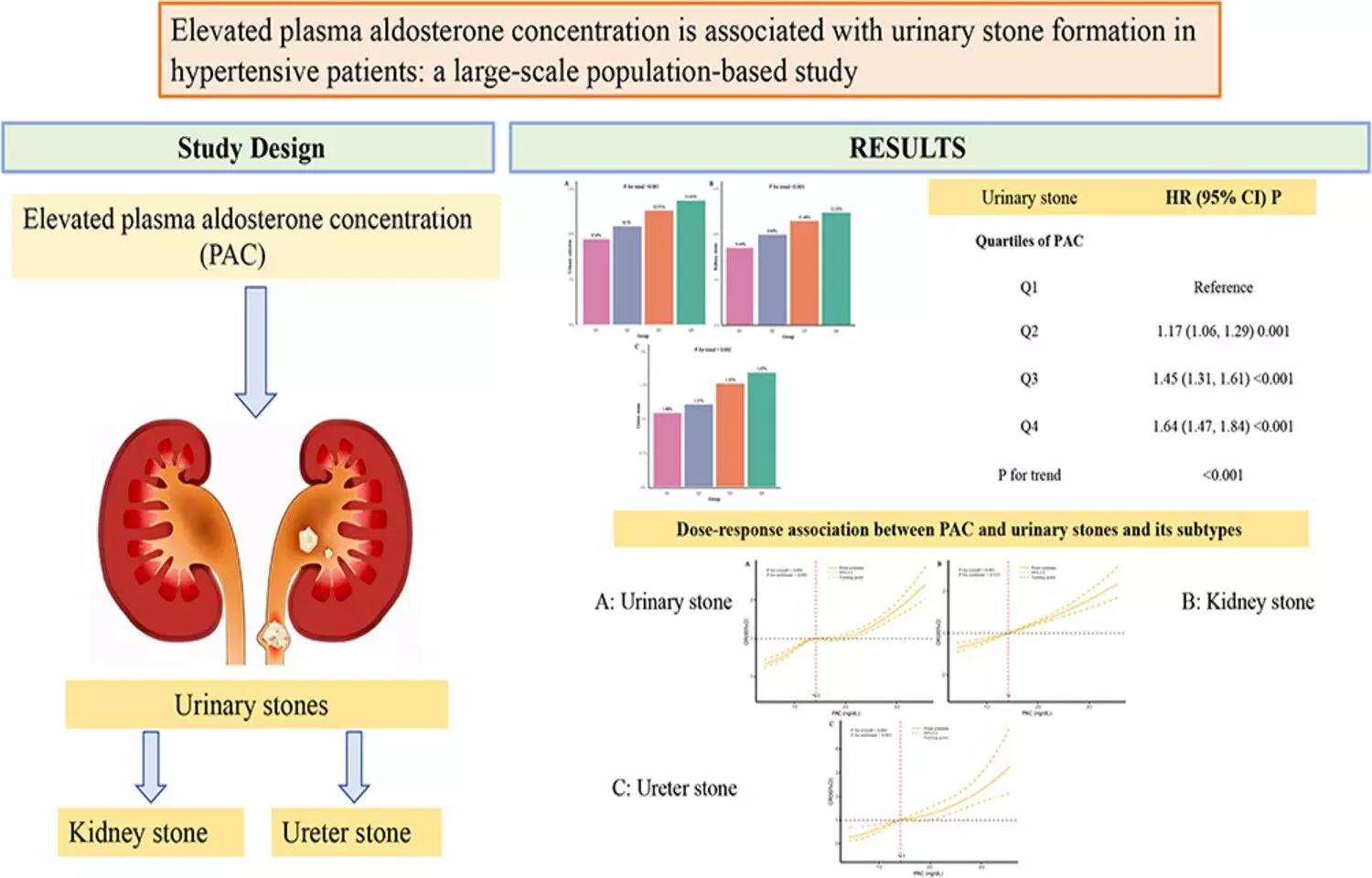


A significant association was found between primary aldosteronism (PA) and an increased risk of urolithiasis, independent of sex. The findings emphasize the importance of urinary stone screening in patients with PA, especially those with hypertension or unexplained metabolic abnormalities. Further prospective studies are needed to clarify underlying mechanisms and assess whether targeted PA treatment can reduce stone risk.
Primary aldosteronism (PA) is the most common cause of secondary hypertension and is associated with various metabolic disturbances, including calcium metabolism disorders and acid-base imbalances. Emerging evidence suggests a potential link between PA and urolithiasis; however, previous studies have been limited by small sample sizes and inconsistent findings. This study aims to investigate the association between PA and urinary stone formation using a large-scale real-world dataset.
They conducted a retrospective cohort study using the TriNetX database, which includes de-identified electronic health records from over 250 million individuals. Patients diagnosed with PA were identified based on ICD-10-CM and ICD-9-CM codes, and a propensity score-matched (PSM) cohort of PA and non-PA patients with hypertension was created. The primary outcome was the incidence of urolithiasis (kidney and urinary tract stones), identified using ICD-10-CM codes (N20-N23). Cox proportional hazards models were used to estimate hazard ratios (HRs) with 95% confidence intervals (CIs). Subgroup analyses were conducted based on sex, metabolic disorders, and renal function (eGFR ≥ 60 vs. <60 mL/min/1.73 m²).
A total of 10,578 PA patients and 7,897,605 non-PA patients were identified, with 10,577 matched pairs included in the final analysis after 1:1 propensity score matching. PA was associated with a significantly higher risk of urolithiasis compared to non-PA patients at 1-year (HR: 1.524, 95% CI: 1.238–1.877), 3-year (HR: 1.312, 95% CI: 1.120–1.537), 5-year (HR: 1.303, 95% CI: 1.130–1.502), and 7-year (HR: 1.269, 95% CI: 1.107–1.456) follow-ups. Subgroup analyses revealed that the increased risk of urolithiasis persisted across both sexes and was more pronounced in patients without metabolic disorders (HR: 1.826, 95% CI: 1.452–2.295).
The findings demonstrate a significant association between PA and increased urolithiasis risk, independent of sex. These results highlight the clinical importance of urinary stone screening in patients with PA, particularly those with hypertension or unexplained metabolic abnormalities. Further prospective studies are needed to elucidate the underlying mechanisms and evaluate whether targeted PA treatment could mitigate stone risk in this population.
Reference:
Lee, HY., Wang, SI., Juan, YS. et al. Increased risk of urolithiasis in patients with primary aldosteronism: a large-scale retrospective cohort study. J Endocrinol Invest (2026). https://doi.org/10.1007/s40618-026-02917-0
Keywords:
Primary, Aldosteronism, Linked, Higher Risk, Urinary Stones, Journal of Endocrinological Investigation, Primary aldosteronism, Urolithiasis, Stone formation, Hypertension, TriNetX